Looking for free ASO tools is a reasonable move right now — whether due to tight budgets, early-stage mobile projects, or just wanting to check what users are actually searching for before committing to something bigger.
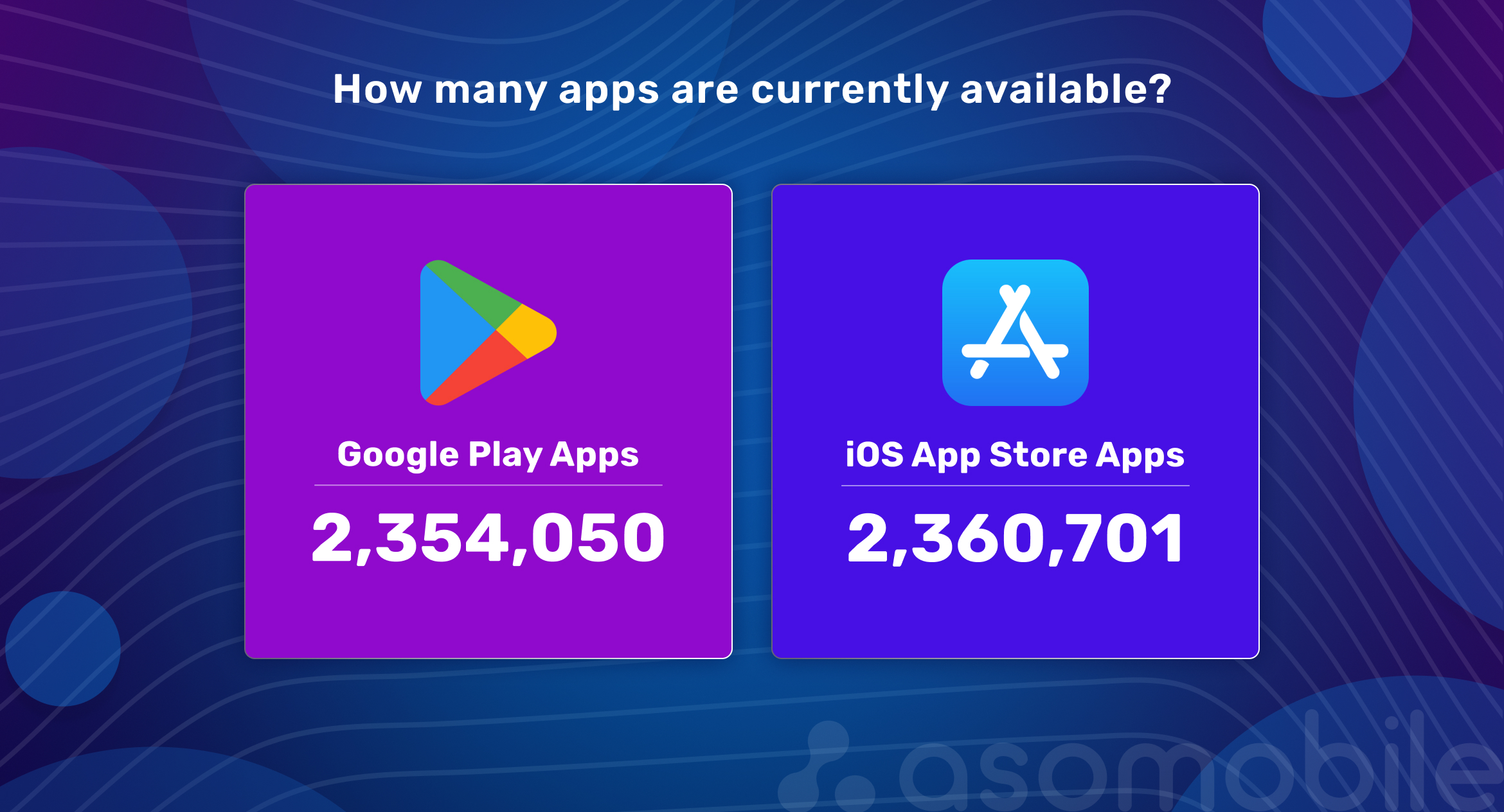
In 2026, you can build a mobile app in two days. AI tools and vibe coding removed the technical barrier, and the market felt it immediately: thousands of new products hit the App Store and Google Play every day. The problem isn't building the app — it's getting it found.
That's exactly what ASO does: it connects the search query, the user's intent, and what your product actually does, so the store shows your app to the right person at the right moment. The product page is where that match happens. ASOMobile's free tools cover the full optimization cycle — from building your semantic core to a final metadata check before you publish.
Why free ASO tools still matter in 2026
Free tools handle three specific scenarios well. Before launch — validate demand in a niche, identify keywords worth targeting, and see what competitors are doing with their metadata. All of this before paying for full access.
If the app is already live but organic traffic is flat, free tools help spot the obvious gaps: keywords missing from the right fields, overloaded or empty locales, duplicate keywords in the keywords field.
The third scenario is day-to-day spot checks: competition for a specific query, keywords pulled from a competitor's description, building the App Store keywords field.
What free tools don't do: track rankings at scale over time, provide deep competitive intelligence, or show download and revenue estimates. For ongoing growth, you need a full platform.
Free tools for keyword research
Keywords are the foundation of text-based ASO. Your semantic core determines which queries the store indexes for your app. Here are the tools that help you build it from scratch.
Keyword Suggest
App Store and Google Play autocomplete suggestions are one of the most reliable keyword sources out there. A user starts typing, the store shows the most popular completions — that's real demand, not estimated.
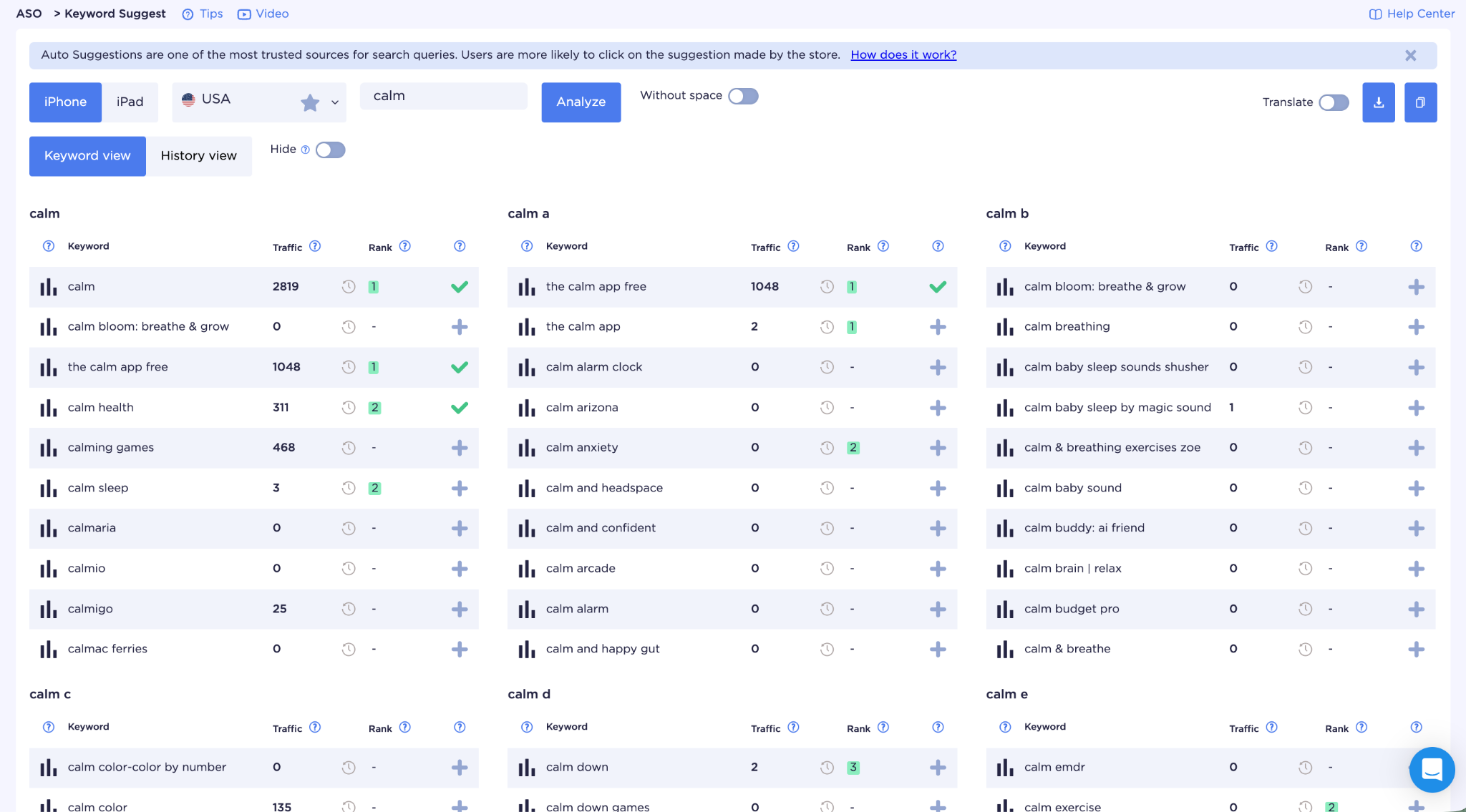
Keyword Suggest pulls these suggestions automatically: pick a country, enter a query, get a list with traffic data and your app's current position. It's especially useful for finding long-tail keywords — three- and four-word queries where competition is lower, and user intent is more specific.
Enable Without space mode, and the tool searches using the first letters of a query without spaces between words, surfacing terms users type from memory.
Trending Searches and Top Keywords
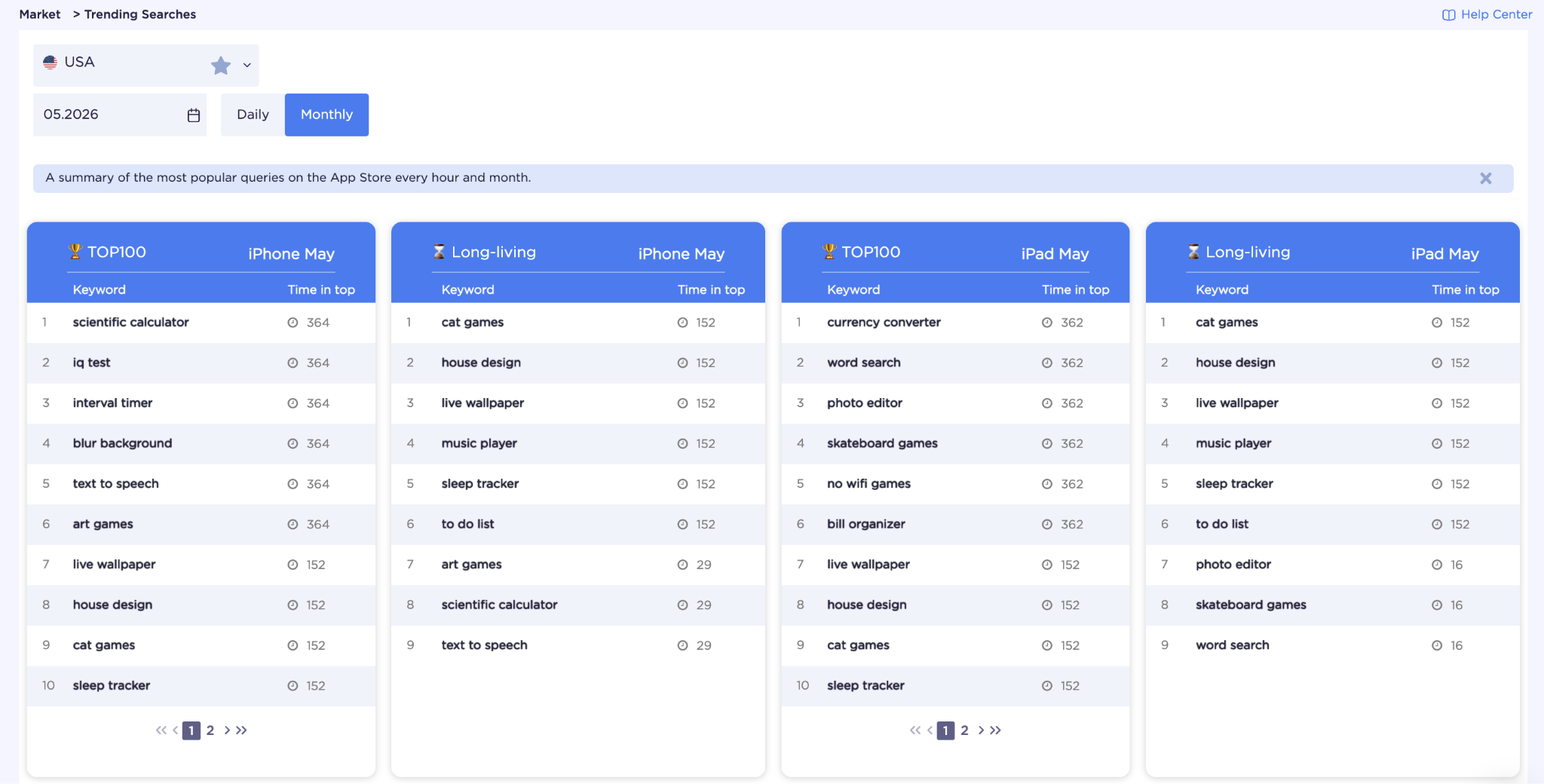
Trending Searches shows queries gaining momentum right now. Two use cases: finding ideas you haven't considered yet, and catching seasonal spikes. Summer brings travel and outdoor queries, November–December brings shopping and holidays, January brings fitness and wellness.
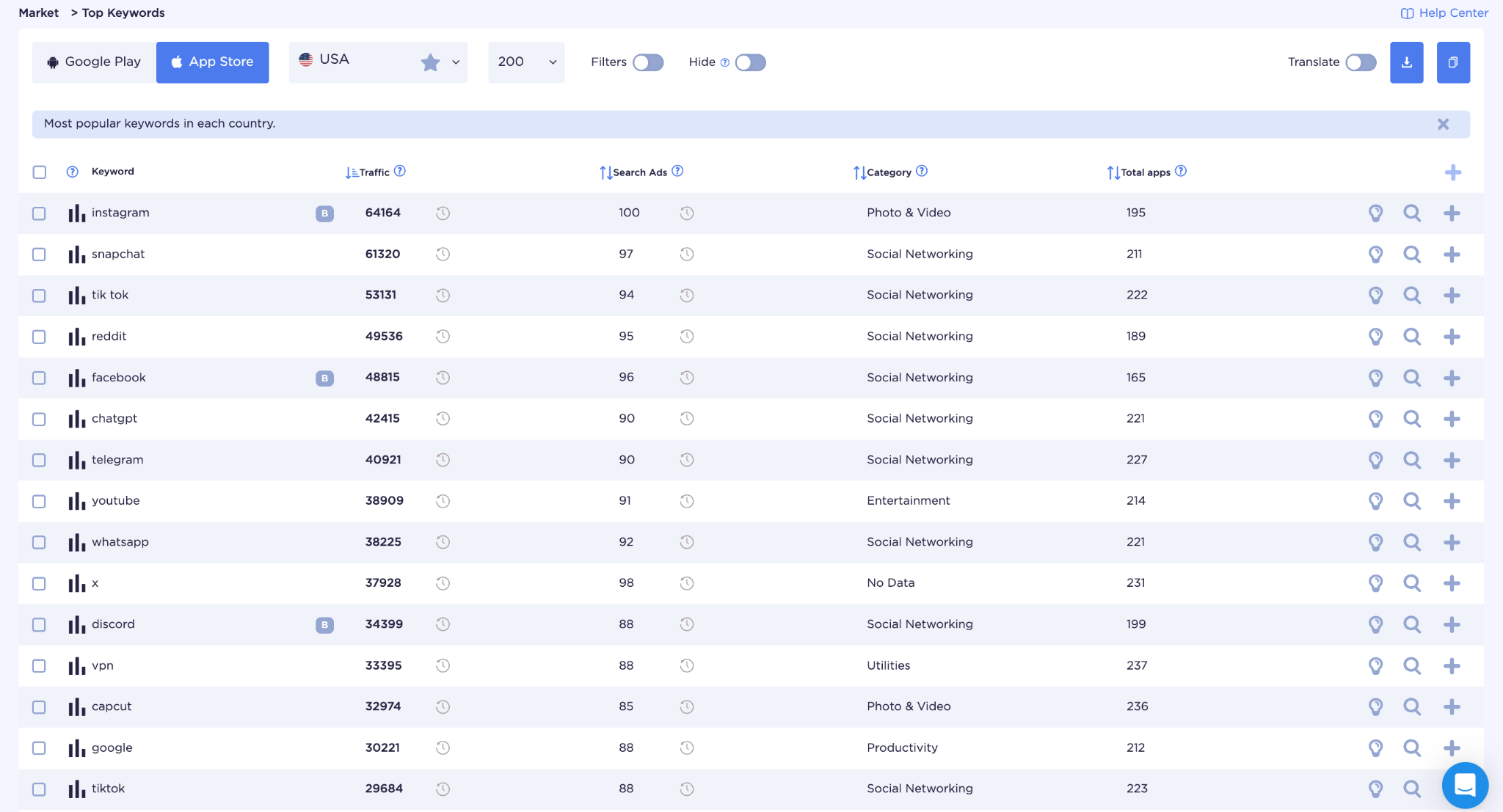
Top Keywords gives the broader picture: the top 200 queries by category and country across all time. Useful at the niche selection stage — even without a specific app, you can understand what users in a given store and region are actually looking for.
Keyword Check
Finding a keyword with traffic is half the job. The other half is figuring out whether you can actually rank for it. That's why every query we plan to use in metadata is worth a close look.
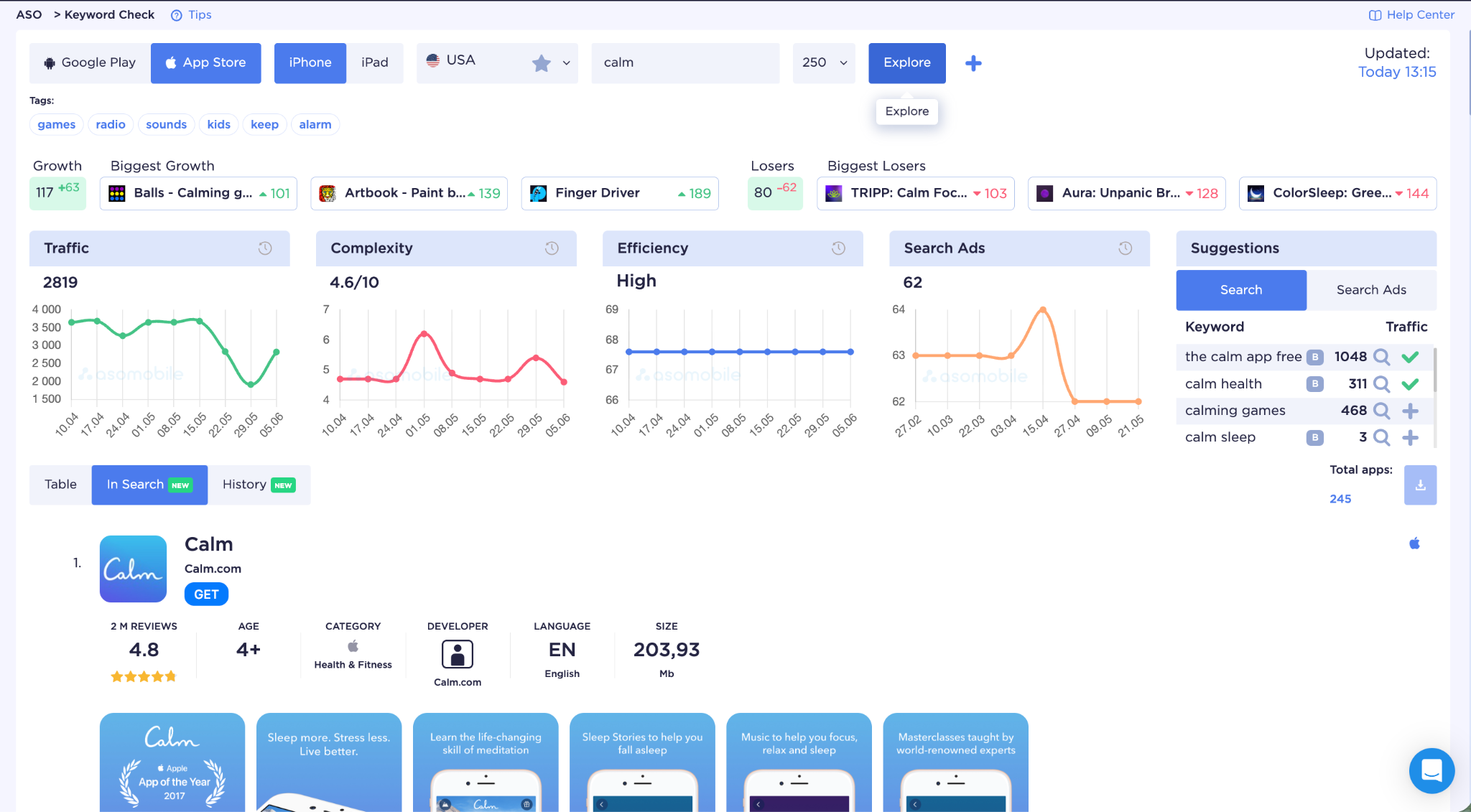
Keyword Check shows traffic, competition level (CI), efficiency (KEI), and the current top-ranking apps for each query. That last part drives the decision: if the top slots are held by apps with hundreds of thousands of ratings and years of ranking history, targeting that query as a primary keyword doesn't make sense. Better to find something less competitive where ranking alongside them is realistic.
The tool also shows the query's ranking history — useful for spotting whether traffic is stable or volatile.
Text Analyzer
Text Analyzer works differently from the other keyword tools. Instead of looking up keywords one by one, you paste in a block of text and get back every search query with traffic that appears in it.
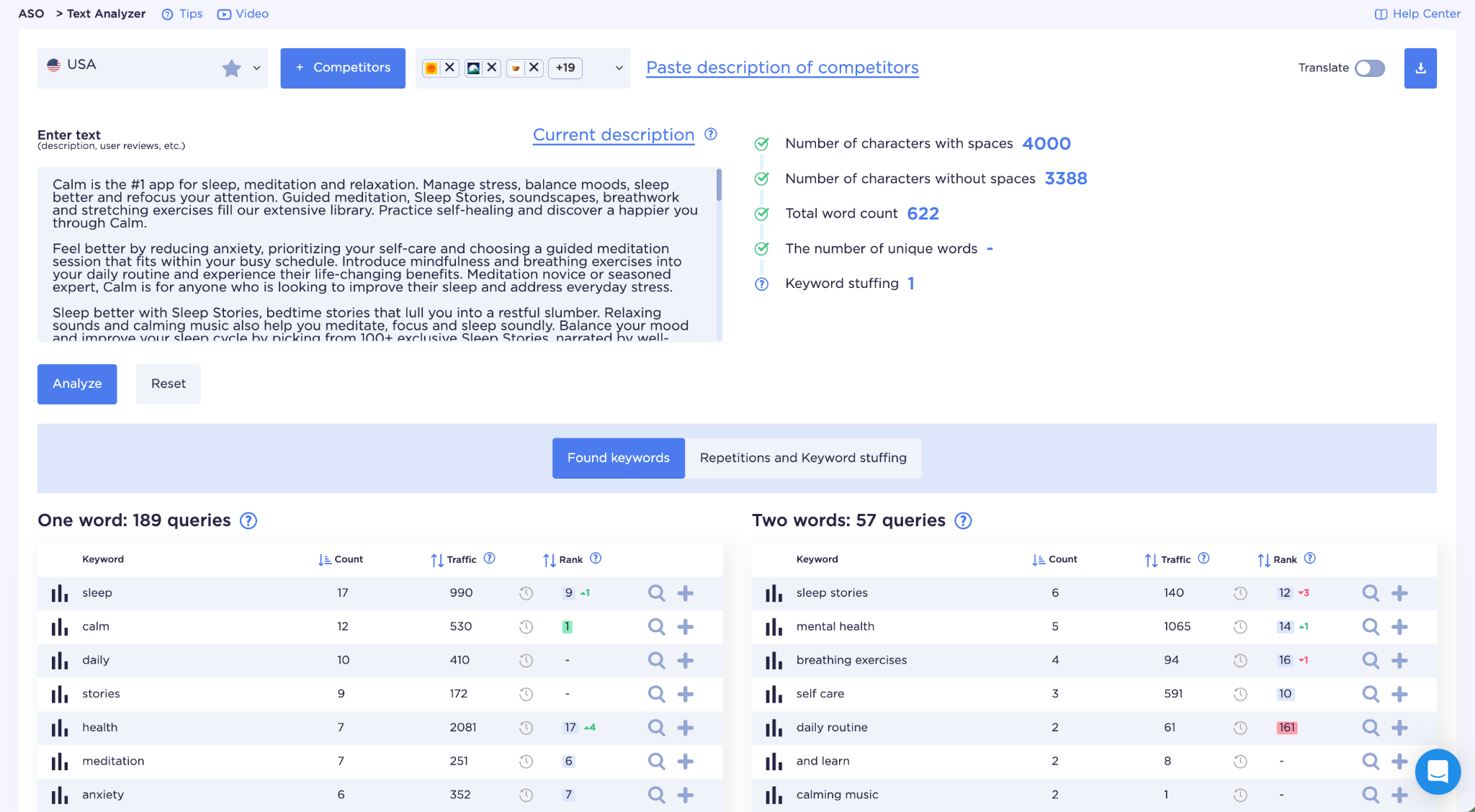
Two main use cases. Competitor research: take a top app's description from your niche, run it through Text Analyzer, and see exactly which queries it's indexed for — faster and more accurate than guessing from metadata alone. Second: auditing your own description before publishing. The tool shows keyword density, flags over-optimization, and highlights gaps where you could add high-traffic queries without hurting readability.
One thing worth knowing: Text Analyzer is particularly valuable for Google Play because the full description is indexed there. In the App Store, the description field isn't indexed — that's the job of the title, subtitle, and keywords field.
Free tools for metadata
Once the semantic core is ready, the work shifts to placing keywords in the right fields. In the App Store, title, subtitle, and the keywords field carry the most indexing weight. In Google Play, the full description is indexed. Two free tools help at the preparation and review stage.
Keyword Builder
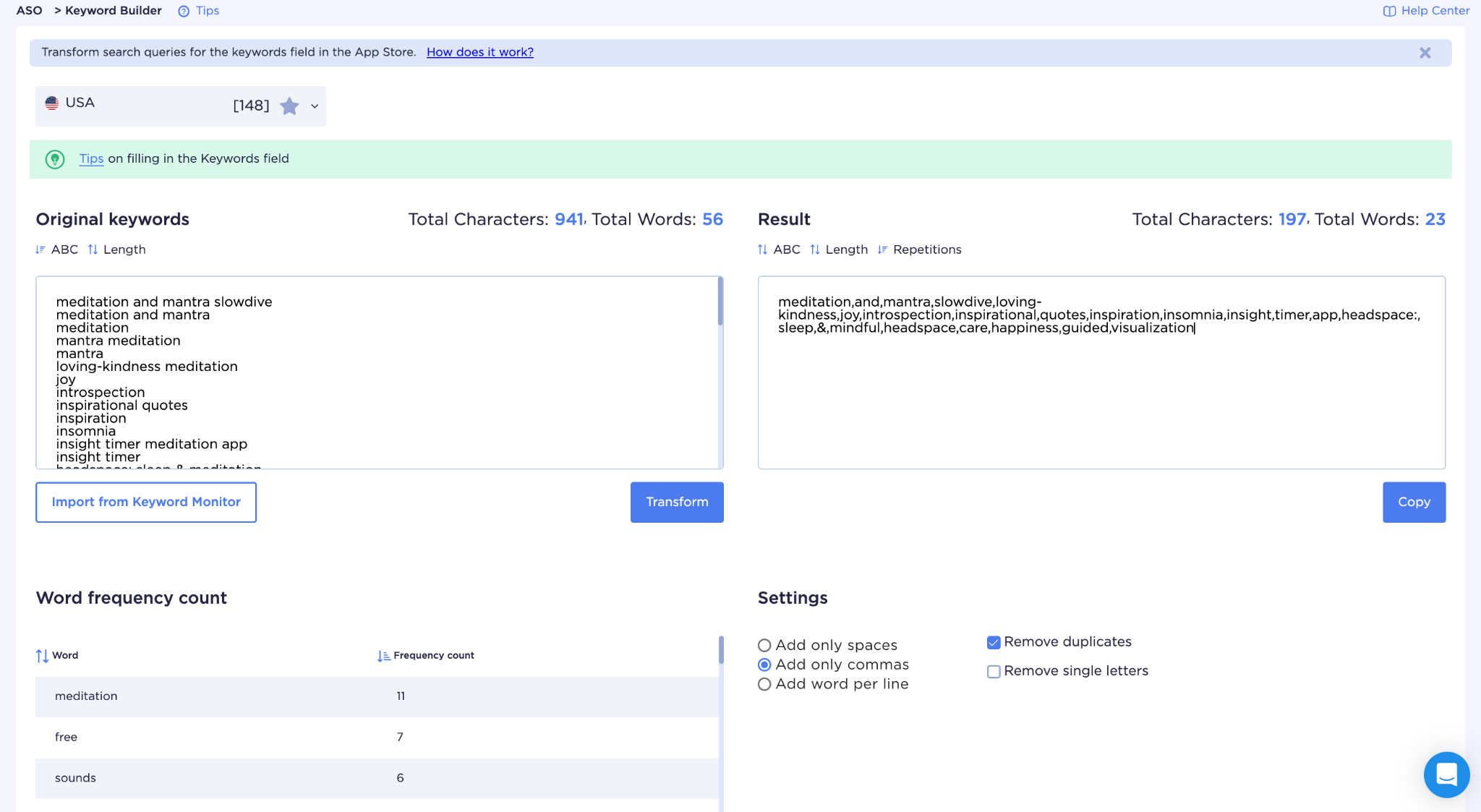
The App Store keywords field has strict rules: unique words, comma-separated, no spaces, 100 characters maximum. Building it manually from a large keyword list is slow and error-prone.
Keyword Builder handles formatting automatically: it removes duplicates, counts characters, and outputs the string in the correct format. Words already used in the title and subtitle should be removed manually — duplicating them in the keywords field wastes space. It saves time on the mechanical work and reduces the technical errors that quietly hurt visibility.
App Store Localizations
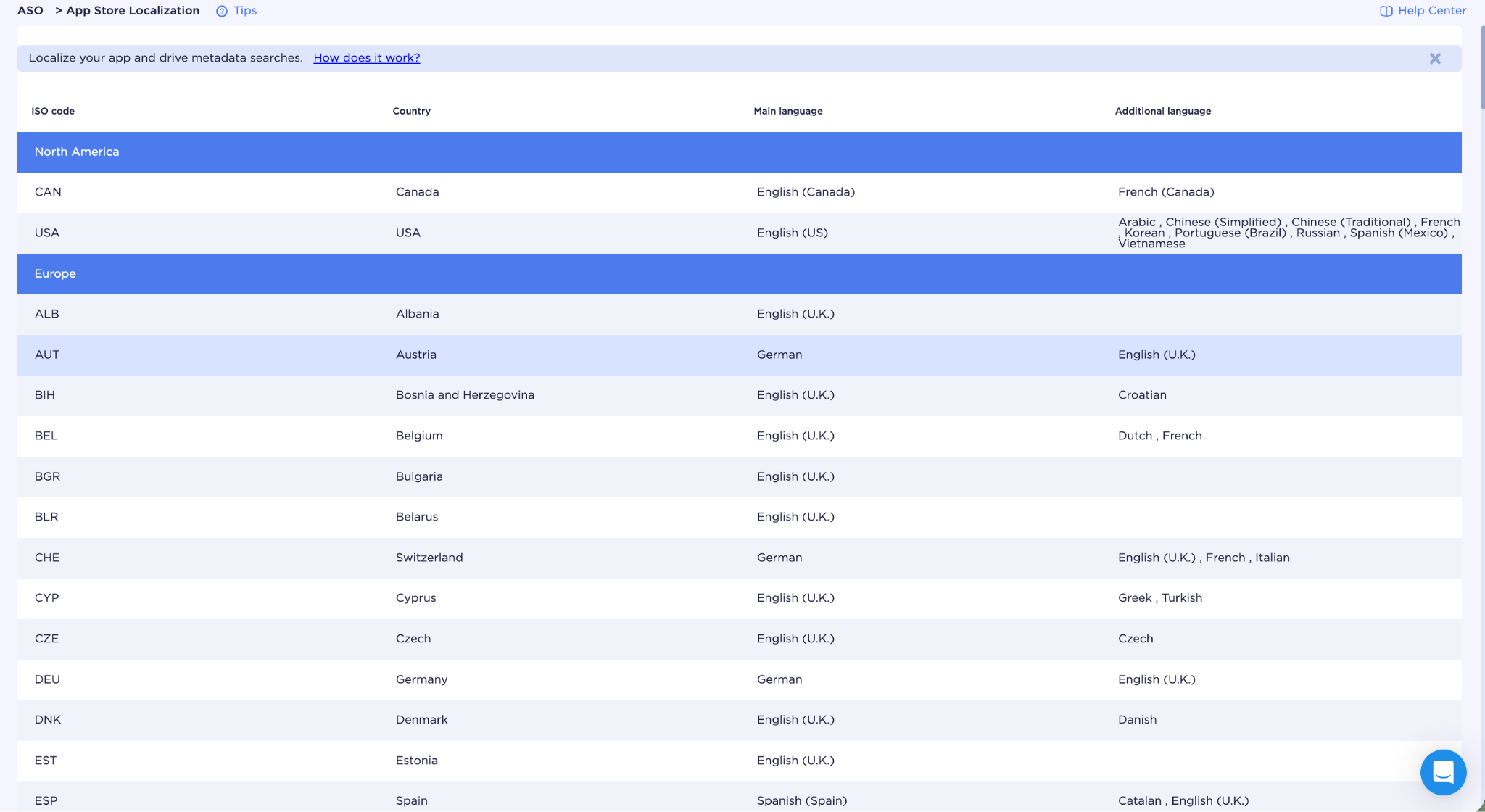
An underrated tool. The App Store doesn't just index apps by their primary locale — each market also indexes additional locales. The US, for example, has nine beyond English (US): Arabic, Chinese Simplified, Chinese Traditional, French, Korean, Portuguese Brazil, Russian, Spanish Mexico, and Vietnamese. Each additional locale comes with its own title, subtitle, and keywords fields — each around 160 characters — that the store factors into its indexing.
The tool shows the full list of locales by country and platform. Empty additional locales mean unused indexing capacity. For smaller apps, filling them in is often the fastest way to expand keyword coverage without touching the main metadata.
Writing metadata: ASO Creator
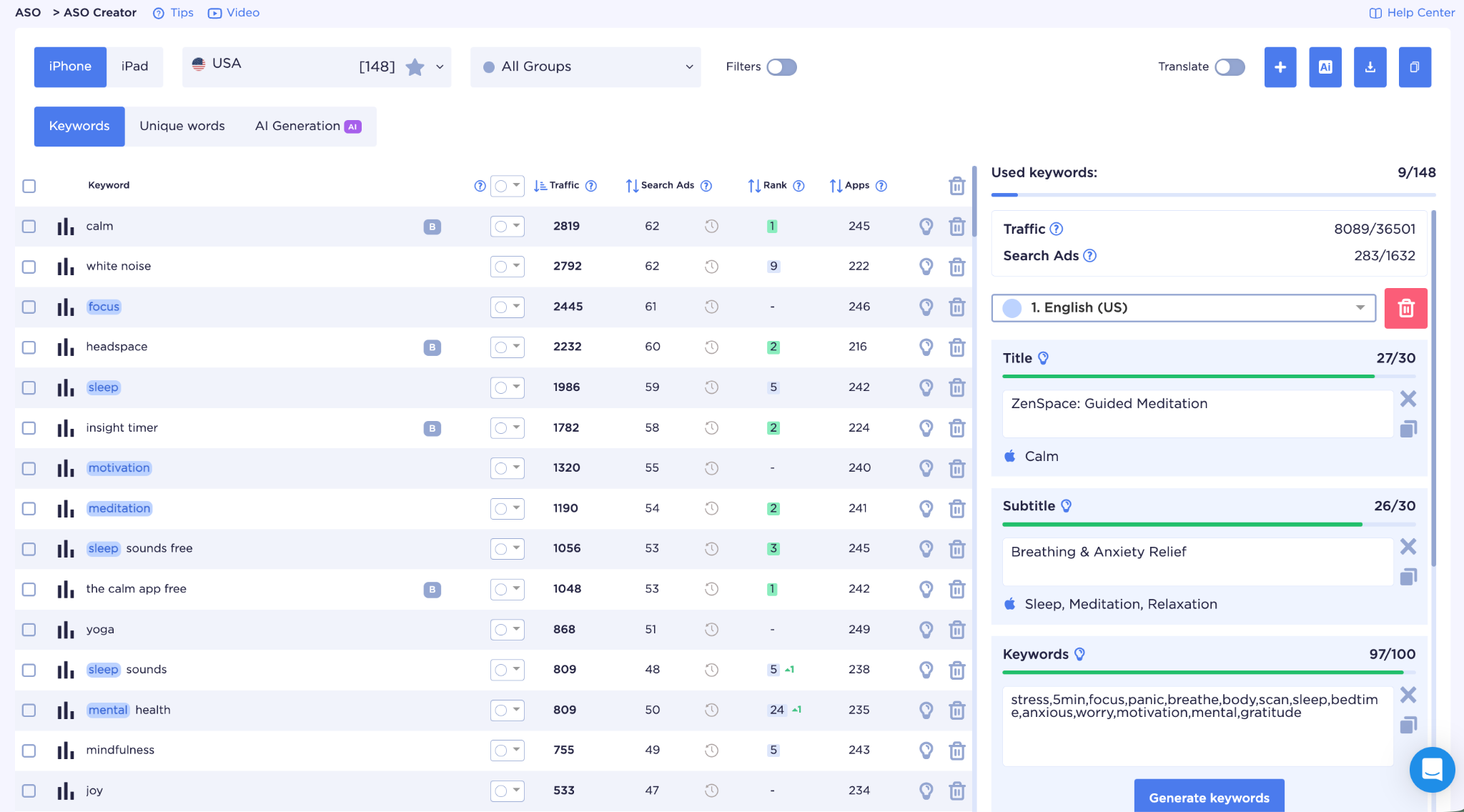
Keyword Builder and Localizations handle the semantic preparation. Actually writing the title, subtitle, keywords, and description is what ASO Creator is for. It's a paid tool, but it works directly with the keyword list from Keyword Monitor: pulls in keywords, shows character and traffic progress bars per field, and checks for duplicate words and over-optimization. It supports up to 10 App Store localizations at once. If you're writing or updating metadata regularly, or across multiple markets, it takes most of the manual work off the table.
Free tools for analytics and monitoring
Beyond keyword research and metadata, these free tools handle tracking and context.
Keyword Monitor
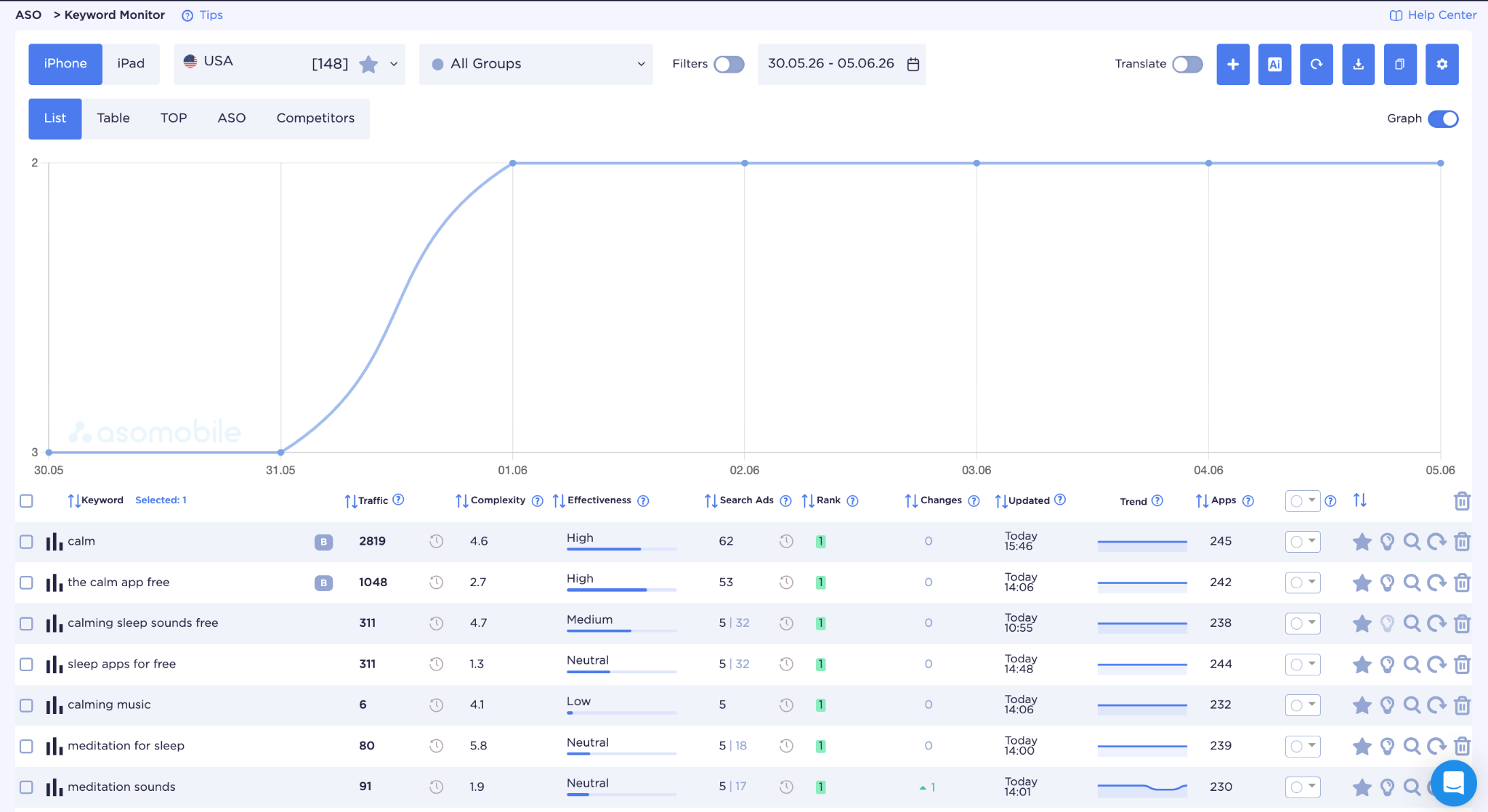
Keyword Monitor is the central hub for your semantic core. All discovered keywords live here — added manually, pulled directly from other tools, or suggested by analytics.
The main value is tracking position changes. After each metadata update, you can see which keywords moved up, which dropped, and which stopped generating impressions. The free tier allows 20 keywords across 2 apps — enough for initial monitoring of a single app, but tight for anything more sustained.
Category History and Category Ranking
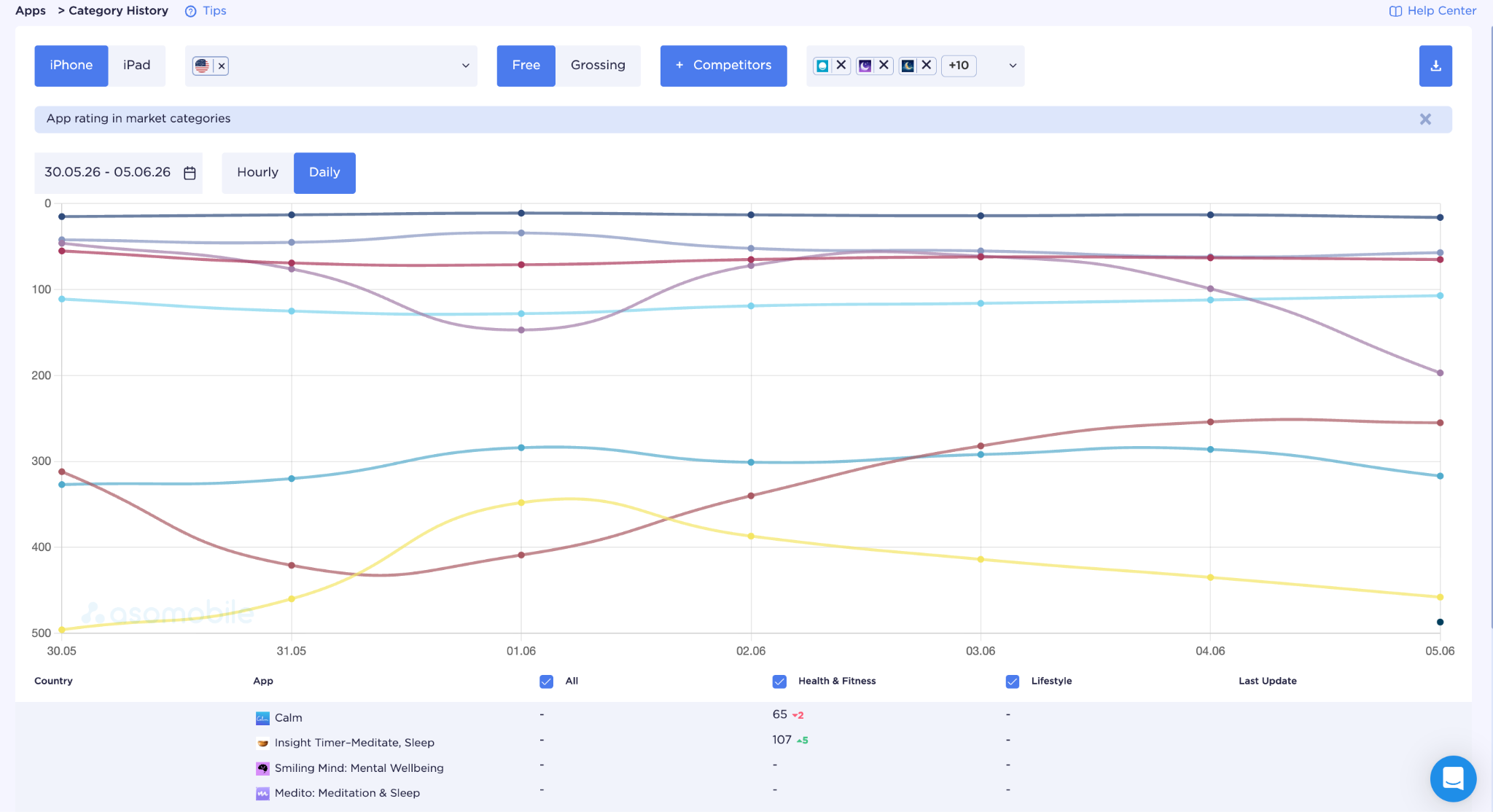
Category History shows the historical trajectory of a category's ranking for any app.
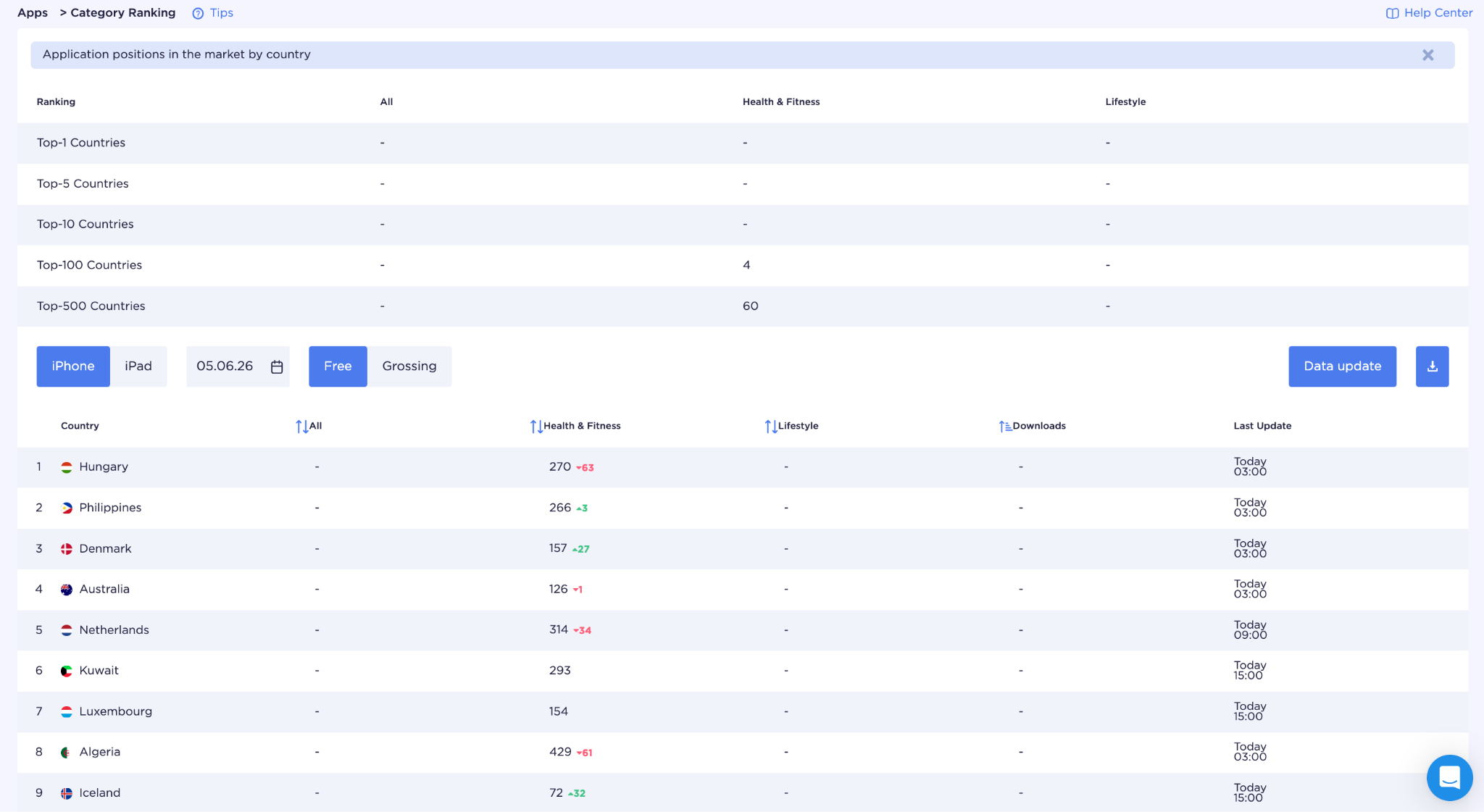
Category Ranking shows current category positions by country. Together they answer the question of where an app is headed without needing paid analytics. Useful for a quick check: where we stand in the category today and how that's changed.
Dashboard
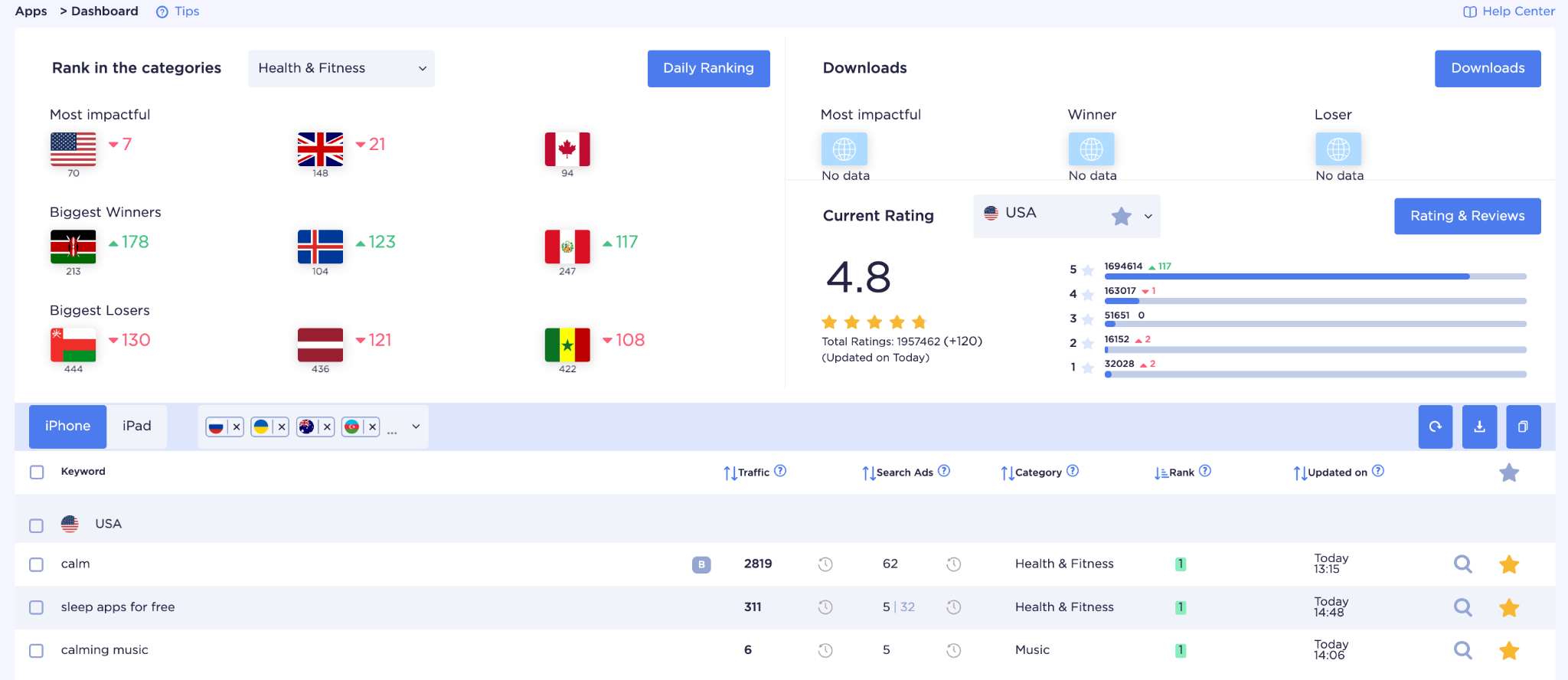
An overview of app performance: keyword visibility, category positions, basic stats. Useful for a fast daily check without opening each tool separately.
Free tools for market analysis
Top Charts
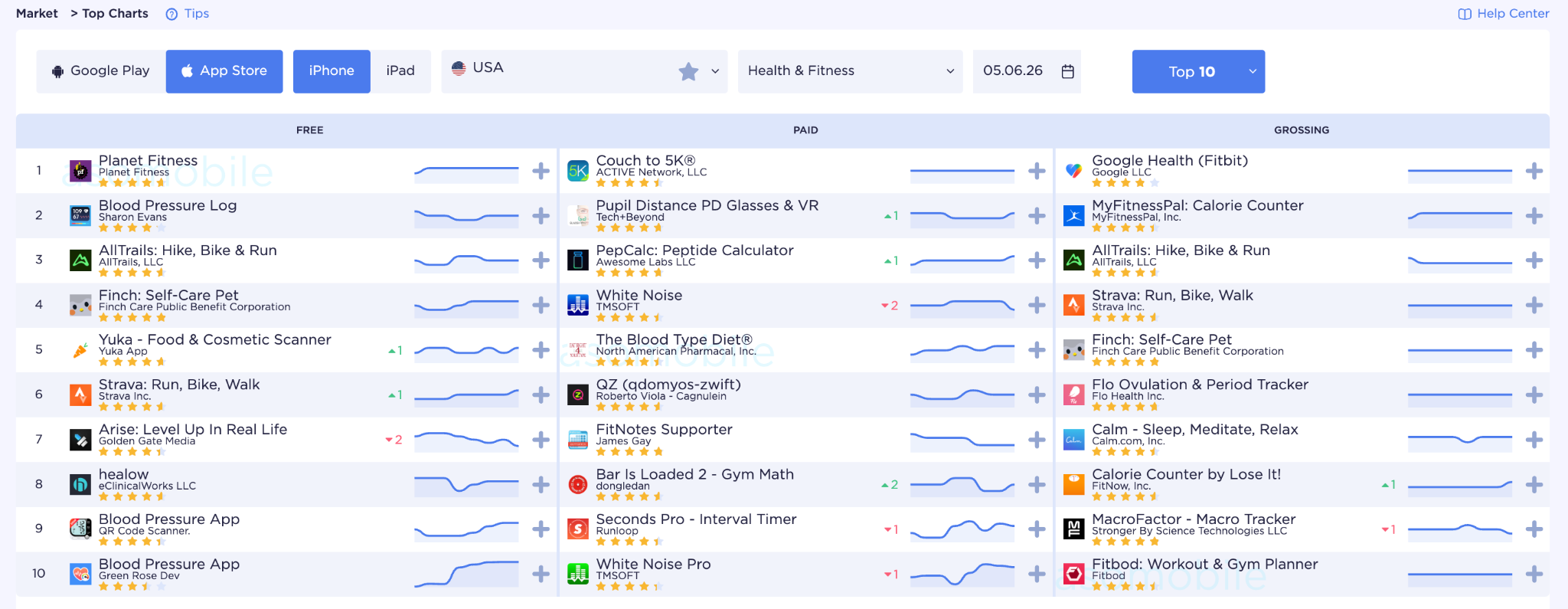
The top apps by category and country in real time. Shows who's leading in a niche, surfaces new entrants, and lets you see how their metadata compares to yours.
Store Benchmarks
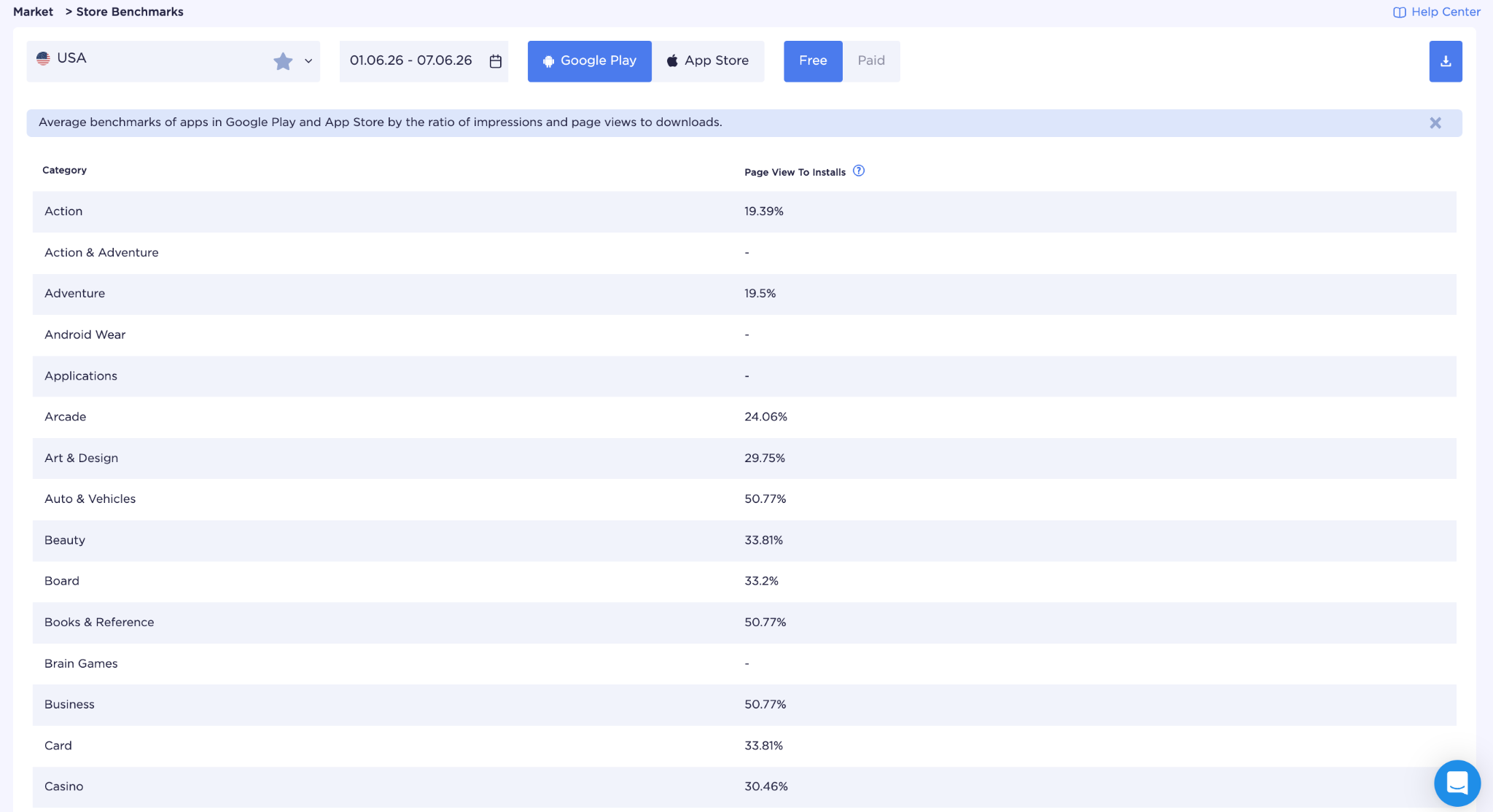
Average category metrics: ratings, review counts, position trends. Helps set realistic targets — understanding what numbers apps of a similar scale typically hold in the top 20, and what it takes to get there.
Featuring
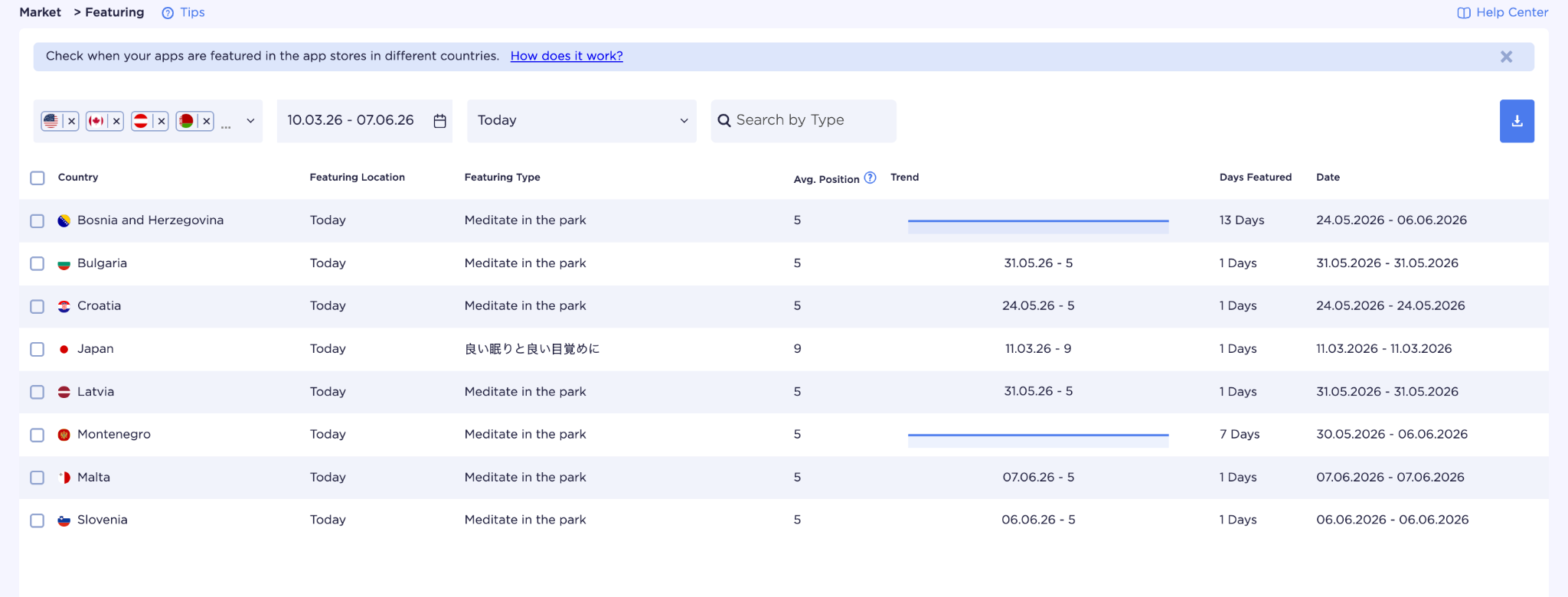
A history of featuring placements by country and category. Useful if you're planning to apply for featuring: you can see what gets placed on the front page, when, and which categories see it most often.
All 14 free ASOMobile tools: summary table
| Tool | What it does | Best for |
| Keyword Suggest | App Store and Google Play autocomplete | Finding long-tail keywords and new ideas |
| Trending Searches | Rising queries by country | Seasonal content, new niches |
| Top Keywords | Top 200 queries by category | Niche research before launch |
| Keyword Check | Traffic, CI, KEI, top apps per query | Filtering your semantic core |
| Text Analyzer | Extract keywords from any text | Competitor research, description audit |
| Keyword Monitor | Track keyword rankings | Daily monitoring after metadata updates |
| Keyword Builder | Build the App Store keywords field | Final metadata preparation |
| App Store Localizations | Full locale list by market | Expanding coverage without new keywords |
| Category History | Historical category ranking | Assessing long-term trajectory |
| Category Ranking | Current category positions | Daily benchmarking |
| Top Charts | Top apps by category | Monitoring the competitive landscape |
| Store Benchmarks | Average category metrics | Setting realistic goals |
| Featuring | Featuring history by country and category | Preparing a featuring application |
| Dashboard | App performance overview | Quick daily check |
All 14 tools are available on the free tier. Some have daily request limits, but for regular spot checks and one-off research sessions that's rarely an issue.
A practical workflow: how to use the tools in order
There are a few ways to sequence these tools effectively, depending on where you're starting from.
Starting from scratch: begin with Keyword Suggest to build an initial keyword list for your niche. Add trending queries from Trending Searches if the topic is seasonal. Check Top Keywords to get a sense of the category overall.
Then filter through Keyword Check. For each promising query, check competition and the top-ranking apps. Keep the keywords where there's a realistic path to ranking nearby.
In parallel, take the descriptions of two or three top competitors and run them through Text Analyzer. You'll likely find several high-traffic queries you hadn't considered.
Collect everything in Keyword Monitor. For App Store, build the keywords field using Keyword Builder. Check App Store Localizations: empty locales are unused keyword slots.
For Google Play, run the final description text through Text Analyzer to verify keyword density before publishing.
After publishing, Keyword Monitor will show how positions shifted. Dashboard and Category History give the broader picture of what's happening.
If you're starting with an existing keyword list you want to validate, go straight to Keyword Monitor. The rest of the workflow follows from there.
When free tools are enough — and when they aren't
Free tools work well for three scenarios: initial pre-launch research, a one-off metadata audit, and quick checks during active work. If you have one or two apps and run optimization every few months, the free tier covers it.
ASO isn't a one-time task, though. Keyword Monitor's 20-keyword limit doesn't hold up for multiple apps, large keyword sets, or ongoing work. Deep competitive intelligence — tracking what competitors added to their metadata last week, how their visibility has shifted — requires the full platform. Download and revenue estimates, market size data, full ranking history for A/B analysis — all of that is behind the paid tier.
ASOMobile's paid plans include unlimited Keyword Monitor, full competitor analysis, download and revenue estimates, and a complete historical dataset for in-depth work.
Wrap-up
ASOMobile's 14 free tools cover the full first cycle of optimization: from keyword research to a final metadata check before publishing. For indie developers, small teams, or agencies at the pre-sales stage, that's enough to do ASO properly. When ASO becomes an ongoing growth channel, the full platform is what makes it sustainable.
The full power of ASO without extra costs 💙
Use the "ASOTIPS40" coupon to get 40% off your first purchase at ASOMobile (the promo code is valid for any plan and any period).
FAQ: Frequently Asked Questions
For keyword research: Keyword Suggest, Keyword Check, Text Analyzer. For metadata preparation: Keyword Builder, App Store Localizations. For monitoring: Keyword Monitor. All free at asomobile.net/free-tools/.
Yes, if you use them to fix specific gaps in your metadata. The biggest gains usually come from two things: adding keywords your app wasn’t indexed for to the title and subtitle, and filling in empty App Store locales. Keyword Check and Text Analyzer together cover both without any cost.
Keyword Check shows the traffic, competition level (CI), efficiency (KEI), and top-ranking apps for any query in the App Store or Google Play. It helps filter out keywords that are too competitive or too low-traffic before they end up in your metadata.
When you need to track rankings over time across a large keyword set, run deep competitive analysis, or manage multiple apps at once. The free tier handles research and preparation; the full platform is for running ASO as an active growth channel.