Every January, millions of people download a fitness and health app — and most delete it by February. Wrong app again. Their own fault again.
The problem is almost always the choice of tool, not the lack of motivation. Fitness apps are built around fundamentally different ideas: some are made for running and cycling, others for nutrition tracking, others for strength training at the gym, others for home workouts without equipment. Picking Strava when you want to lose weight through diet is like buying a speedometer instead of a scale.
This review covers 10 apps that actually work. We break them down by use case, the honest pros and cons, and what's worth paying for versus what's enough for free. At the end — an ASO perspective on the category: it's one of the most competitive in the stores, and there's a lot to learn from it.
How we selected these apps
An app made the list if it's actively maintained (updates in 2025–2026), available on iOS and Android, has a real user base, and solves a specific problem — not just carries a fitness label. We deliberately covered different segments: cardio and activity tracking, nutrition, strength training, home workouts, and specialized audiences. Prices and features verified at the time of publication.
Comparison table
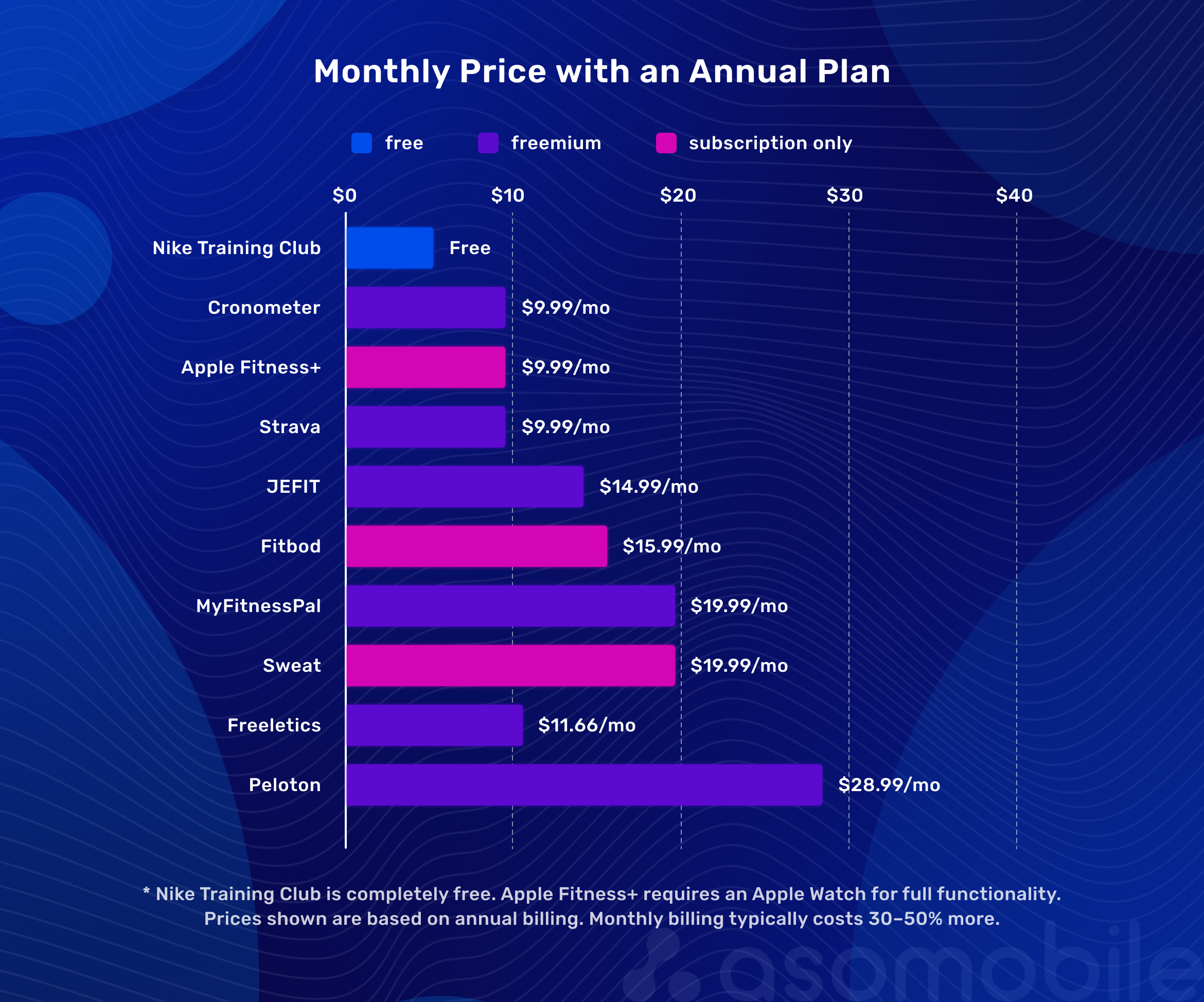
| App | iOS / Android | Best for | Key features | Pricing | Free version |
| Strava | ✅ / ✅ | Runners and cyclists | GPS tracking, segments, social feed, routes | $9.99/mo, $79.99/yr (Summit) | Yes, basic |
| MyFitnessPal | ✅ / ✅ | Nutrition and calorie tracking | 14M products, barcode scanner, 50+ integrations | $19.99/mo, $79.99/yr (Premium) | Yes, with ads |
| Nike Training Club | ✅ / ✅ | Structured workouts for free | 100+ workouts, adaptive plans, audio coaching | Completely free | Yes, fully |
| Fitbod | ✅ / ✅ | Strength training with AI programming | Adapts to muscle recovery, 1,400+ exercises | $15.99/mo, $95.99/yr | Limited trial |
| Peloton | ✅ / ✅ | Studio-style workouts at home | Cardio, strength, yoga, meditation, 1,000+ classes | $28.99/mo (App+) | Limited access |
| Apple Fitness+ | ✅ / — | Apple Watch users | Video workouts, real-time metrics, 12 activity types | $9.99/mo, $79.99/yr | 1-month trial |
| JEFIT | ✅ / ✅ | Strength tracking, advanced users | 1,400+ exercises, progressive overload, analytics | $14.99/mo, $71.99/yr | Yes, functional |
| Freeletics | ✅ / ✅ | Functional training without equipment | AI coach, HIIT, adapts to your level | $34.99/quarter, $89.99/yr | Limited access |
| Cronometer | ✅ / ✅ | Precise nutrition tracking, micronutrients | Verified NCCDB database, biomarkers | $9.99/mo, $49.99/yr (Gold) | Yes, full |
| Sweat | ✅ / ✅ | Women's fitness, BBG programs | BBG, PWR, LISS cardio, cycle tracker | $19.99/mo, $99.99/yr | 7-day trial |
App reviews
Strava
Best for: runners, cyclists, and anyone motivated by competition.
Strava is more than an activity tracker — it's a social network for athletes. Over 180 million registered users across 185+ countries (Strava, February 2026). GPS tracking is accurate, but the real draw is segments: stretches of routes where you compete against other users. Run down a familiar street and compare yourself to thousands of people who've done the same. For anyone who needs external motivation, nothing works quite like this.
According to Business of Apps, Strava generated $415M in revenue in 2025. In 2026, they added Group Runs — live joint workouts with voice chat. The paid Summit tier ($79.99/yr) unlocks training plans, load analysis, and route planning. For serious runners and cyclists, it's necessary. For anyone who just wants to track runs, the free tier is plenty.
One thing worth knowing: Strava collects 21 types of user data, including location. The app has made headlines a few times for accidentally exposing routes — if privacy matters to you, set up privacy zones.
Key features: GPS tracking, segments and leaderboards, social feed, group runs, route planner (Summit), training load analysis (Summit).
Pros: the best community among running apps; segments create real motivation; works with any device — Garmin, Apple Watch, Wahoo.
Cons: best features are behind the paywall; no strength or nutrition tracking; location data privacy concerns.
Platforms: iOS, Android, Web, Apple Watch, Garmin, Wahoo. Pricing: free (basic), Summit $9.99/mo or $79.99/yr.
MyFitnessPal
Best for: anyone who wants to control what they eat and actually understand it.
220 million users and a database of 14+ million food products (ProMealPlan, 2026) — that's not a marketing number; it's a real competitive edge. Almost any product from any store can be found via barcode scan in seconds. The logic is simple: calories in, activity out, balance in the middle.
Integrations are a separate strength: 50+ connections including Apple Watch, Fitbit, Garmin, Oura, Strava, and Nike Run Club. Burned calories on a Strava run — MFP automatically recalculates your daily budget.
The weak point: the database is user-built, so accuracy on some entries varies. For professional nutrition tracking with verified data — Cronometer is better. For everyday convenience — MFP has no real competition.
Key features: 14M+ product database, barcode scanner, photo food logging, 50+ integrations, macro tracking, recipes. Platforms: iOS, Android, Web. Pricing: free (with ads), Premium $19.99/mo or $79.99/yr.
Nike Training Club
Best for: anyone who wants structured workouts completely free.
NTC is an anomaly in this category. Over 50 million users (Netmaxims, 2026), professional-grade workouts, adaptive plans, audio coaching from real trainers — all without a subscription, without ads. Nike keeps the app free deliberately, as a brand-building tool.
In 2026, they added Adaptive Training Plans: set a goal (run a half marathon in under 2 hours, for example), and the app builds a dynamic plan that adjusts after every workout. The library covers 100+ programs: HIIT, strength, yoga, mobility, recovery.
The weak point: social features are much thinner than Strava's. You can't compete with others — NTC is about personal progress, not rankings.
Key features: 100+ workouts and programs, adaptive plans (2026), audio coaching, progress tracking, Apple Watch integration. Platforms: iOS, Android, Apple Watch. Pricing: completely free.
Fitbod
Best for: gym-goers who want AI to program their training instead of a coach.
Fitbod is built around one idea: it knows which muscles you worked yesterday and builds today's session around the ones that have already recovered. No more wondering what to train — the app decides based on your history and recovery data. Library of 1,400+ exercises with video demonstrations. Adapts to available equipment: tell it there's no cable machine in your gym and it recalculates automatically. Integrates with Apple Watch and Garmin.
One downside: without a subscription, the app barely works. The free tier is more of a demo for a few sessions.
Key features: AI workout programming based on muscle recovery, 1,400+ exercises with video, equipment adaptation, wearable integration. Platforms: iOS, Android, Apple Watch, Garmin. Pricing: $15.99/mo or $95.99/yr, limited trial.
Peloton
Best for: anyone who wants the feel of a studio workout at home.
Peloton started as an app for a $2,000 exercise bike. Today it's a standalone fitness platform with 1,000+ classes: cardio, strength, yoga, stretching, meditation, walking — all without Peloton hardware. The trainers are real, charismatic, with names and fan bases. That's what people pay $28.99/mo for — not a feature set, but an atmosphere.
The community is a separate value: live classes with thousands of people simultaneously, leaderboards, high-fives from strangers. For anyone motivated by social context, it works better than any AI coach.
Key features: 1,000+ classes (cardio, strength, yoga, meditation, walking), live workouts, leaderboards, progress tracking, Garmin and Apple Watch integration. Platforms: iOS, Android, Web, Apple TV, Fire TV. Pricing: $28.99/mo (App+), limited free access.
Apple Fitness+
Best for: Apple Watch users who want to get the most out of their device.
Apple Fitness+ only works with Apple Watch — and that's a feature, not a bug. During workouts, metrics from your watch (heart rate, cadence, activity rings) display directly on screen alongside the trainer. No need to glance at your wrist — everything is visible in real time. That connection between device and workout isn't available anywhere else.
12 activity types, Fitness Intelligence personalization, Apple Health integration. At $9.99/month it's nearly three times cheaper than Peloton at comparable content quality. First month free.
Key features: video workouts with real-time Apple Watch metrics, 12 activity types, Fitness Intelligence, Apple Health integration. Platforms: iOS, Apple Watch, Apple TV. Pricing: $9.99/mo or $79.99/yr, 1-month trial.
JEFIT
Best for: anyone serious about strength training who wants data, not motivation.
JEFIT — 20 million users, 42,000+ five-star ratings across the App Store and Google Play (JEFIT, 2026). 1,400+ exercises with demonstrations, sets/reps/weight tracker, rest timer, muscle group analytics. The AI feature NSPI gives a weekly score across four parameters: volume, movement balance, strength growth, consistency.
Key features: 1,400+ exercises with demos, volume and progressive overload tracking, NSPI analytics, 13M+ community, Strava and Apple Health integration. Platforms: iOS, Android, Apple Watch, Wear OS, Web. Pricing: $14.99/mo or $71.99/yr, functional free tier.
Freeletics
Best for: functional training without equipment, with an AI coach.
Freeletics has been building on one idea since 2013: your body as the gym. HIIT workouts, functional exercises, no equipment needed. The AI coach adapts the program to your level, progress, and feedback after each session.
Key features: AI coach with progress adaptation, HIIT and functional workouts without equipment, recovery tracking, exercise library. Platforms: iOS, Android. Pricing: $34.99/quarter or $89.99/yr, limited free access.
Cronometer
Best for: people who care about precision — not just calories, but micronutrients.
Cronometer is a niche app for people who want to deeply understand nutrition. Not just calories and protein, but vitamin D, iron, magnesium, omega-3. The database is verified — NCCDB and USDA, not user-contributed entries like MFP.
Key features: verified NCCDB/USDA database, micronutrient tracking, biomarkers, wearable integration, food diary. Platforms: iOS, Android, Web. Pricing: free, Gold $9.99/mo or $49.99/yr.
Sweat
Best for: women who want structured programs designed around female physiology.
Sweat grew out of Kayla Itsines's BBG programs. Today it's a multi-program platform: BBG for weight loss and toning, PWR for strength, LISS cardio, postpartum programs. The menstrual cycle tracker helps adjust workout intensity to the cycle phases — a feature most competitors don't offer.
Key features: BBG, PWR, LISS programs, menstrual cycle tracker, nutrition and recipes, community. Platforms: iOS, Android. Pricing: $19.99/mo or $99.99/yr, 7-day trial.
How to choose a fitness and health app: matching the tool to the goal
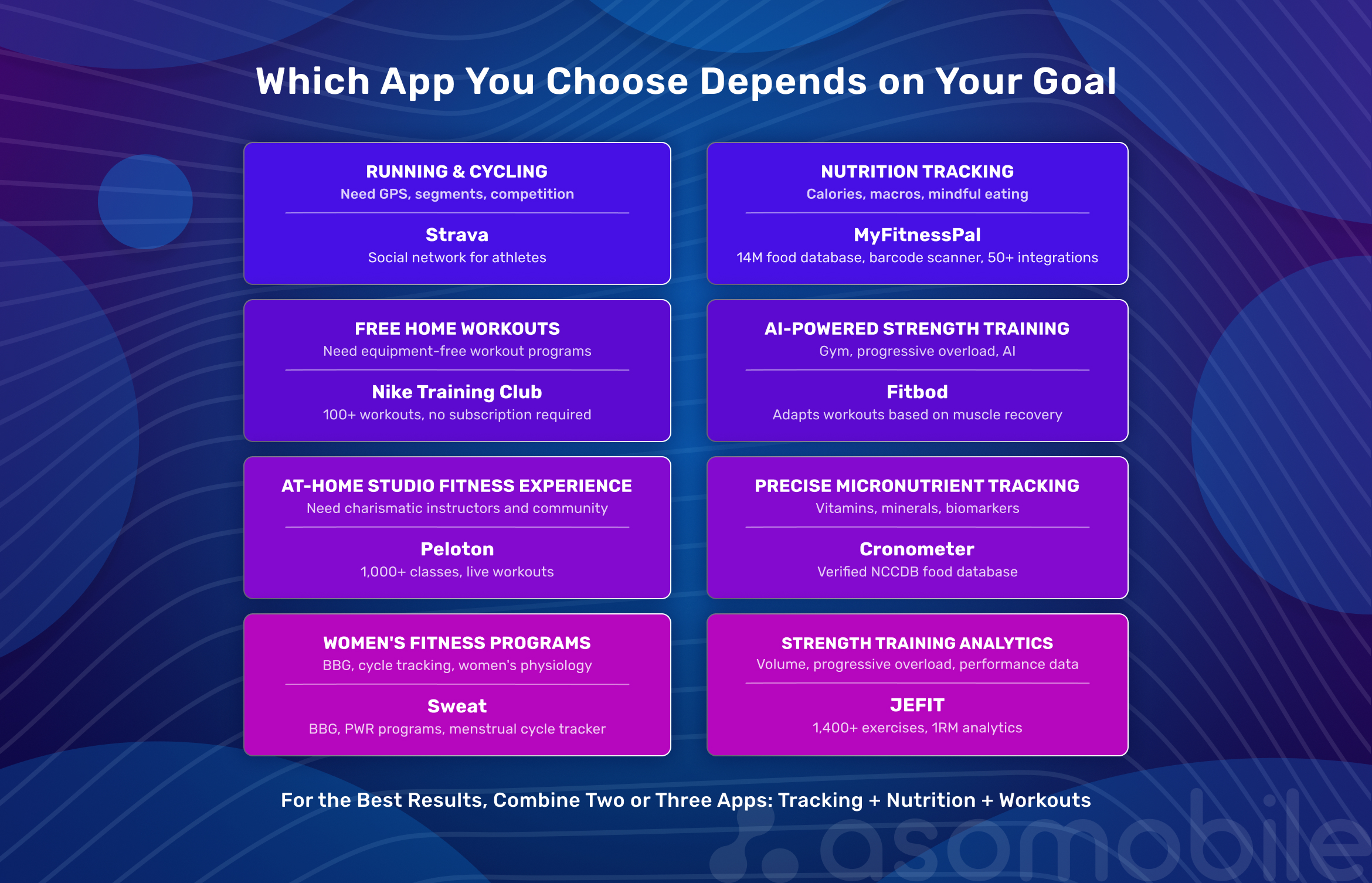
The choice depends on the task, not the rating. Each app solves a specific problem — below maps it out visually.
ASO insight: how the listing game works in this category
Health & Fitness is one of the most expensive categories in the App Store by cost per install. According to ASOMobile, the Health & Fitness category generated approximately $6 billion in 2025, with 17% year-over-year growth (ASOMobile Blog).
The market is concentrated but not closed. Strava, Fitbit, and FitCoach hold 16%, 10%, and 6% of the market respectively (Wellness Creatives, 2026). The top three hold a large share, but the category is wide enough: running, nutrition, strength, women's programs, meditation — each segment can be won separately. Nike Training Club took the home workout segment through full free access and doesn't compete head-to-head with Strava.
The icon and first screenshot matter more than the description. In this category, a user decides whether to install in 3–5 seconds. Look at Strava — the orange S icon is instantly recognizable. Nike Training Club — black background, clean branding. Freeletics — aggressive visuals with athletes. Each app builds its icon for its specific audience: running enthusiasts, home trainers, or people focused on body transformation.
Free as a listing strategy. Nike Training Club is the best example: a completely free app in a category where everyone else charges. This affects install conversion rate dramatically — apps without a paywall see much higher conversion from impression to install. The payment comes through brand value and equipment sales, not subscriptions.
Seasonality — the January spike. Health and fitness has the most pronounced seasonal pattern in the App Store: January generates a massive traffic surge on queries about weight loss, home workouts, and calorie counters. Apps that update their metadata and screenshots for January capture a disproportionately large share of that traffic. And there's a second peak many miss — March, when the motivation shifts from "new year, new me" to "get ready for summer." A different user with a different query, and a January-optimized page no longer works for them.
If you're working on an app in this category, ASOMobile is a convenient way to analyze competitor keyword coverage and seasonal traffic patterns. We covered this in detail in two blog posts: ASO for fitness apps: what to know before you start — on category strategy, seasonal peaks, and audience behavior; and ASO in 2026: the complete guide to app optimization — on algorithm changes, Custom Product Pages, and organic traffic.
Conclusion
Strava for runners, MyFitnessPal for nutrition, Nike Training Club for free home workouts, Fitbod for AI-powered gym sessions — each tool solves its own problem, and none of them solve everything at once. Fortune confirms the same four in their best fitness apps of 2026 roundup. People who actually transform their fitness through apps rarely use just one — they typically combine two or three: one for activity tracking, one for nutrition, one for workout programming.
For anyone building in this category: competition is tough, but segments are open. There are no universal winners — only category leaders in specific niches. The listing, icon, and first screenshot in Health & Fitness carry more weight than in most other categories — because install decisions happen fast and emotionally. January traffic is a separate chapter for those who know how to catch it.
ASO for your top apps💙
FAQ: Frequently Asked Questions
Depends on the goal. For running and cycling — Strava. For nutrition and calories — MyFitnessPal. For free home workouts — Nike Training Club. For AI-powered strength training — Fitbod. For women’s programs — Sweat. There’s no single best — only the best for a specific purpose.
An app is a tool, not a weight loss program. MyFitnessPal helps track calories and understand your deficit. Nike Training Club or Peloton provide the workouts. But without consistency and real changes to your habits, no app will do the work.
Nike Training Club and Cronometer deliver a full experience for free. Strava, MyFitnessPal, and JEFIT have functional free tiers. Fitbod and Peloton are barely useful without a subscription. Before paying — use the trial; most apps offer 7–30 days.
Nike Training Club — structured workouts for any level, no cost. MyFitnessPal — if you want to start with nutrition. Strava — if you plan to run or cycle.
Technically, the app works without one, but it loses its core functionality — real-time metrics during your workout. Without the watch, it’s just a video platform for $9.99/mo, which is hard to justify compared to the free Nike Training Club.