
Why ASO for finance apps works differently from every other category — and that's precisely what makes it both harder and more valuable. The category pulls in 7.7 billion downloads a year. Yet, the average finance app loses half its potential organic traffic before a user even opens its store page. The problem isn't the app itself — it's that trust, intent, and barriers in this niche don't respond to generic optimization advice.
In this breakdown, we cover the Finance category in depth: how keywords work across banking, payments, budgeting, investing, and other subsegments; where organic growth opportunities actually sit; and how to build a system that can hold its own alongside banks and fintech giants.
Why Finance Apps Need a Separate ASO Strategy
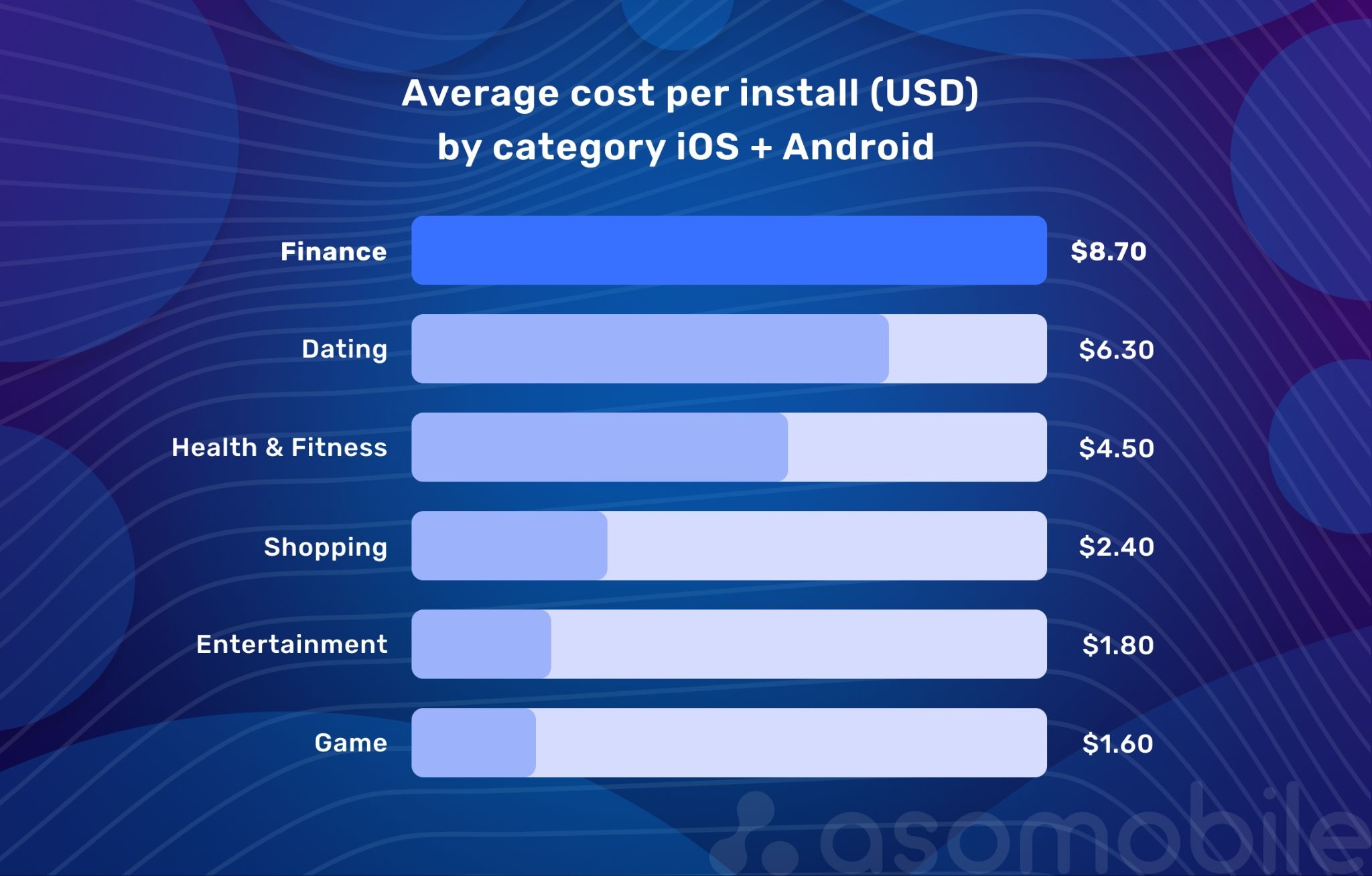
Finance is one of the few categories where organic growth directly competes with paid acquisition costs. Install prices in fintech consistently rank in the top 3 across the market. At those acquisition costs, the organic channel shifts from desirable to essential.
But finance apps also face structural challenges that don't exist in other niches — and those are exactly what demand a separate strategy.
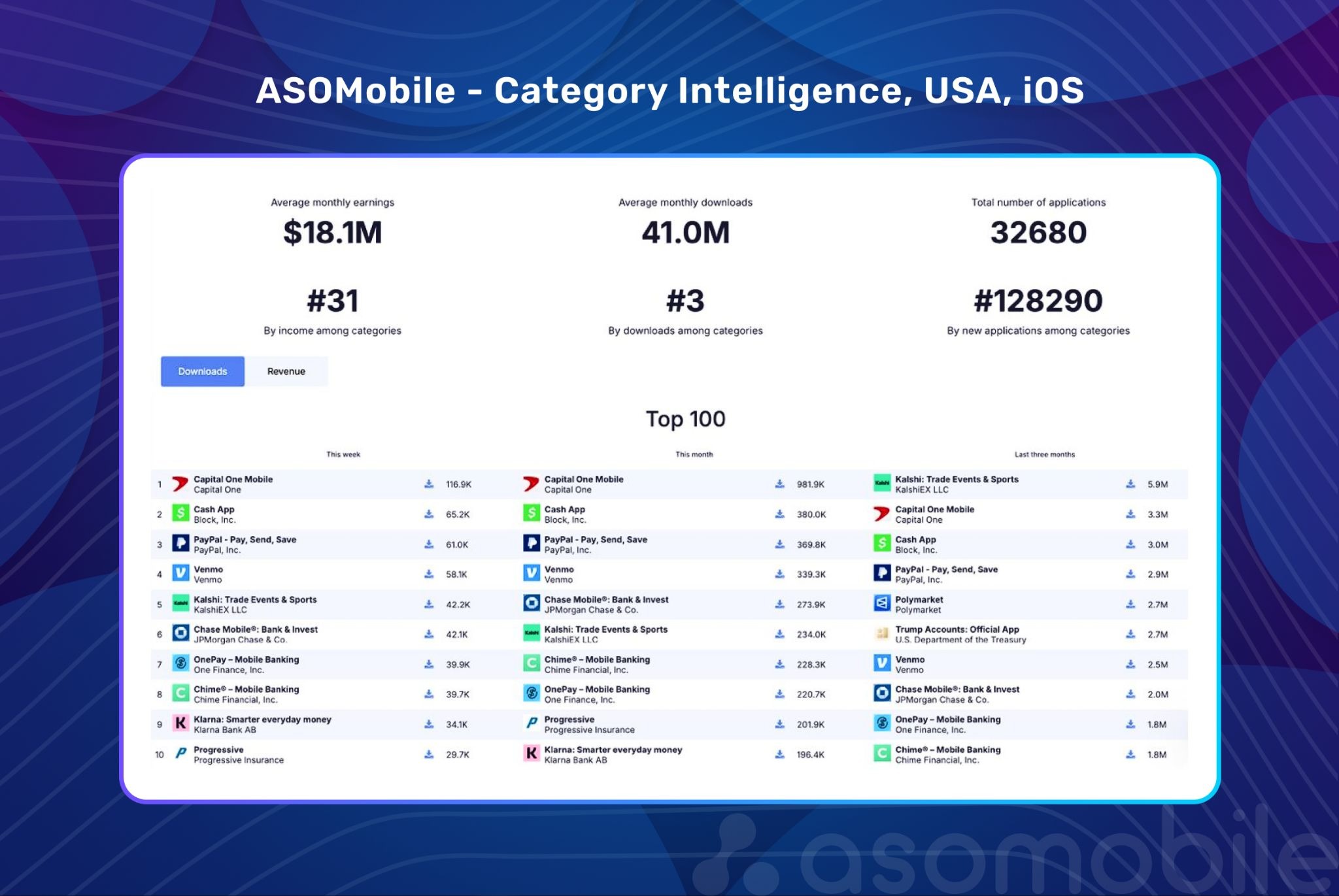
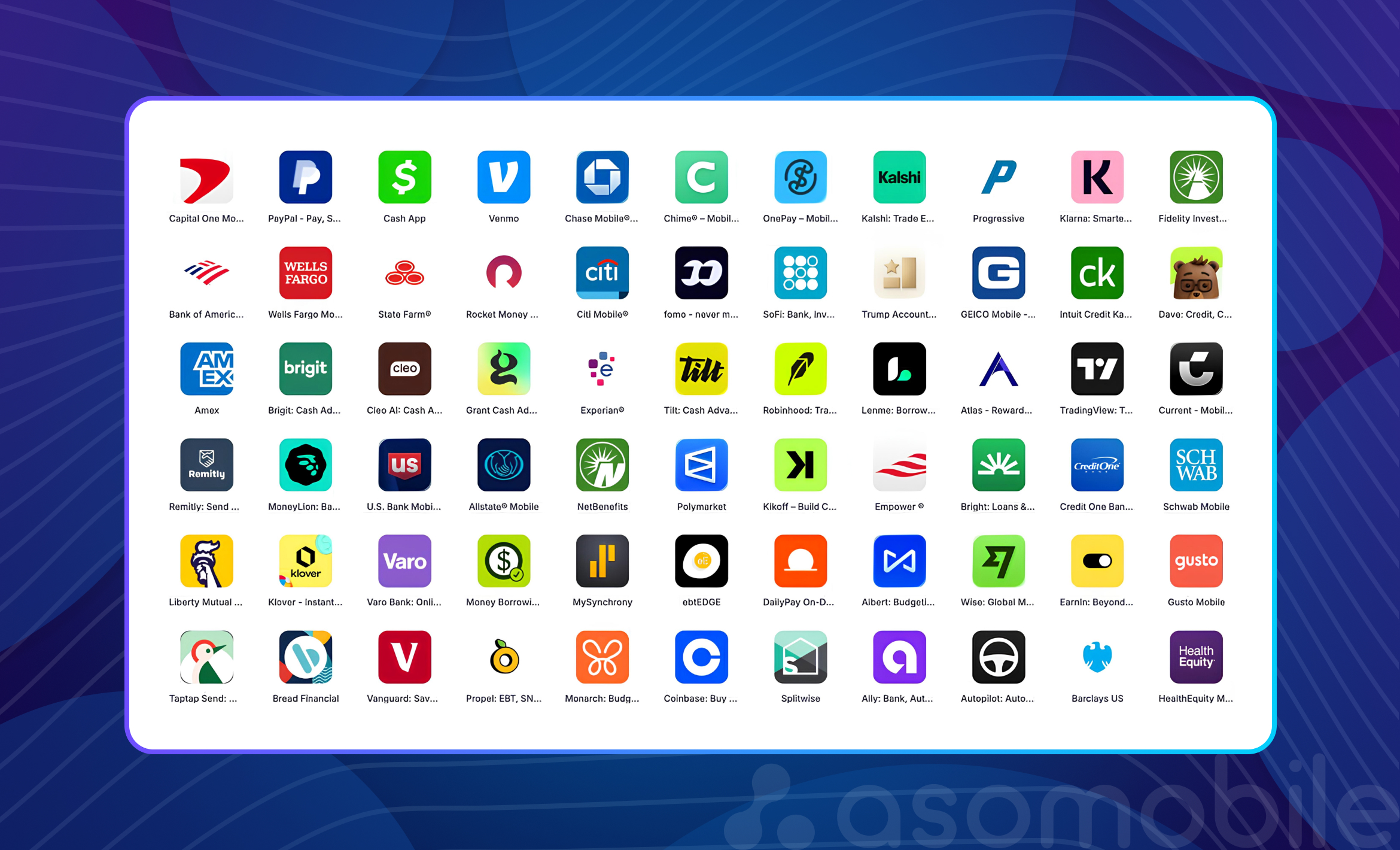
The first challenge is brand traffic saturation. The top spots for most high-volume queries belong to Chase, PayPal, Revolut, Robinhood, Coinbase, and Google Wallet. Eight of the ten most downloaded finance apps globally are mobile banking and digital wallets. They rack up tens of millions of downloads per quarter not because they're well keyword-optimized, but because users know and trust them. A new app can't push them out of the top for "banking" or "investment app" — it doesn't have the store history, review volume, or brand recognition to do it. Competing for those queries is a direct path to zero organic results.
The second challenge is trust as a conversion barrier. A user will download a game or utility on first impression. Finance is a different conversation: the user needs to believe they can hand over personal data, card details, connect online banking, or trust the app with their money. A good screenshot doesn't remove this barrier. It gets removed systematically — through metadata, visuals, ratings, and reviews. An app that doesn't treat this as a unified system loses conversion at every stage of the funnel.
The third challenge is compliance sensitivity in copy. Finance apps face strict restrictions on metadata content: you can't promise returns, guarantee outcomes, or use certain financial terms without proper disclaimers. An app that writes "earn guaranteed 15% per year" in its subtitle risks not just low conversion, but moderation problems. An ASO specialist in this niche needs to understand these limits as well as the marketing or legal team does.
The fourth challenge is country-specific search behavior. In India, a UPI payment app is a clear, high-volume query. In Brazil — transferencia Pix. In the UK — open banking app. In Germany — SEPA-Überweisung-App. In the US — Zelle alternative or check deposit app. Local payment systems, local regulators, and local financial habits create entirely different keyword pools in every market. An app with no localized metadata loses visibility in each market separately — and that multiplies the lost organic reach.
How Users Search for Finance and Fintech Apps
Search in Finance isn't random. It's hard to imagine someone casually deciding to browse for a financial app. Users arrive with a specific task or a query they've already formed. Understanding the search pattern for your sub-niche is the first step to a sound keyword strategy — because the pattern determines which keywords are worth targeting and which to drop.
Brand search — the user is looking for an app they already know: PayPal, Revolut, Wise, Cash App, Venmo. This traffic goes to market leaders. Competing with Chase or Coinbase on branded queries makes no sense. But knowing that part of the audience actively searches for these brands matters for positioning through competitive queries: Revolut alternative, Wise alternative, apps like Robinhood. A user searching for an alternative has already decided to switch — this is one of the warmest traffic types in Finance.
Service-type queries — mobile banking app, crypto wallet, expense tracker, stock trading app, personal loan app: high volume, but high competition. The top spots belong to established brands or apps with years of store history, thousands of reviews, and strong ratings. For a new app or startup, fighting directly for these queries is an inefficient use of resources.
Feature-based queries — bill reminder, split expenses, auto savings, investment portfolio tracker, round up savings app, shared expense tracker for couples. Lower competition, clearer intent. The user is looking for a specific capability, not a category-level app. These queries attract qualified users who already know what they need. Conversion is higher because the match between the search query and what the app does is precise.
Problem-based queries — how to save money app, track spending app, get out of debt app, debt payoff calculator, stop overspending. These convert well precisely because the user has already articulated a problem and is searching for a solution. Competition for these keywords is often significantly lower than for broad service-type queries.
Audience-based queries — banking app for teens, finance app for freelancers, investment app for beginners, business expense tracker. Niche, but highly precise in intent. The user describes themselves in the query — if the app matches that profile, conversion is significantly above average.
Competitive queries — Revolut alternatives, Robinhood alternatives, Mint replacement. A niche opportunity that few use, yet it delivers some of the highest conversion rates in the category.
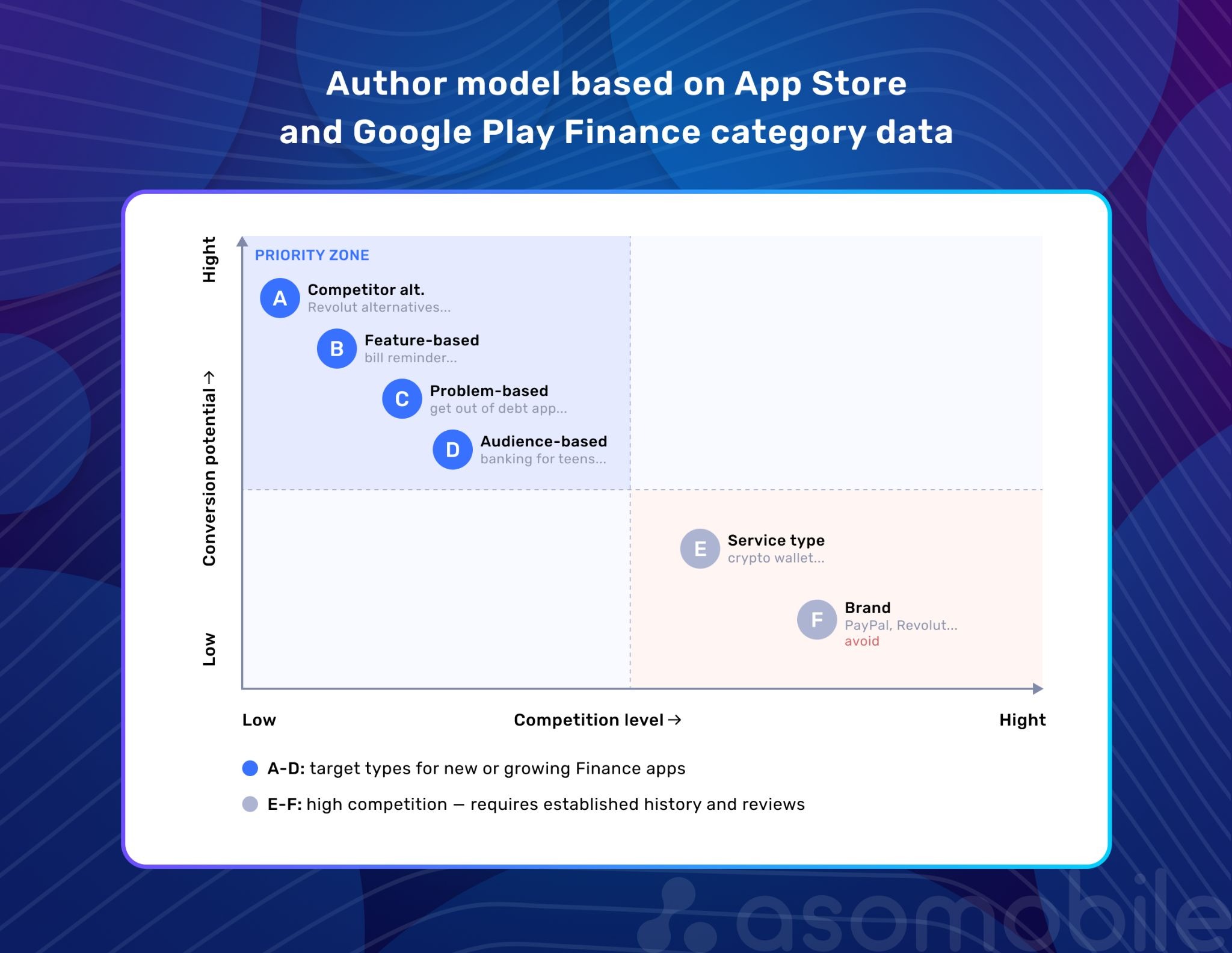
For a fintech startup or new app, real organic growth lives in feature-based, audience-based, and problem-based queries. That's where major brands have no monopoly, and where reaching the top in a reasonable timeframe is actually possible.
Key Clusters for Banking, Payments, Budgeting, Investing, and Fintech
Keyword strategy in Finance is built around clusters. Each cluster has its own semantic logic, distinct user intent, different competition level, and different conversion triggers. Trying to work all clusters at once means working none of them effectively — metadata gets diluted, intent gets lost.
| Cluster | User intent | Metadata angle | Conversion proof |
| Banking / Mobile bank | Open a digital account, replace a bank | Security, no fees, instant access | License/regulator, user count, rating |
| Payments / Money transfer | Send money fast and cheap | Speed, fees, destination countries | Real transfer times, supported currencies |
| Budgeting / Expense tracker | Control spending, find budget leaks | Category automation, analytics, reports | Average user savings, outcome reviews |
| Investing / Stock trading | Buy stocks, start investing | Ease of entry, fees, instrument range | Regulator, real portfolio screenshots |
| Crypto | Buy/sell crypto, store in wallet | Wallet security, supported coins | Security audits, asset insurance |
| Personal finance / Net worth | See the full financial picture | Account aggregation, auto-categorization | Accuracy reviews, number of connected banks |
| Lending / Loans | Get a loan quickly on clear terms | Interest rate, approval speed | Transparent terms, no hidden fees |
| Insurance | Insure an asset or life | Ease of enrollment, policy cost | Partnerships with known companies, payout data |
| Tax / Finance utilities | Calculate taxes, keep records | Calculation accuracy, supported systems | Compatibility with tax authorities |
The one-priority rule: one product, one primary cluster, and at most one or two adjacent ones with a clear hierarchy. An app that tries to be a bank, an expense tracker, and an investment platform all at once becomes a product about everything and nothing in the metadata. Users can't tell why they'd choose it over anything else.
How to Prioritize High-Intent Keywords
High-volume terms like bank or invest look attractive but actually convert worse than narrow queries with clear intent. A user typing track daily expenses automatically knows what they want. A user typing finance doesn't — their intent is diffuse; they could be looking for anything from a calculator to a crypto exchange.
When working with keywords for finance apps, evaluate three parameters simultaneously: search volume, competition level, and how precisely the keyword matches the app's functionality. A keyword with moderate volume, low competition, and a tight match to what the app does will drive more installs than a high-volume query where you'll never reach the top 10. Chasing popular queries when top rankings are out of reach is a direct loss of semantic potential.
Keyword stuffing — packing metadata with keywords at the expense of readability — works worse in Finance than in other categories, for two reasons. First, both App Store and Google Play algorithms detect unnatural term repetition. Second, users who see a keyword-heavy subtitle like "Expense tracker budget planner money manager savings app finance" read it as a signal of an untrustworthy product. Keywords need variety: synonyms, adjacent queries, feature+audience combinations.
Seasonality is an additional filter when setting priorities. Tax queries (tax calculator, tax return app, income tax) peak from January through April depending on the country. Budgeting queries (save money this year, new year budget) spike sharply at the start of the year. Investing queries react to market volatility: after major moves in crypto or equities, search traffic on those terms rises noticeably. Tracking seasonality in your cluster means having the data for timely metadata updates — not guessing when to act.
Competitive Analysis in an Overcrowded Finance Category
The first mistake in Finance competitive analysis is looking at the whole category. The Finance section holds tens of thousands of apps on each platform. Analyze your sub-niche: if your app is a budgeting app, your direct competitors are Monarch Money, YNAB, and Copilot —not JPMorgan Chase or Robinhood. Different niches compete for different users and different queries.
The second level of competition is substitute apps. A user searching for an expense tracker might choose either a standalone app or a built-in feature inside a banking or card app. In many cases, a banking app with expense tracking is the real competitor to an independent budgeting product — not other standalone trackers. That matters for positioning.
When analyzing competitors in the finance niche, track a few things: which keywords they rank for and where they have gaps, how often they update metadata and screenshots, what their rating is and how reviews trend. A competitor's rating dropping below 4.3 is a direct opportunity window. Users start looking for alternatives, and if your app shows up for "competitor alternative" queries with a strong rating at that moment, conversion will be above category average.
One of the best insight sources is competitor reviews. Users in reviews explicitly say what they're missing: "wish it had multi-currency support", "no export to spreadsheet", "too complicated for beginners", "notifications are broken". Each recurring complaint is a ready-made cue for your own metadata and screenshots. If a competitor is weak on data export and you have it — make that visible.
The goal of analysis isn't to copy what competitors do, but to find positioning gaps: what they don't cover, which audience they don't capture, which queries they're not optimized for. A large banking competitor often ignores queries like bank for freelancers, account for digital nomads, or teen banking app — these are ready niches with a defined audience and real search volume.
Metadata Optimization for Finance Apps
ASO for finance apps starts with metadata — it's the only thing the algorithm sees before a user clicks through to the page. The title is the primary asset in both stores. App Store and Google Play algorithms give maximum weight to words in the app name. In finance, Brand + function works well: "Wallet — Budget Tracker", "Fintory — Expense Manager", "Cleo — Budget & Cash Advance". This structure builds brand recognition while capturing functional queries.
The subtitle in the App Store and the short description in Google Play are the second-ranking fields. This is where you address the second-priority cluster or sharpen differentiation with a specific fact: "No fees. No jargon. Real banking." or "Save automatically, spend smarter". The App Store subtitle is 30 characters — they're indexed and visible alongside the title in search results. Every word needs to carry weight.
The Keywords field in the App Store is 100 characters, with no spaces and no words repeated from the title or subtitle. The delimiter is a comma with no spaces: billreminder,savingsgoal,moneytransfer. For finance apps, prioritize functional queries from the secondary cluster and niche, problem-oriented queries that competitors haven't covered and that don't duplicate already-indexed words from other fields.
The Google Play description is fully indexed, so write it with keywords in mind. The first 3-4 sentences matter most — they're visible before the "Read more" button. Use that space to convey the product's core value and main benefit, not a corporate tagline. Below that: a full feature list, security details, a target audience description, and an in-description FAQ.
In Finance, avoiding compliance violations in metadata matters more than in most categories. Don't promise returns, don't guarantee outcomes, don't use language like "guaranteed returns", "risk-free investment", or "make money fast". These formulations create moderation problems and undermine user trust — the financially literate audience in this niche knows these claims don't hold up.
Trust, Security, Ratings, Reviews, and Conversion
Finance is the one category where users are literally deciding whether they can trust you with their money before they hit "Install." The conversion funnel in the finance niche is longer than in any other. That's not a problem — it's a feature of the category, one that requires a systematic approach.
Regulatory information in metadata outperforms any tagline if the app is licensed or operates under a financial regulator's oversight — state that clearly. "FCA-regulated", "FDIC-insured", "Regulated by BaFin" — these markers mean more to users than any copy claim. A regulator functions as an independent guarantor, and mentioning it immediately lowers the trust barrier. This is one of the most effective conversion improvements available in Finance, costing at most a few words in the subtitle.
Social proof works through scale and specificity. User counts, assets under management, awards, and mentions in recognized publications perform well on first-screen screenshots. "2M+ users trust us with their money", "$500M+ processed daily", "App of the Year — Forbes" — specifics that users can actually evaluate. "Leading finance app" or "Trusted by millions" without supporting detail convinces no one, because any app can write the same thing.
Ratings and reviews are more critical in Finance than in any other category. In most niches, a 4.0 rating is enough to drive installs. In Finance, dropping below 4.3 meaningfully reduces conversion: users read reviews more carefully because the stakes are higher. They're looking for reports of lost money, blocked accounts, withdrawal problems, and poor support. One such review without a developer response causes more reputational damage than ten positive ones.
Rating prompts should hit moments of success: after the first successful transfer, after reaching a savings goal, after a loan is approved. Asking for a rating during a frustrating moment or in the middle of a complex flow is counterproductive. Major fintech apps consistently show that users prompted at a moment of success are significantly more likely to leave a high rating than those interrupted at an arbitrary point.
Responding to reviews is a conversion tool, not a support formality. A developer who responds to a negative review with a concrete resolution demonstrates the level of support users expect from a financial product. Users evaluating the app read not just reviews but responses — it's a second chance to win over a skeptic.
Security in metadata and screenshots is a conversion trigger. "Bank-level encryption", "Biometric authentication", "We never sell your data" — these statements address the core objection before the install. Users won't read a privacy policy before downloading, but they'll notice a clear security signal.
Visual Optimization for Finance App Pages
The first screenshot in Finance carries more weight than in almost any other category. It either clears the trust barrier or it doesn't. Most users decide whether to install before scrolling past the third screenshot — which is why the first two screens carry the entire conversion load.
What works in this niche: professional interfaces with realistic data. Not empty states, but live data that shows the product in action — spending trend charts, transaction history, category analytics. Specific numbers on a screenshot outperform any copy: "+$340 saved this month", "0 transfer fees", "3.2% APY on savings". Visible security indicators. Minimal design without information overload.
What doesn't work: stock photos of people with phones, abstract taglines like "Take control of your finances" with no specifics, empty interface states without data, small unreadable text over a gradient background.
Finance color palettes are traditionally built around blue (trust, stability), green (growth, returns), and dark or black (premium feel). Crypto segments can support a more aggressive visual style. Red in a financial context signals loss — use it carefully and never on the first screenshot.
Video previews in Finance are rare, but when done well, the first 3-5 seconds must show core value — not a logo with music. Most users watch without sound, so subtitles or text overlays are mandatory.
A/B testing through App Store Product Page Optimization and Google Play Store Listing Experiments lets you validate icon and screenshot hypotheses on real traffic. For Finance, this is especially valuable: the conversion difference between a first screenshot with and without a security marker can be significant.
Localization and Country-Specific Search in Finance
Localization for finance apps isn't translation. It's adapting to each market's financial reality: local payment systems, local regulators, local search patterns, and financial habits that vary dramatically by country.
In India, the key query is a UPI payment app. No Brasil — transferência via Pix or app de pagamento Pix. In the UK — open banking app. In Germany — SEPA-Überweisung-App. In the US — Zelle alternative or check deposit app. The same product without country-specific metadata loses visibility in every market. PhonePe hit 128.5 million downloads precisely because it matched the Indian market's reality with UPI-focused queries — those drove organic volume that no paid channel could replicate at the same scale.
Beyond terminology, localize: currency in screenshots — show local currency, not USD by default; regulatory markers — the local regulator's name carries more conviction than international abbreviations; user scenarios — banking habits differ significantly across countries. A user in Nigeria values "send money to family abroad"; a user in Germany values "IBAN transfers with no fees"—different scenarios, different language, different screenshots.
Seasonality is also country-specific. Tax season in the US is April. In the UK — January. In Germany — May through July. If the app handles tax features across multiple markets, update metadata for each country's seasonal peak separately — this isn't extra work; it's a direct organic traffic gain at the right moment.
Emerging markets — Latin America, Southeast Asia, Africa — offer finance apps opportunities that don't exist in saturated Western markets. Competition is lower, fintech adoption is growing quickly, and users are actively seeking alternatives to traditional banking. For products ready to invest in localization, this is a strategic window that will close as larger players move in.
A Practical ASO Workflow for Finance Apps
ASO in the finance niche isn't a one-time setup — it's an iterative process. Each step builds on the previous one, and the cycle repeats every 4-6 weeks or when something significant shifts in the market.
Step 1. Market audit: category size by country and platform, top 10 by downloads and revenue, competitive structure, conversion benchmarks by sub-category. Goal: understand where the market stands and where the gaps are.
Step 2. Competitive benchmark: analyze metadata, keyword strategy, screenshots, ratings, and 3-6 months of trend data for direct competitors. Look not for what they do well, but for what they miss.
Step 3. Build keyword clusters: identify the priority cluster and one or two adjacent ones; break them down by intent, volume, and competition level; identify seasonal peaks and high-intent queries.
Step 4. Metadata optimization: title using the Brand + function formula; subtitle/short description with a differentiating angle; Keywords field with niche and functional queries; description focused on the first 3-4 sentences.
Step 5. Visuals and trust signals: screenshots with specific numbers and realistic data, security markers, social proof on the first screen.
Step 6. Localization: country-specific metadata and screenshots for priority markets, accounting for local payment systems, regulators, and search terminology.
Step 7. Tracking and iteration: monitor keyword cluster rankings, funnel conversion, ratings, and competitor visibility. Make decisions on data — not instinct.
The cycle from audit to first publish takes 2-3 weeks for an experienced team. After publishing, wait at least 4 weeks before concluding: algorithms need time to index, and behavioral signals need time to accumulate. Changing metadata too frequently prevents the algorithm from evaluating the previous version.
How to Measure ASO Results for Finance Apps
The key metrics in Finance differ from other categories by their emphasis on trust and the conversion funnel — not just organic download volume.
Visibility on non-branded keywords is the baseline indicator of organic growth. Track rankings for functional and niche queries in your priority cluster — not just high-volume ones. Moving from position 50 to 15 for expense tracker for couples is real progress, even if nothing visible has changed in the overall Finance top.
Impression to Page View measures how well the title and icon convert impressions into store page visits. In Finance, this metric runs below market average: users are more selective. A low figure signals a need to improve the icon or title—it's not generating enough confidence for users to click through.
Page View to Install measures how convincing the page is. In Finance, this is lower than in entertainment categories: App Store sits around 33%, Google Play around 20%. Finance apps that systematically work on trust signals convert 30-50% above the category average. A below-average figure signals work on screenshots, ratings, or the first section of the description.
Ratings and review velocity are leading indicators of conversion. A ratings drop typically precedes an install drop — sometimes by several weeks. Track not just the average score, but the rate of new reviews — they show user reaction to the latest update before it's reflected in the overall rating.
Competitor visibility: track which queries they're rising or falling on. When a competitor changes their subtitle or a new keyword signal appears in their description, it often signals a strategy shift—better to prepare than to react three months later.
Country-level performance: in Finance, country-level conversion differences can be dramatic. The same product converts at 2% in one country and 8% in another. A dedicated dashboard for priority markets is essential — without it, sound decisions on localization and resource allocation are impossible.
How ASOMobile Helps Finance Teams Track Search and Competitors
ASO work in Finance requires continuous monitoring: the market moves fast, competitors update their strategies, and seasonality creates short-lived opportunity windows. Manual monitoring at that pace doesn't scale — you need a system.
Keyword Monitor in ASOMobile tracks keyword rankings by country and platform. You can see trends per cluster and react quickly: if tax season starts and competitor positions for tax calculator app surge — that's the signal to adjust your own metadata while the window is open.
Spy Keywords shows competitor keyword strategies: which queries they rank for, what's changed in their metadata. For Finance, where competitive gaps are the primary source of organic growth, this is one of the most valuable tools available. Seeing that a competitor has stopped optimizing for business expense tracker means seeing an open spot in the top.
Category Intelligence shows the structure of your sub-category's top: who leads, how rankings trend, how downloads and revenue are distributed. This helps you assess your market position realistically and identify segments with lower competition for your next growth move.
Store Benchmarks provide conversion reference points for the Finance category—you can see how your Impression-to-Install figures compare to the average and prioritize work at the right funnel stage. Still, Page View to Install is weak, the problem is the page, not the icon.
Ratings & Reviews Monitoring tracks rating trends after each update. Seeing the correlation between a specific release and a spike in negative reviews means having the data to fix things before the rating hits a critical threshold.
Geo Checker helps assess country-level opportunities: where in Finance demand is growing with relatively low competition. That's how you identify the next market to enter — before larger competitors arrive with years of store history and thousands of reviews.
Conclusion
ASO for finance apps is a category where organic growth is harder than in most niches — and more valuable: a user who arrives through a precise functional query typically converts to a paying customer better than any banner traffic. Start with one cluster, pick 3-5 niche queries with real volume, add trust signals to the first screenshot, and check results after 6-8 weeks. Most Finance teams skip exactly this sequential step, working on everything at once and never knowing what actually moved the needle.
Finance ASO: straightforward and cost-effective, if you know where to look.
FAQ: Frequently Asked Questions
Paid acquisition costs in Finance rank in the top 3 across the market. Organic traffic from App Store and Google Play is one of the few channels with an acceptable CAC in this niche. Users who arrive through a functional search query convert to paying customers better than those from ad banners — they come with clear intent. Solid ASO reduces dependence on paid channels and creates a steady organic flow — especially valuable for financial products where paying-user LTV is high.
It depends on the product type. Banking apps build their keyword strategy around mobile bank, online banking, and digital account. Budgeting apps — around expense tracker, budget planner, spending tracker. Investing — around stock trading app, investment portfolio, ETF app—crypto — around crypto wallet, bitcoin app, DeFi. The best results come not from broad, highly competitive queries, but from functional, problem-oriented ones with moderate volume—the space where major brands don’t hold a monopoly.
Three things: the trust barrier (users don’t install finance apps impulsively — they evaluate reliability); compliance constraints (you can’t promise returns or guarantee outcomes); and country-specific requirements (financial terminology, regulators, and payment systems differ across markets, and without localized metadata the product loses visibility).
Work on trust signals systematically: add regulatory information to metadata, show specific social proof (user count, processed volume), place security markers on the first screenshot. In parallel — maintain a strong rating and respond to reviews with concrete resolutions. Abstract taglines without numbers don’t persuade Finance users.
Finance users read reviews more carefully than in any other category — because the stakes are higher. A rating below 4.3 significantly hurts conversion. Reviews describing security issues or financial losses spread quickly and cause reputational damage that’s very hard to undo through ASO.
Competitor analysis in Finance helps identify keyword gaps (queries where competitors rank but you don’t) and positioning gaps (audiences and needs competitors don’t serve). User complaints in competitor reviews are a ready-made messaging guide for your own screenshots. Responding to a competitor’s rating drop is also part of the competitive strategy.
Yes. ASOMobile lets you track keyword rankings by country and platform, analyze competitor keyword strategies through Spy Keywords, monitor ratings and review trends, benchmark conversion metrics across the Finance category, and identify country-level opportunities through Geo Checker.