
Most people have a finance app in 2026. Most of them use it like a fancy bank statement: open it, check the balance, close it. That’s not managing money — that’s the illusion of control.
The difference between apps that actually change financial behavior and those that just show numbers lies in the method and what they’re built to do. Budgeting, subscription tracking, investing, international transfers, credit monitoring — each of these needs a different tool.
This review covers 10 apps from different segments of the financial market. We break them down by use case, honest pros and cons, and what’s worth paying for. At the end — an ASO take on the Finance category: one of the most competitive and expensive in the stores.
How we selected these apps
An app made the list if it’s actively maintained (updates in 2025–2026), available on iOS and Android (or justifiably occupying a niche on one platform), has a rating above 4.5 in the App Store, and a real user base. We deliberately covered different segments: budgeting, personal finance, banking, international transfers, investing, and credit monitoring. Prices and features verified at the time of publication.
Comparison table
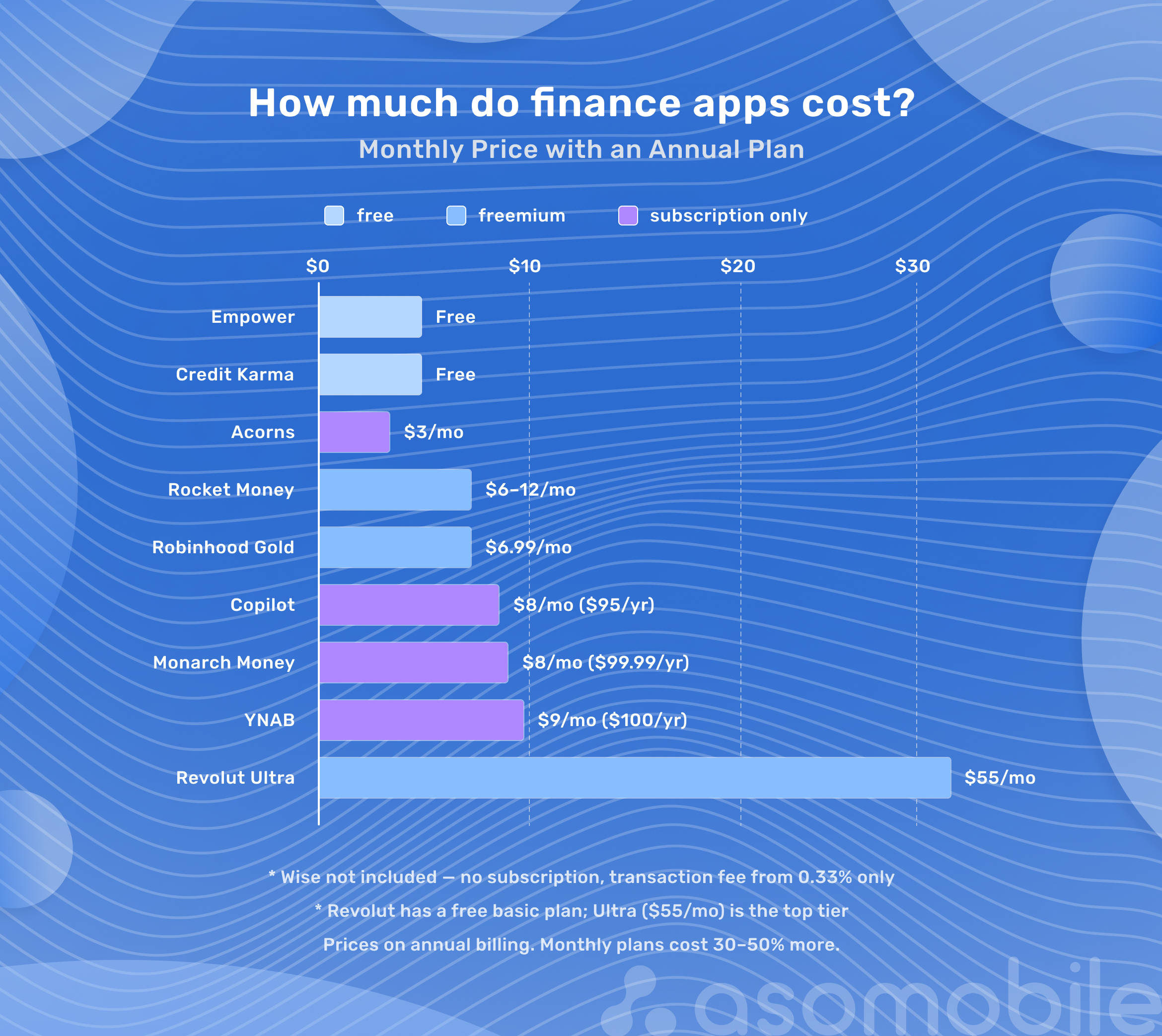
| App | iOS / Android | Best for | Key features | Pricing | Free version |
| YNAB | ✅ / ✅ | Zero-based budgeting | Assign every dollar, goals, reports | $14.99/mo, $109/yr | 34-day trial |
| Monarch Money | ✅ / ✅ | Shared finances, couples | Joint budget, net worth, investments | $14.99/mo, $99.99/yr | 7-day trial |
| Empower | ✅ / ✅ | Net worth and investment tracking | Account aggregation, portfolio, budget | Free | Yes, fully |
| Rocket Money | ✅ / ✅ | Canceling subscriptions, expense tracking | Subscription detection, auto-tracker | $6–12/mo (Premium) | Yes, limited |
| Copilot | ✅ / — | Best UX in budgeting | Auto-categorization, rules, AI insights | $13/mo, $95/yr | 1-month trial |
| Revolut | ✅ / ✅ | Multi-currency banking | Currency exchange, transfers, crypto, analytics | Free / Ultra $55/mo | Yes, basic plan |
| Wise | ✅ / ✅ | International transfers | Interbank rate, 40+ currencies, card | No subscription, transfer fee | Yes |
| Robinhood | ✅ / ✅ | Commission-free investing | Stocks, ETFs, crypto, Gold 4.25% APY | Free / Gold $6.99/mo | Yes |
| Acorns | ✅ / ✅ | Micro-investing, beginners | Round-up, auto contributions, IRA | $3/mo (Personal), $5/mo (Family) | 30-day trial |
| Credit Karma | ✅ / ✅ | Credit score monitoring | Equifax and TransUnion free, credit monitoring | Free | Yes, fully |
App reviews
YNAB
Best for: anyone who wants to fully control spending and actually live by a budget, not just observe it.
YNAB stands for You Need A Budget — an honest description of the philosophy. The app is built on zero-based budgeting: every dollar of income gets a job before it’s spent. YNAB users save an average of $600 in their first two months and $6,000 in their first year (ynab.com) — the company’s own data, confirmed by independent reviews.
Pros: the best budgeting methodology in the category; 34-day trial is enough for a real evaluation; strong community.
Cons: no free version after the trial; steeper learning curve than competitors; bank sync is occasionally unstable.
Platforms: iOS, Android, Web. Pricing: $14.99/mo or $109/yr.
Monarch Money
Best for: couples and families who want to manage money together.
Monarch Money is the successor to Mint, which shut down in 2024. Shared budget, shared net worth, shared goals — all in real time. Rating 4.9 in the App Store with 20,000+ reviews (App Store).
Pros: the best solution for shared finances; seamless migration from Mint; flexible customization.
Cons: more expensive than average; some features only available on web; sync with smaller banks occasionally unstable.
Platforms: iOS, Android, Web. Pricing: $14.99/mo or $99.99/yr. 7-day trial.
Empower
Best for: anyone who wants to see the complete picture of their finances for free.
Empower is an anomaly in the category: a full financial aggregator that’s completely free. Connect your banks, credit cards, investment accounts, mortgage — the app builds a unified dashboard with net worth, expense tracking, and portfolio analysis.
Pros: fully free with no hidden charges; Investment Checkup is a unique feature; clear net worth visualization.
Cons: budgeting is less detailed than YNAB or Monarch; US only.
Platforms: iOS, Android, Web. Pricing: free.
Rocket Money
Best for: anyone who wants to find and cancel forgotten subscriptions.
Rocket Money (formerly Truebill) finds all subscriptions quietly hitting your card every month. On average, users discover forgotten subscriptions worth $80–120/month. There’s also a bill negotiation feature — Rocket Money contacts your provider and tries to lower your bill, taking 60% of whatever you save.
Pros: the best tool against subscription overload; pay-what-you-want Premium model; bill negotiation is unique.
Cons: no full budgeting functionality; negotiation service takes 60% of savings.
Platforms: iOS, Android, Web. Pricing: free (basic), Premium $6–12/mo.
Copilot
Best for: iPhone users who prioritize the best UX in budgeting.
Copilot is iOS-only — a deliberate choice. AI auto-categorization learns from your habits and gets more accurate over time. Custom rules let you handle any transaction pattern.
Pros: the best UX among finance apps on iOS; AI categorization improves over time; one-month free trial.
Cons: iOS only, no Android or web; more expensive than competitors; US and Canada only.
Platforms: iOS. Pricing: $13/mo or $95/yr. 1-month trial.
Revolut
Best for: frequent travelers and anyone working with multiple currencies.
Revolut grew from a currency converter into a full digital bank: 70M+ customers as of January 2026. Currency exchange at the interbank rate with no markup, instant transfers, crypto, expense analytics, virtual cards — all in one app.
Pros: the best currency exchange rates among mobile banks; large feature set on the free plan; works in 160+ countries.
Cons: support is slow when account issues arise; unavailable in some countries due to sanctions.
Platforms: iOS, Android, Web. Pricing: Standard — free. Premium $10/mo, Metal $17/mo, Ultra $55/mo.
Wise
Best for: international transfers with the lowest possible fees.
Wise (formerly TransferWise) solves one problem: sending money abroad cheaper and faster than a bank. Interbank rate with no markup, transfers to 80+ countries. No subscription — just a transaction fee from 0.33%.
Pros: the most transparent fees in the category; no subscription; most transfers arrive within a few hours.
Cons: no cashback or rewards; not a replacement for a primary bank account.
Platforms: iOS, Android, Web. Pricing: no subscription, fee from 0.33% per transfer.
Robinhood
Best for: anyone who wants to start investing without commissions.
Robinhood democratized investing: zero commissions on stock and ETF trades, fractional shares from $1. IRA comes with 1% matching; the Gold account adds 4.25% APY on your balance.
Pros: zero commissions — the standard Robinhood set for the industry; IRA with 1% matching is rare; simple entry for beginners.
Cons: reputational damage from the 2021 events; analytics trail professional platforms.
Platforms: iOS, Android, Web. Pricing: free. Robinhood Gold — $6.99/mo.
Acorns
Best for: micro-investing and anyone who’s intimidated by getting started.
Acorns is built on the round-up mechanic: every purchase is rounded up to the nearest dollar, and the difference automatically goes into a diversified ETF portfolio. Personal plan is $3/mo — it includes a brokerage account, IRA, and educational content.
Pros: the best tool for passive micro-investing; removes the psychological barrier; brokerage, IRA, and education in one place.
Cons: $3/mo is expensive on a small portfolio — $3,000 in assets means 1.2% annually just in fees.
Platforms: iOS, Android. Pricing: Personal $3/mo, Family $5/mo. 30-day trial.
Credit Karma
Best for: free credit score monitoring.
Credit Karma shows your credit score from Equifax and TransUnion for free — no credit card, no subscription. Beyond the score, it shows factors affecting it, tracks changes, and alerts you to suspicious activity.
Pros: genuinely free credit score with no restrictions; monitors both major bureaus; clear explanations of what affects your score.
Cons: many financial product recommendations; shows VantageScore, not FICO; US and Canada only.
Platforms: iOS, Android, Web. Pricing: free.
How to choose a finance app for your goal
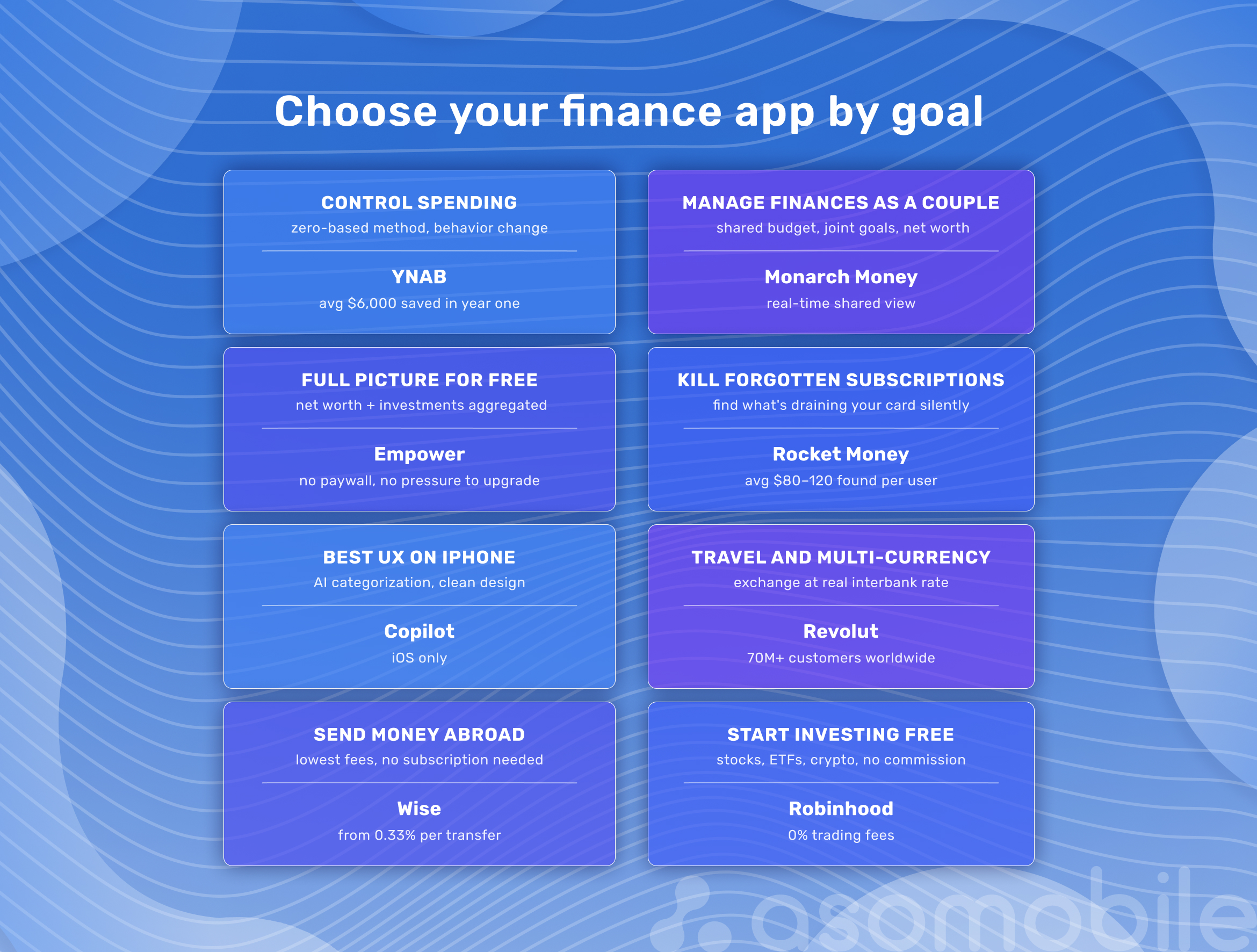
The right choice depends on your specific financial need, not on store rankings.
- I want to control spending and actually live by a budget → YNAB
- I manage finances with a partner → Monarch Money
- I want the full financial picture for free → Empower
- I suspect I’m paying for subscriptions I forgot about → Rocket Money
- I need the best budgeting UX on iPhone → Copilot
- I travel often or work with multiple currencies → Revolut
- I need to send money abroad cheaply → Wise
- I want to start investing without commissions → Robinhood
- Investing feels scary — I want to start automatically → Acorns
- I need to monitor my credit score → Credit Karma
ASO insight: how the listing game works in the Finance category
Finance is the category with the highest cost per install in the App Store. A few observations on listings.
Trust sells before features. The first screenshot in Finance isn’t about the interface — it’s about credibility: regulatory markers, specific social proof numbers, security labels.
Keyword strategy is built on clusters, not volume. Real opportunities are in functional queries (expense tracker for couples, auto savings app, round-up investing) and competitive ones (Mint alternative, YNAB alternative).
Ratings matter more here than in any other category. Dropping below 4.3 in Finance is a real conversion hit: users read reviews more carefully because it’s their money.
A detailed breakdown of ASO strategy for finance apps is in our post ASO for Finance Apps: How to Grow in a Competitive Niche in 2026.
Conclusion
Finance apps work only when the tool matches the job. YNAB won’t replace Wise, and Acorns won’t replace YNAB — that’s not a flaw, that’s specialization. People who genuinely change their financial behavior through their phones almost always use two or three apps together: one for budgeting, one for investing, one for monitoring.
For anyone building in this category: Finance is one of the hardest niches for organic growth in the stores, but with the right strategy, organic here delivers the best CAC-to-LTV ratio.
Your finances in order — start with analytics
FAQ: Frequently Asked Questions
Depends on the goal. For budgeting — YNAB or Monarch Money. For tracking net worth — Empower (free). For fighting subscription waste — Rocket Money. For international transfers — Wise. For investing — Robinhood or Acorns. For credit scores — Credit Karma.
If the goal is just to see spending, Empower or the basic Rocket Money are enough. If the goal is to change financial behavior, $109/year for YNAB pays off quickly: users save an average of $600 in the first two months.
Wise is a specialized transfer service: transparent fixed fee, no subscription. Revolut is a digital bank that also does transfers. Revolut works better as a primary account for frequent travelers; Wise is better for a one-off transfer.
All apps on this list use Plaid or equivalent certified services — without storing your banking passwords. Data is passed through an encrypted token.
Yes, and it’s common practice. A typical setup: Empower for net worth + YNAB for budgeting + Robinhood or Acorns for investing + Credit Karma for credit monitoring.