Every month, 130+ million people open a language learning app — and most of them quit within three weeks. Not because they lack motivation, but because they picked the wrong tool for what they actually needed.
Language learning apps differ fundamentally in their approach: some are built on gamification and habit-forming, others on immersion without translation, others on audio and conversational language from lesson one. Picking the best one without understanding your goal is like choosing a gym without knowing whether you want to lose weight or lift heavy.
This review covers 10 apps that genuinely work. Not a ranking by download count — a breakdown by method, honest pros and cons, and specific use cases. At the end, an ASO perspective on how this category looks from the store listing side. There's a lot going on there.
How we selected these apps
An app made the list if it's actively maintained (with updates in 2025–2026), available on iOS and Android, has a verified methodological foundation, and has a real user base. We deliberately covered different learning approaches to address different types of needs — from someone starting from zero to someone who needs to speak in a month. Prices and features were checked at the time of publication.
Comparison table
| App | iOS / Android | Best for | Key features | Pricing | Free version |
| Duolingo | ✅ / ✅ | Building a habit, beginners | Gamification, 40+ languages, AI features | Super $7–8/mo (annual), Max $14/mo | Yes, full |
| Babbel | ✅ / ✅ | Structured courses, grammar | Live dialogues, speech recognition, 14 languages | from $8/mo (annual), $107/yr | 7-day trial |
| Busuu | ✅ / ✅ | Native speaker feedback, certificates | Native corrections, McGraw-Hill certificates, 14 languages | Premium from $6/mo (annual) | Yes, limited |
| Pimsleur | ✅ / ✅ | Conversational language from scratch | 30-min audio lessons, 51 languages, spaced repetition | from $20/mo per language, $165/yr for all | 7-day trial |
| Rosetta Stone | ✅ / ✅ | Immersion without translation | Image/audio learning, TruAccent, 25 languages | from $11/mo (annual), $179/yr | 3-day trial |
| Memrise | ✅ / ✅ | Vocabulary, spaced repetition | Native speaker videos, MemBot, 20+ languages | Pro from $5/mo (annual) | Yes, limited |
| HelloTalk | ✅ / ✅ | Practice with native speakers | Language exchange, voice chats, corrections | VIP from $6.99/mo | Yes, full |
| Anki | ✅ / ✅ | Self-study, advanced learners | Flashcards, spaced repetition, 10,000+ decks | Free (Android), $24.99 one-time (iOS) | Yes |
| Speak | ✅ / ✅ | AI conversation practice | AI conversation partner, pronunciation analysis, role-play | from $9.99/mo | 7-day trial |
| Mondly | ✅ / ✅ | Wide language coverage, AR/VR | 41 languages, AR mode, chatbot, daily lessons | $9.99/mo, $47.99/yr | Yes, limited |
App reviews
Duolingo
Best for: people who need a habit, not a course.
Duolingo is the most downloaded language learning app in App Store history. Over 130 million monthly active users, 40+ languages, including Klingon and High Valyrian. The mechanic is simple: short lessons, streaks, leagues, XP. The system works exactly where most people struggle — getting yourself to open the app again tomorrow.
In 2025, Duolingo shifted to AI-generated content. Course output accelerated, but users started leaving reviews saying lessons feel less natural. Competitors with real native speakers in their material — Babbel, Pimsleur, Busuu — have started leaning into that difference. Still, for building a base and vocabulary, Duolingo remains one of the most effective tools in the category. The weak point: grammar is explained superficially, and at intermediate level learners often hit a ceiling.
A personal experience that illustrates this well. I studied Portuguese on Duolingo for about a year — streak intact, lessons progressing, visible improvement. Then I traveled to Portugal and understood maybe thirty percent. The issue was the dialect: Duolingo teaches Brazilian Portuguese by default, and European Portuguese sounds fundamentally different — different pace, different reduced vowels, different intonation. The app does not warn you about this. A good illustration of how an app can build a foundation without preparing you for real use of the language in a specific region. For that, I needed Pimsleur with European Portuguese or HelloTalk with native speakers from Lisbon.
Key features: gamified lessons, streak system, stories, listening exercises, AI features in Max (role-play, error explanations).
Pros: genuinely the best habit-forming mechanic in the category; massive language library; free tier is full-featured.
Cons: grammar is superficial; AI-generated content since 2025 raises quality questions; aggressive upsells in the free version.
Platforms: iOS, Android, Web.
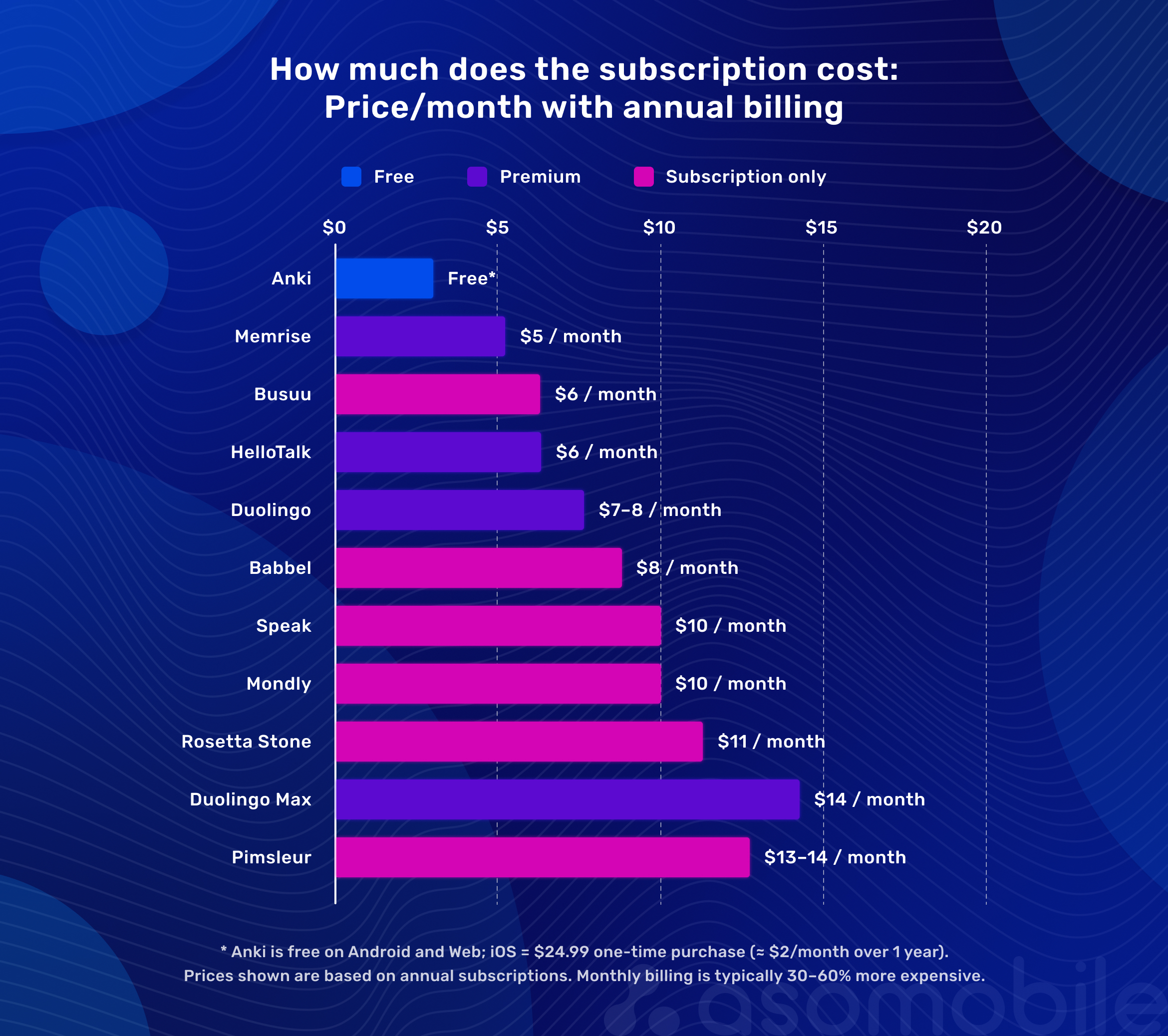
Pricing: free, Super ~$7–8/mo (annual), Max ~$14/mo.
Babbel
Best for: people who need structure and real grammar.
Babbel builds courses around real conversational situations: ordering coffee, negotiations, introductions. Lessons run 10–15 minutes and are recorded with native speakers — not synthetic voices. Grammar explanations are clear and actually present, which sets Babbel apart from Duolingo. 14 languages — fewer than competitors, but all major European ones plus Indonesian and Portuguese.
One real downside: pricing. Babbel pushes the annual subscription hard — the monthly plan ($17.95) is only available on the website, not in the app. The minimum in-app purchase is three months for $54. That is frustrating if you just want to try it.
Key features: dialogue lessons with native speakers, speech recognition, grammar explanations, live lessons (Babbel Live, at an additional cost).
Pros: best grammar foundation among mainstream apps; lessons feel like practice, not a test; strong onboarding.
Cons: expensive compared to competitors; 14 languages is not many; pronunciation module weaker than Pimsleur or Speak.
Platforms: iOS, Android, Web.
Pricing: from $8/mo (annual), $107/yr for all languages.
Busuu
Best for: people who want feedback from real humans.
Busuu's main differentiator is live native speaker correction. Write an exercise or record a voice note, and a real person who is learning your language reviews it in exchange. No AI can replicate that. A separate plus: certificates developed in partnership with McGraw-Hill Education — a rare thing among mobile apps.
The language selection is limited — just 14 — and the free tier is noticeably more restricted than Duolingo's.
Key features: native-speaker corrections, language exchange, McGraw-Hill certificates, adaptive lessons, and offline mode.
Pros: live feedback — a unique advantage in the category; certificates as a real deliverable; reasonable price.
Cons: 14 languages — fewer than most competitors; correction speed depends on community activity; free tier is sparse.
Platforms: iOS, Android, Web.
Pricing: Premium from $6/mo (annual), $83/yr.
Pimsleur
Best for: people who want to speak from lesson one.
Pimsleur is a method with a history of 50+ years. Built on audio learning and spaced repetition: 30-minute lessons with native speakers, no text, no flashcards. You hear a dialogue, repeat it, and the system brings the words back exactly when your brain is about to forget them. The result is pronunciation and conversational language — not reading ability.
51 languages — including Arabic, Swahili, Tagalog — the widest coverage for rare languages in the category. Price is high ($20/mo per language or $165/yr for all), but the method delivers where other apps stay surface-level.
Key features: 30-minute audio lessons, spaced repetition in audio, 51 languages, short in-app activities for quick practice.
Pros: best method for conversational language from zero; 51 languages including rare ones; audio format is ideal on the go.
Cons: the most expensive option in the category; no writing or reading; content runs out at advanced levels.
Platforms: iOS, Android, Web.
Pricing: $19.95/mo per language; $164.95/yr for all 51 languages.
Rosetta Stone
Best for: immersive learning without relying on your native language.
Rosetta Stone does not translate. New words are introduced through images and sound — the same way a child learns their first language. No explanations in English, no cheat sheets. TruAccent — their proprietary speech recognition system — provides real-time pronunciation feedback from the very first lesson.
The approach works well for people who want to think in the language rather than translate in their head. For complete beginners, it is slower — adults are used to explanations, and the first lessons without them can feel ineffective. 25 languages, mid-range pricing.
Key features: immersion method without translation, TruAccent speech recognition, live tutoring sessions, 25 languages.
Pros: genuinely teaches you to think in the language rather than translate; TruAccent is one of the better pronunciation modules in the category; lifetime license available.
Cons: slow start for absolute beginners — hard without explanations; pricier than Babbel and Busuu; interface feels dated.
Platforms: iOS, Android, Web.
Pricing: from $11/mo (annual), $179/yr, lifetime license available.
Memrise
Best for: vocabulary and long-term retention through spaced repetition.
Memrise is built on two pillars: native speaker videos (short clips of real people pronouncing words and phrases in context) and spaced repetition — a review system that surfaces a word exactly when it is about to leave your memory. MemBot, an AI conversation partner, rounds out the experience.
20+ languages at a below-average price ($5/mo on an annual plan). Works best as a complement to a main course — while Babbel or Pimsleur provides structure, Memrise builds vocabulary.
Key features: native speaker video clips, spaced repetition, MemBot (AI practice), 20+ languages, offline mode.
Pros: one of the best vocabulary retention systems in the category; native speaker videos give real pronunciation; accessible price.
Cons: light on grammar — more of a supplement than a full course; AI chatbot is text-only; free tier is limited.
Platforms: iOS, Android, Web.
Pricing: Pro from $5.17/mo (annual), $62/yr.
HelloTalk
Best for: live practice with native speakers through language exchange.
HelloTalk is not a course — it is a language exchange platform. You are learning Spanish; you find a Spanish speaker learning English. You message each other, correct each other's mistakes, send voice notes. No AI can replace live conversation, and HelloTalk is one of the few tools that make it available in a mobile format.
Built-in correction tools let you highlight a phrase, fix it, add a translation, or record the correct pronunciation. 260+ languages in the user base. The free version works well; the VIP version adds extra filters to find conversation partners.
Key features: language exchange with native speakers, voice and video calls, correction tools, 260+ languages, short-form community video feed.
Pros: live conversation — something no course-based app offers; free version genuinely works; massive user base.
Cons: no structured course— only practice; the quality of interaction depends on the partner; finding a good match takes time.
Platforms: iOS, Android.
Pricing: free, VIP from $6.99/mo.
Anki
Best for: self-directed learners who know what they are doing.
Anki is not a language learning app in the conventional sense. It is a flashcard tool with spaced repetition that has been around for 15+ years. No course, no hints, no gamification. What it does have: 10,000+ community-made decks and complete freedom to build your own.
Used by linguists, polyglots, and medical students — anyone who needs to retain a large volume of material long-term. For language learning: vocabulary, kanji, irregular verbs. Anki's spaced repetition algorithm is one of the best-calibrated on the market.
One pricing note: free on Android and Web, $24.99 one-time on iOS. The money goes toward development.
Key features: customizable flashcards, spaced repetition algorithm, 10,000+ ready-made decks, cross-device sync, media support in cards.
Pros: best spaced repetition algorithm in the category; full flexibility; huge library of ready-made decks; works offline.
Cons: no course — you need to know what to study; interface is outdated; iOS version costs money; steep learning curve for beginners.
Platforms: iOS, Android, Web, Desktop.
Pricing: free (Android/Web), $24.99 one-time (iOS).
Speak
Best for: conversation practice without the fear of making mistakes in front of people.
Speak is focused on one thing — giving you the chance to actually speak — and does it well. An AI conversation partner runs real dialogues, corrects pronunciation in real time, and offers role-play scenarios: job interviews, introductions, ordering at a restaurant. The fear of making mistakes in front of another person is the biggest barrier for most learners. Speak removes it.
Available for English, Korean, Japanese, Spanish, and a few others — fewer than Mondly or Pimsleur, but coverage is solid for the most in-demand languages. The 7-day trial lets you evaluate it before paying.
Key features: AI conversation practice, real-time pronunciation analysis, role-play scenarios, detailed error feedback.
Pros: best tool for conversation practice without a live partner; pronunciation analysis more accurate than most competitors; removes the psychological barrier.
Cons: limited number of languages; does not fully replace live conversation; hard to start without basic vocabulary.
Platforms: iOS, Android.
Pricing: from $9.99/mo, 7-day trial.
Mondly
Best for: wide language coverage and people interested in AR.
Mondly covers 41 languages in one app — Romanian, Swahili, Vietnamese, Hindi, Tagalog, and dozens more. Plus an AR mode: a virtual native speaker appears in your space, and lessons run through your camera.
In terms of depth, Mondly trails Babbel and Pimsleur, but as a starting point or for learning multiple languages in parallel, it is one of the best in terms of coverage. Annual subscription at $47.99 for 41 languages.
Key features: 41 languages, AR mode, daily lessons, chatbot, leaderboards, VR version.
Pros: widest language coverage in the category; AR is a genuinely unique feature; accessible price point; good for getting started or for light exposure to a new language.
Cons: course depth behind Babbel and Rosetta Stone; grammar is shallow; AR mode is more novelty than daily-use tool.
Platforms: iOS, Android, Web, VR.
Pricing: $9.99/mo, $47.99/yr.
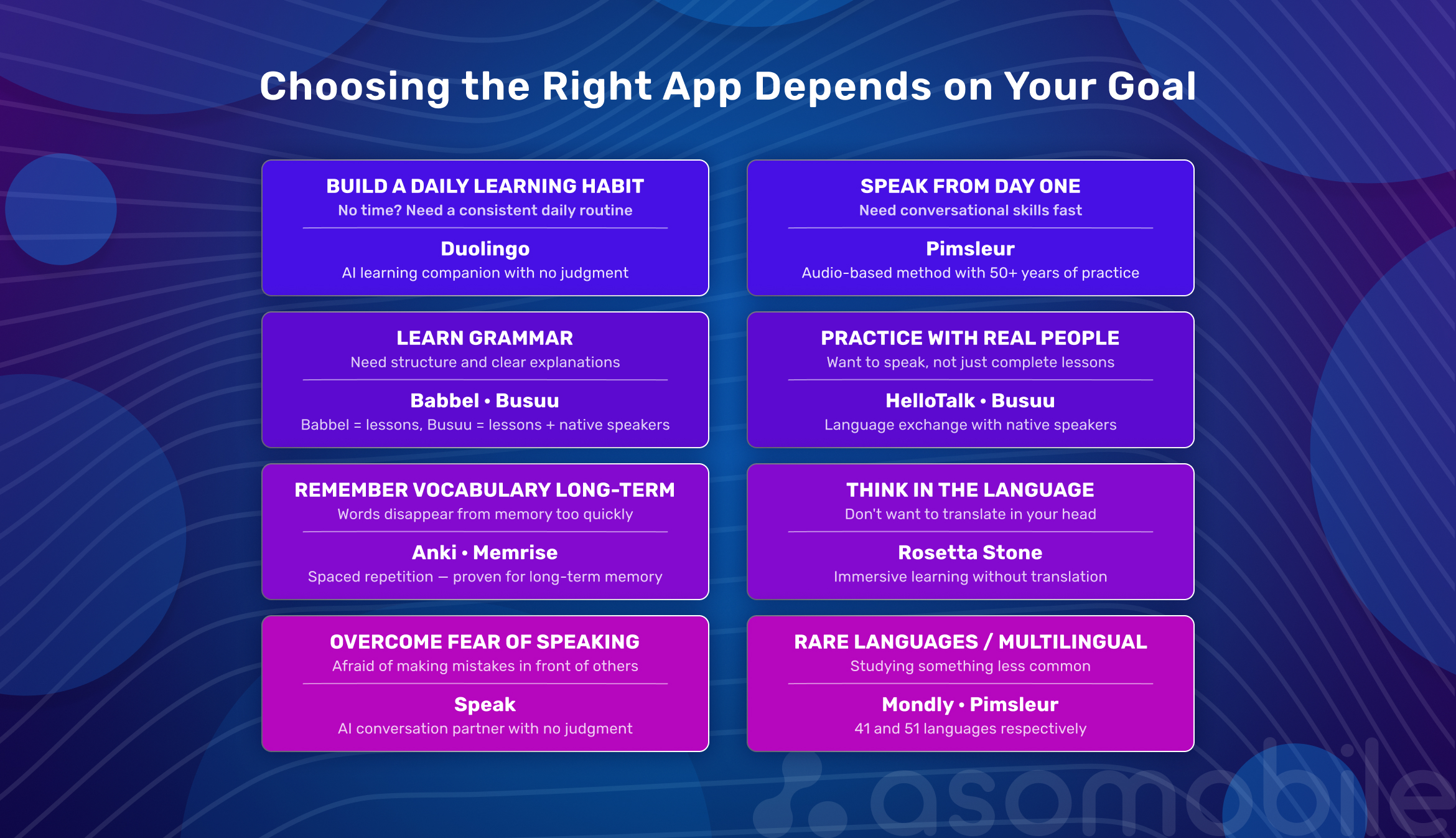
How to choose a language learning app: matching the tool to the goal
The choice depends on what you are trying to do, not on ratings. Each app solves a specific problem — the infographic below illustrates this.
ASO insight: how the listing game works in this category
Language learning is one of the most competitive categories on the App Store, in terms of ad spend and metadata density. A few observations on store listings — useful for developers and ASO specialists.
Duolingo as a category landmark. The green owl has become an icon not just for the app, but for the whole category. Every other player visually distances itself — Babbel goes orange, Busuu a different shade of green, Pimsleur dark navy. Once one player claims a visual position, competitors benefit from looking different, and that shows across every Duolingo rival.
The keyword battle comes down to three intents. Learn Spanish, speak Spanish, Spanish lessons — three different queries with three different audiences behind them. Look at how top apps position themselves: Babbel leads with structured courses, Duolingo with free access and habit-building, Pimsleur with conversational language. Each has locked into the segment where it converts best.
Duolingo's AI content shift as an opportunity. In 2025, the company moved to AI-generated lessons — faster output, but reviews started calling the content less natural. Competitors with real native speakers in their material (Babbel, Pimsleur, Busuu) have started highlighting that more actively in descriptions and screenshots. One player changes strategy — others get a differentiation angle.
Screenshots sell the method, not the interface. In the meditation category, screenshots sold a feeling. Here, they sell a result. Babbel shows 14 languages and 10 million subscribers. Duolingo shows a streak and progress. Rosetta Stone promises you will think in the language, not translate. Each sells its promise, not a feature list.
If you are working on an app in this category, ASOMobile is a convenient way to analyze keyword coverage among the top 20 competitors and spot uncovered niches — especially useful for examining traffic distribution across language-specific queries across different regions.
Conclusion
Duolingo builds habits, Babbel delivers grammar, Pimsleur teaches you to speak, HelloTalk throws you into live practice — each tool solves its own problem, and none of them solve all of them at once. People who actually learned a language on their phone almost never did it with a single app — they typically ran two or three in parallel: one for structure, one for vocabulary, one for practice.
For anyone building in this category: competition is real but not monopolistic. Duolingo owns the mass market but loses on depth. Specialized tools — pronunciation, rare languages, live exchange — hold their niches steadily. In a category with this much traffic, the difference between 3rd and 7th position on a key query is thousands of installs a month. The listing here is not finishing work — it is part of the product.
Your language at the top of the stores — start with analytics
FAQ: Frequently Asked Questions
To a conversational level — difficult but genuinely possible if you combine several tools. Pimsleur builds pronunciation; HelloTalk gives live practice with native speakers; Babbel or Busuu provide structure and grammar; Anki or Memrise handle vocabulary. Getting to B1 on Duolingo alone is a tough road.
Depends on the goal. For habit and motivation — Duolingo. For speaking quickly — Pimsleur. For grammar and structure — Babbel. Beginners often make the mistake of choosing the most popular app instead of the one that best fits their needs.
Free Duolingo is enough to get started and build a habit. If the goal is real progress rather than maintaining a streak, a paid subscription makes a meaningful difference — Babbel, Pimsleur, and Busuu offer noticeably deeper content. Use a trial before paying — most apps give 7 days.
10–15 minutes daily, consistently, beats an hour once a week. Most apps are designed around exactly this format. Pimsleur is the exception: their lessons are 30 minutes long, and they’re audio you can listen to on the go.
Mondly covers 41 languages, Pimsleur 51, including rare ones. For Japanese and Korean, a Duolingo-Anki combination with a community deck works well. For Arabic and Hindi, Pimsleur is currently the best mobile option — the audio method matters especially for pronunciation in those languages.