5.79 billion people use social apps — that's around 70% of the world's population. But a social app in 2026 means completely different things depending on who you ask: short video, text discussions, closed communities, professional networking, anonymous forums. Choosing the right platform for the right job is not a matter of personal preference — it's a question of where your audience actually lives.
This review is for developers and ASO specialists. We break down 10 platforms: who each one is built for, which formats work, and how that affects the listing and growth of mobile products in adjacent niches. Understanding where your audience lives is not a marketing question — it's a product question.
How we selected the platforms
A platform made the list if it has a verified active user base, recent updates in 2025–2026, and a clear positioning. We deliberately covered different formats: visual content, short video, text discussions, closed communities, professional networks, and decentralized alternatives. Statistics verified at publication using official platform data and analytics from Statista, DataReportal, and Sprout Social.
Comparison table
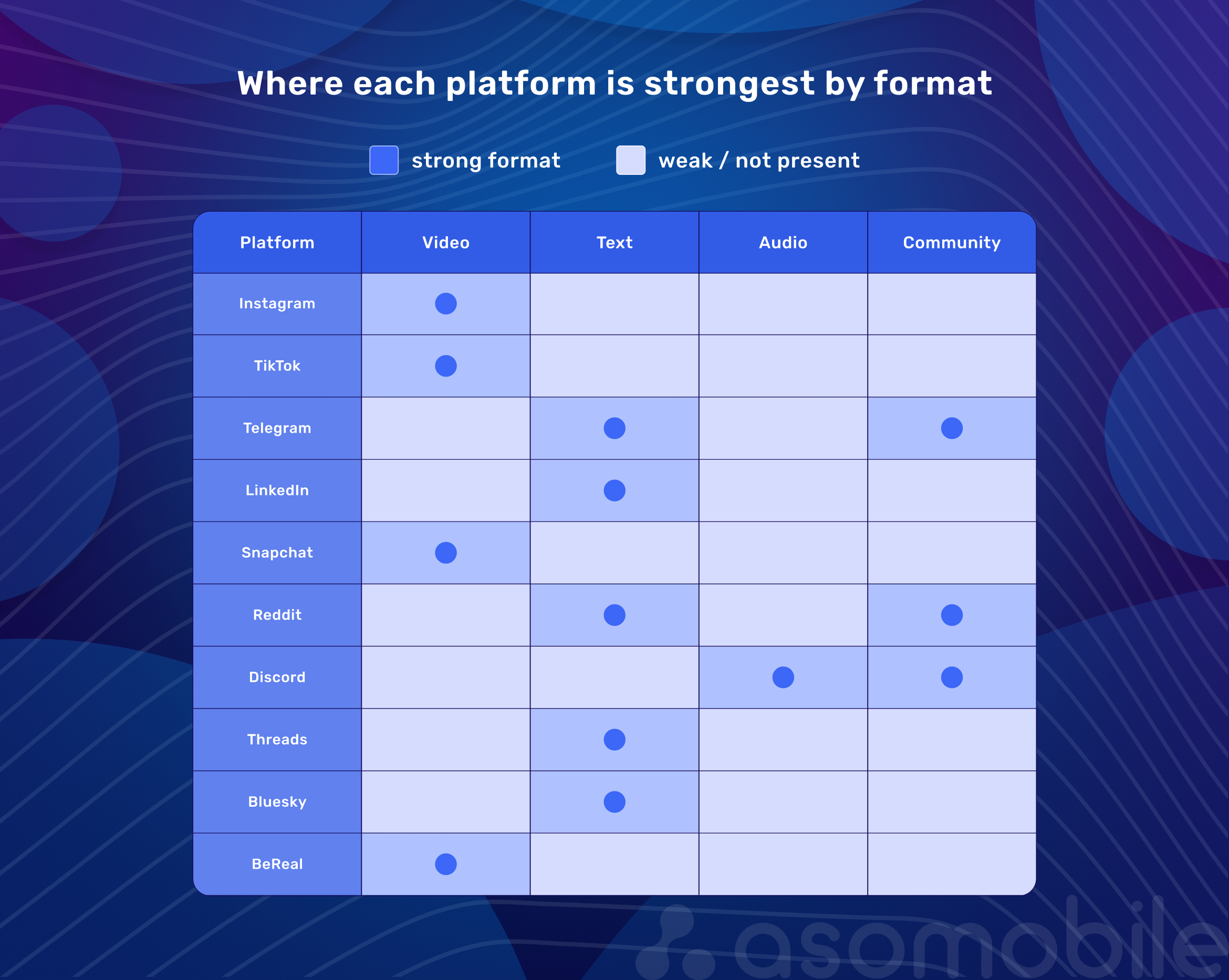
| App | iOS / Android | Best for | Key formats | MAU 2026 | Monetization |
| ✅ / ✅ | Visual content, brands, eCommerce | Reels, Stories, posts, Shop | 3B | Ads, Shopping | |
| TikTok | ✅ / ✅ | Short video, discovery, Gen Z | Short video, LIVE, TikTok Shop | 1.9B | Ads, Shop, gifts |
| Telegram | ✅ / ✅ | Channels, communities, private messaging | Channels, groups, bots, Stars | 1.05B | Stars, Premium, ads |
| ✅ / ✅ | Professional networking, B2B | Posts, articles, jobs, video | 1.15B | Premium, ads | |
| Snapchat | ✅ / ✅ | Gen Z, AR, personal messaging | Snaps, Stories, AR Lenses, Spotlight | 956M | Ads, AR |
| ✅ / ✅ | Niche discussions, communities | Subreddits, posts, AMA | 1.4B+ | Ads, Premium | |
| Discord | ✅ / ✅ | Closed communities, voice chat | Servers, voice channels, bots | 200–260M | Nitro, boosts |
| Threads | ✅ / ✅ | Text discussions, news | Posts, threads, replies | 141.5M DAU | None (yet) |
| BeReal | ✅ / ✅ | Authentic content, Gen Z | Dual photos, BTS, reactions | 40M | None |
| Bluesky | ✅ / ✅ | Decentralized networking, journalists | Posts, Skyfeeds, AT Protocol | 42M+ | None |
Platform reviews
Best for: brands, content creators, visual marketing, and eCommerce.
Instagram with 3B MAU is no longer just a photo network — it's a full commercial platform. Reels account for 50%+ of all time users spend in the app. Short video has displaced static posts, changing not just the content but the algorithm: Reels give new accounts higher organic reach than any other format.
eCommerce is a separate story. Instagram Shop, product tags in posts and Reels, direct purchases without leaving the app. 52% of Gen Z interactions on Instagram happen through short video, and 77% of that audience uses TikTok to search for products — which is pushing Instagram to develop its Shopping features aggressively.
The weak point: organic reach is declining. The algorithm favors paid content, and growing without an ad budget is harder than it was three years ago.
Key formats: Reels, Stories, static posts, carousels, Instagram Shop, live streams, Broadcast Channels.
Pros: the most mature eCommerce infrastructure among visual platforms; Reels give organic reach to new accounts; massive audience across all age groups.
Cons: organic reach drops without advertising; algorithm is opaque and changes frequently; growing competition from TikTok for video audiences.
Platforms: iOS, Android, Web.
For developers: Instagram Shopping API, Instagram Graph API, eCommerce integration, and conversion tracking capabilities.
TikTok
Best for: discovery, short video, and reaching younger audiences.
TikTok with 1.9B MAU (Q1 2026) is one of the fastest-growing major platforms: +19.5% year over year. The key differentiator from competitors is the For You algorithm: it promotes content based on engagement, not follower count. An account with zero followers can get a million views on its first video — that's not the exception, it's the norm.
77% of Gen Z use TikTok to search for products — this has turned the platform from entertainment into a product discovery channel that competes with Google. TikTok Shop expanded beyond the US and UK in 2025–2026, and for many categories (beauty, fashion, gadgets) it has become the primary content-driven sales channel.
A risk that cannot be ignored: regulatory pressure continues. In the US, the question of a TikTok ban remains open, which affects long-term platform planning.
Key formats: short video (15 sec–10 min), LIVE streams, TikTok Shop, Duet/Stitch, Series.
Pros: the best algorithm for organic reach among all platforms; TikTok Shop enables direct content-driven monetization; high time-in-app engagement — 52–58 minutes per day in the US.
Cons: regulatory risks in some countries; content ages quickly, the pipeline demands constant production; hard to build a long-term loyal audience — followers are less sticky than on Instagram.
Platforms: iOS, Android, Web.
For developers: TikTok for Developers API, TikTok Shop Open Platform, product catalog integration, and install tracking via TikTok Ads.
Telegram
Best for: channels, communities, and private messaging without algorithmic filtering.
Telegram with 1.05B MAU occupies a unique niche: it's a hybrid of messenger, media platform, and community tool. The key difference from Instagram and TikTok is that there is no algorithm in channels. Subscribe to a channel — you see every post, unfiltered. For publishers and creators, this means 100% subscriber reach, which has long been unachievable on any other major network.
Monetization via Stars is a relatively new system that lets creators receive donations and sell digital content directly through the app. Bots have opened a full ecosystem of mini-apps inside Telegram: from online stores to games and booking services.
Key formats: channels (broadcast), groups, private chats, bots, mini-apps, voice chats.
Pros: 100% subscriber reach without algorithmic filtering; strong privacy and encryption; bots and mini-apps create an ecosystem within the platform.
Cons: moderation is weak — the platform regularly makes headlines for controversy; Stars monetization still trails Instagram and TikTok; harder to attract new audiences without external traffic.
Platforms: iOS, Android, Web, Desktop.
For developers: Telegram Bot API, mini-apps on the Web App platform, Telegram Stars as a built-in payment system.
Best for: professional networking, B2B marketing, and hiring.
LinkedIn with 1.15B MAU has taken the top spot among professional networks, surpassing Telegram in size. Growth is coming from India, Southeast Asia, and Latin America — the platform is rapidly becoming less exclusively Western. Content format has shifted toward video and personal stories: posts with vulnerability and personal experience earn better reach than corporate press releases.
For B2B, LinkedIn remains unmatched: targeting by job title, industry, and company is more precise than any other platform. LinkedIn Ads cost more than Facebook, but conversion rates in the B2B segment are generally higher.
Key formats: posts, articles, video, carousels, job listings, Company Pages, LinkedIn Live.
Pros: the only platform with precise B2B targeting; organic reach for expert content is still meaningful; growing audience in emerging markets.
Cons: expensive advertising; organic reach drops without a personal brand; the platform feels formal — hard to build informal community.
Platforms: iOS, Android, Web.
For developers: LinkedIn Marketing API, Sign in with LinkedIn integration, B2B conversion tracking capabilities.
Snapchat
Best for: Gen Z, AR formats, and personal messaging with ephemeral content.
Snapchat with 956M MAU (Snap Q1 2026) remains the dominant platform for young audiences in Western markets: 65% of Americans aged 18–29 use Snapchat. The ephemeral mechanic — content disappears after 24 hours — makes communication more personal and less performative, attracting users who are tired of Instagram's polished aesthetic.
AR is a separate strength: AR Lenses are played more than 9 billion times per day — one of the most scaled AR formats among mobile platforms. Snap Lens Studio gives brands access to custom filters — a unique ad format with no real equivalent among competitors at this scale.
Key formats: Snaps (photo/video), Stories, Spotlight (short video), AR Lenses, Snap Map, My AI.
Pros: dominant platform for Gen Z in the US, UK, and Western Europe; AR tools for brands with no equivalent at scale; ephemeral mechanic reduces user anxiety.
Cons: limited effectiveness beyond young audiences; Spotlight algorithm is less efficient for organic growth than TikTok; monetization options for creators are limited.
Platforms: iOS, Android.
For developers: Snap Kit SDK for auth and AR integration, Lens Studio for branded filters, Snap Audience Network for traffic monetization.
Best for: niche discussions, topic-specific communities, and authentic feedback.
Reddit with 1.4B+ MAU is the internet within the internet: 100,000+ active subreddits on any topic imaginable. Reddit's core value is authenticity. Users trust content on Reddit more than branded content on other networks: the voting system surfaces genuinely useful content rather than paid placement.
For developers, Reddit is a challenging but important platform. Advertising performs worse than on Facebook or Instagram because the audience reacts negatively to anything that looks like a sales pitch. Organic presence through useful answers and community participation works well — and drives high-quality site traffic.
Key formats: posts (text, links, images, video), comments, AMA (Ask Me Anything), subreddits, Awards.
Pros: the most authentic audience among major platforms; strong SEO presence (Reddit posts frequently rank at the top of Google); niche communities with high engagement.
Cons: audience aggressively rejects commercial content; hard to scale presence; interface and UX trail competitors.
Platforms: iOS, Android, Web.
For developers: Reddit API for monitoring mentions and reviews, Reddit Ads API for targeted campaigns in niche communities.
Discord
Best for: closed communities, voice communication, and niche groups.
Discord with 200–260M MAU started in gaming and became the infrastructure for any type of community. 54% of users are now in non-gaming communities: education, crypto, development. There's no algorithmic feed, no recommendation engine — only servers you've chosen to join.
The key differentiator from all other platforms: Discord is about voice. Voice channels work like permanently open rooms — you drop in and out whenever you want. This creates a sense of physical presence that no text messenger can replicate.
Key formats: text channels, voice channels, video calls, bots, forums, Stage Channels.
Pros: the best tool for building closed communities; voice channels create a unique sense of presence; flexible role and permissions system.
Cons: steep learning curve for newcomers — higher entry barrier than other platforms; weak for reaching new audiences or public content; Nitro monetization is limited.
Platforms: iOS, Android, Web, Desktop.
For developers: Discord Developer Portal, bots via Discord API, OAuth2 for user authentication through Discord accounts.
Threads
Best for: text discussions, news, and anyone looking for an alternative to X.
Threads launched in July 2023 and became a real player within 18 months: in January 2026 it reached 141.5M DAU, officially surpassing X (125M DAU). Growth rate is second only to TikTok among major platforms: +9.4% year over year.
The main advantage is Instagram integration. Account, followers, and verification transfer automatically. For brands and creators already on Instagram, the barrier to entry is zero. The algorithm is currently more forgiving than X — organic reach is higher, toxicity is lower. No advertising yet — but Meta is clearly preparing the platform for monetization.
Key formats: text posts (500 characters), photos, video up to 5 minutes, quote posts, polls.
Pros: fast start through Instagram import; high organic reach while there's no advertising; less toxic environment than X.
Cons: no creator monetization; functionality still behind X; no chronological feed by default.
Platforms: iOS, Android, Web.
For developers: Threads API (limited access via Meta), cross-posting options with Instagram through Meta Business Suite.
BeReal
Best for: authentic content and audiences tired of performative social media.
BeReal is the most unusual platform on this list. 40M MAU, 78% of whom are Gen Z. The mechanic is simple: the app sends a random notification once a day, and you have 2 minutes to take a photo with both front and rear cameras simultaneously. No filters, no preparation, no editing. That's exactly what differentiates it from Instagram.
After explosive growth in 2022–2023, the platform went through a cooling period and found its stable niche: not a mass network, but a space for close connections. In 2025, BeReal added RealPeople — a feed from celebrities and brands — attempting to expand beyond personal use.
Key formats: dual photos (BeReal), BTS (behind the scenes), reactions, RealPeople (public accounts).
Pros: unique authenticity mechanic with no real equivalent; high loyalty among the active audience; lower anxiety level compared to Instagram.
Cons: too small an audience for commercial presence; monetization is undeveloped; random notification timing is inconvenient for some users.
Platforms: iOS, Android.
For developers: API is not publicly open; the platform is interesting as a reference for authentic content mechanics in your own products.
Bluesky
Best for: journalists, technical specialists, and anyone who values decentralization.
Bluesky is a decentralized social network on the AT Protocol. 42M+ registered users as of April 2026, with 60% growth through 2025 (SocialPilot, 2026). The main narrative: an alternative to X without algorithmic manipulation and without single-owner control. 43% of news influencers already have Bluesky accounts according to Pew Research (SocialPilot, 2026).
The unique feature is custom Skyfeeds: users can build their own algorithmic feeds using open-source code. This fundamentally separates Bluesky from every other platform — the algorithm is transparent and configurable.
For now it's a niche platform for technically literate, media-savvy, and politically engaged audiences. No ads, no creator monetization. But the growth rate and the draw for journalistic communities make it an interesting asset over the medium term.
Key formats: posts (300 characters), custom Skyfeeds, lists, AT Protocol (open standard).
Pros: open and transparent algorithm; no advertising; active audience of journalists and developers; decentralized model reduces dependence on a single company.
Cons: small audience relative to X and Threads; no monetization; functionality still behind mature platforms.
Platforms: iOS, Android, Web.
For developers: AT Protocol is an open standard on which you can build your own clients and services. Bluesky API is publicly available.
How to choose a platform for your product
Platform selection depends on where your target audience lives and what type of interaction you need.
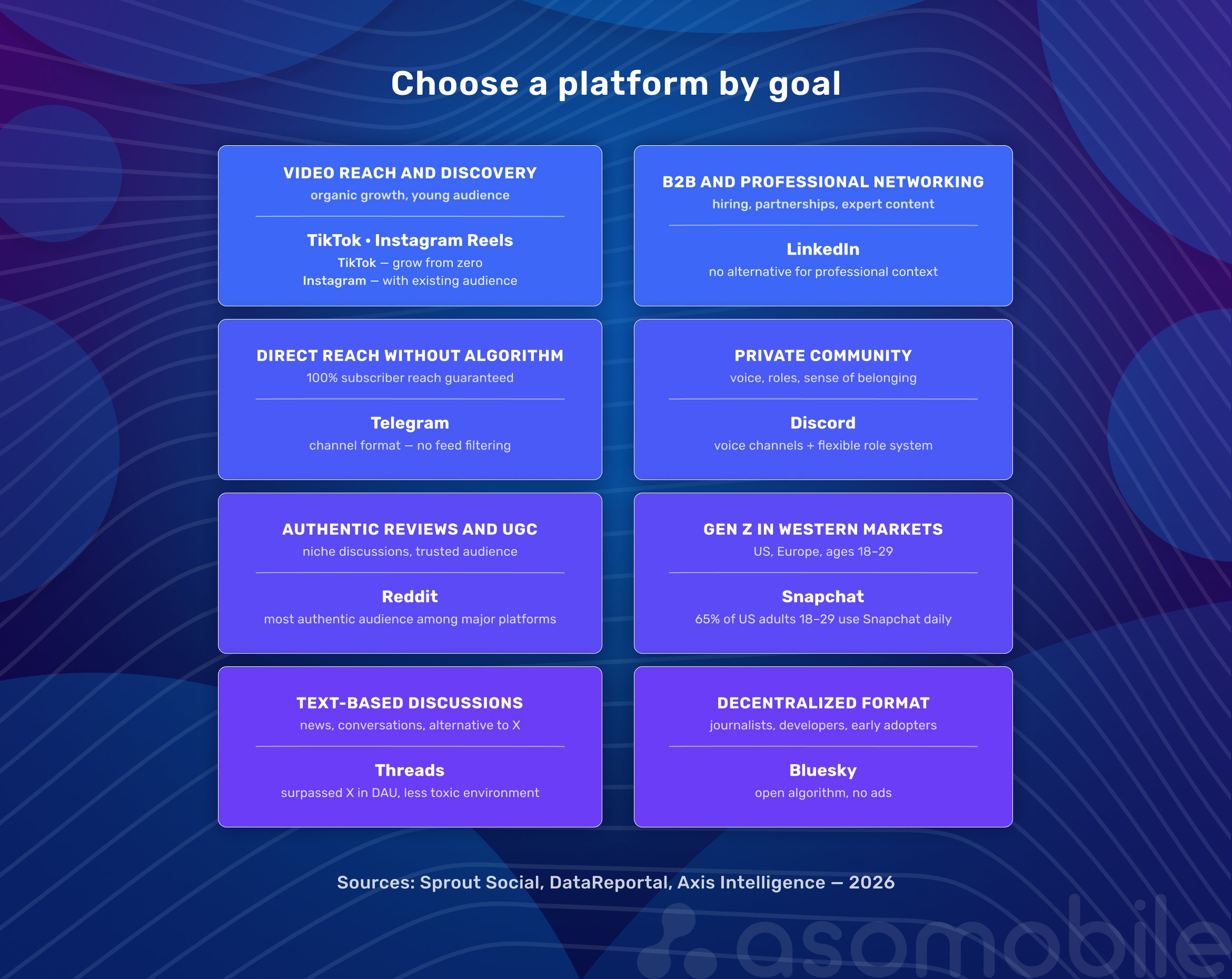
- Your audience is young users, you need organic reach → TikTok or Instagram Reels. TikTok delivers the highest organic reach for new accounts; Instagram provides the commercial infrastructure for conversion.
- Your product targets B2B or a professional audience → LinkedIn. The only platform with precise targeting by job title and industry.
- You need a direct communication channel with users without algorithmic filtering → Telegram. 100% subscriber reach is a unique property of the channel format — unavailable on any other major platform.
- You need a community around your product → Discord. Voice channels, the role system, and bots create infrastructure for an engaged user community.
- You want to monitor feedback and reviews about your product → Reddit. Users openly discuss apps in niche subreddits — a valuable source of insight.
- Your product targets Gen Z in the US or Western Europe → Snapchat. Reaches 65% of Americans aged 18–29 — an audience that's hard to capture through other channels.
- You need a platform for public announcements and discussions → Threads. Surpassed X in DAU, organic reach is higher, and the environment is less toxic for brand content.
- Your audience is technical specialists and early adopters → Bluesky — small but concentrated audience of developers, journalists, and media.
ASO insight: how the listing game works in the Social category
Social is one of the most competitive categories in the App Store by search query volume, with a paradoxical traffic distribution: the top 5 platforms capture almost all of it, and everything else fights for the remainder. A few observations for developers and ASO specialists.
The icon sells identity, not function. In most categories, the icon communicates what the app does. In Social, it communicates who it belongs to. Instagram (gradient), TikTok (music note on black), Discord (white mask on purple), Bluesky (butterfly) — each icon is instantly read as belonging to a specific subculture. A new player in the category can't just design a beautiful icon — they first need to define what identity they're selling.
Keyword strategy is built around replacement. Many users search for an alternative to an existing platform: "Twitter alternative," "Instagram without ads," "private social network." Bluesky, BeReal, and Threads build their listings around exactly these queries. This principle works for any niche social network — positioning through contrast with the market leader is often more effective than an abstract description of features.
Screenshots show content, not interface. In the Social category, users want to understand not how the app works, but who is there and what's happening. The best listings in the category show real posts, real discussions, real people — not empty screens with functional elements.
Ratings and reviews are the sharpest tool. No other category generates as many user reviews as Social. Moderation policy changes, algorithm updates, new features — all of these show up in ratings immediately. A 0.2-star drop in a week after an update is normal for major platforms. Managing reviews here is critical.
If you're building a social app or an adjacent product, ASOMobile is a convenient way to analyze the keyword strategies of top platforms across different regions — you can see how metadata changes in response to news context and algorithm updates.
Conclusion
Social apps in 2026 are not competing clones of one format — they're an ecosystem of specialized tools. TikTok won discovery, Instagram won commerce, Telegram won reach without an algorithm, Discord won community, Reddit won authenticity. Trying to be everywhere is a strategy that works for neither brands nor creators.
For anyone building a product in this category or adjacent ones: social platforms create the greatest ASO challenge precisely because competition isn't for the best app — it's for the best identity and the best audience. A listing here is a statement of who you are, not just a description of what you do.
Your app at the top of the stores — start with analytics 💙
FAQ: Frequently Asked Questions
By MAU, Facebook leads at 3.07B, but by growth rate and engagement among young audiences — TikTok (+19.5% year over year). By time in app, TikTok is also first: 52–58 minutes per day in the US versus 33 minutes for Instagram.
Depends on the audience and goal. Threads — yes, if you already have an Instagram presence: zero entry barrier and strong organic reach while there’s no advertising. Bluesky — if your audience consists of journalists, developers, or technically literate early adopters. BeReal — only if you work with Gen Z and are ready for a format where you can’t control the posting time.
No single answer. B2B — LinkedIn without question. eCommerce in mass market — TikTok Shop and Instagram Shopping. Community around a product — Discord. Working with niche audiences and UGC — Reddit. Direct access to subscribers — Telegram.
Through the For You algorithm, which keeps users in an endless stream of personalized content without the need to search for anything. Instagram was originally built on follows and the social graph; TikTok was built on interests and engagement. These are fundamentally different retention architectures.
By DAU — yes. In January 2026, Threads reached 141.5M daily active users versus 125M for X. By depth of engagement and volume of public content, X still has an edge: more breaking news, political discussions, and journalistic content. But the trend toward Threads is clear.