Targeting the Social category through broad keywords means competing with Instagram, TikTok, and Discord on their home turf. That's not a strategy. But demand in this category is structured so that right alongside the giants sits an entire layer of unclaimed keywords — specific, functional, niche. That's where organic growth happens when you have no brand recognition and no years of ranking history in the store.
Starting Point: Low Visibility in a Competitive Social Category
When a new app enters the Social category, it faces a landscape where broad keywords — social network, messaging app, chat app — are already owned by products with hundreds of millions of installs. The algorithm knows those products well and surfaces them first — not because they're better optimized, but because accumulated behavioral signals long ago locked them into stable rankings.
The app in this case study is a niche social platform with interest-based rooms, voice communication, anonymous discussions, and a people-discovery mechanic built around hobbies. Monetization is freemium, with paid access to advanced features. At launch, the product had no brand, no install history, and no ranking history in the store. Positioning was vague — the product page didn't explain what set the app apart from Reddit or Discord, and the metadata didn't reflect a single real differentiator.
ASO Audit and Competitor Analysis
Before touching metadata or visuals, we needed to understand where we were starting from. The audit covered three areas: keyword coverage, search visibility, and the product page.
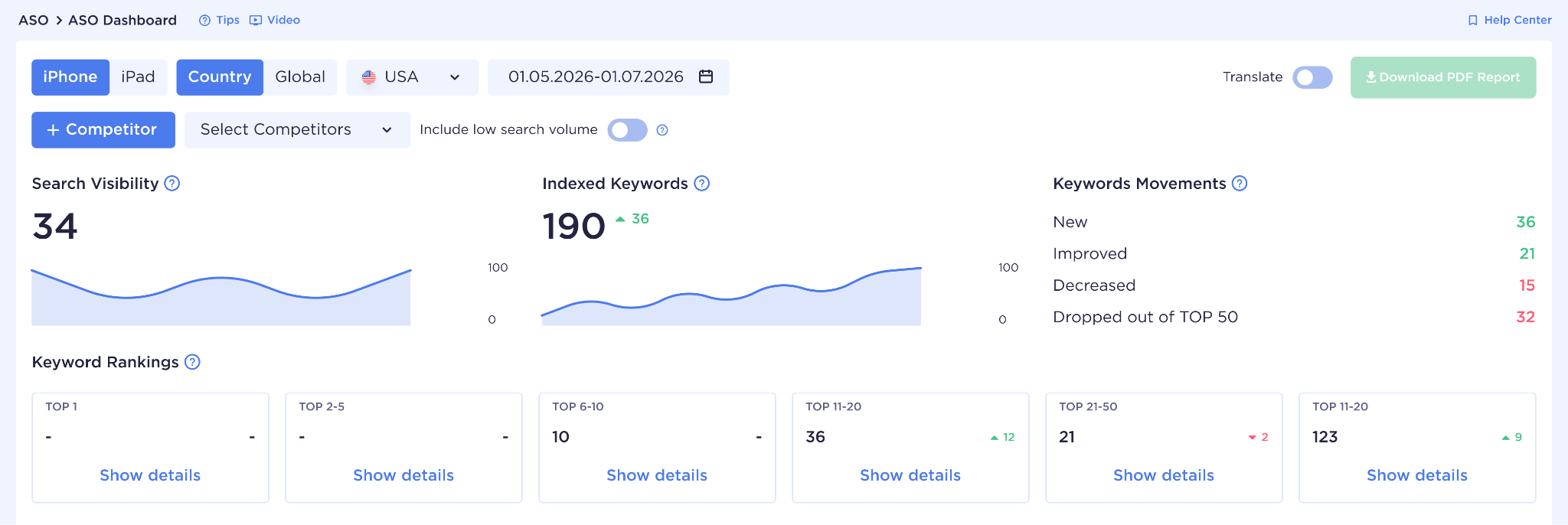
The keyword picture was predictable for a new product: a small number of indexed relevant keywords, most of them coincidental rather than intentional. A low Visibility Score confirmed it — the app simply wasn't appearing for the searches that could bring it an audience.
The product page was a separate conversion risk. The first screenshot showed the UI, not a use case. The description read like a technical spec. The icon was an abstract design that didn't read as a social platform or as any specific function. Even if rankings had started to climb, this page would have burned the traffic.
Competitor analysis was done at the sub-niche level, not the whole category — apps with a similar use-case pattern. In the niche Social segment, that means Discord with voice rooms, Reddit with topic-based communities, Amino with interest communities, and Yik Yak with anonymous discussions.
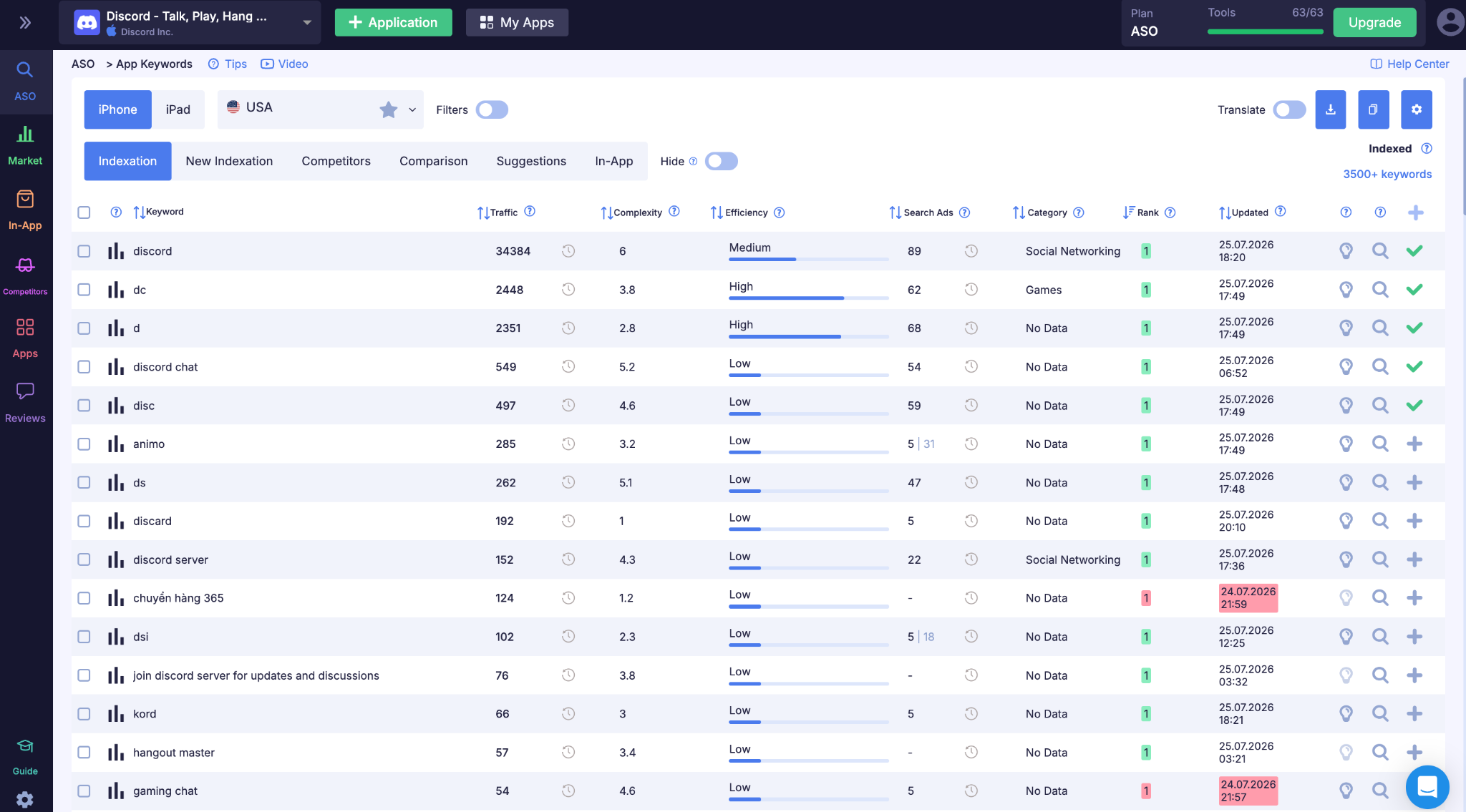
Discord has 3,500+ indexed keywords, most of them branded traffic and general voice communication queries. But within those thousands of keywords are rankings the algorithm gave Discord purely on category authority — not through intentional optimization for any specific keyword. Niche interest queries, voice-plus-specific-audience combinations — those are the entry points for a new app.
Reddit shows the same pattern for topic-based communities. They appear for queries like "book lovers community app" or "gaming fan community" not because they optimized for those keywords, but because the algorithm extends their authority to adjacent queries. Ranking alongside Reddit in a niche is achievable when your metadata is dialed in for that keyword, and the major player has no deliberate defense of it.
The audit produced a clear priority order: semantic core first, then metadata, then visuals, then monitoring and the next iteration.
Clustering Keywords by Search Intent for Social Apps
Keywords were collected around search intents, not product features. The difference matters: intent is what the user wants to get, not what the app can do. In the Social category, intents fall into several stable clusters.
The community cluster covers users looking for a community around an interest, not just an app. Queries like community app for book lovers, online community for gamers, hobbyist community have significantly lower competitive density than broad queries, because a specific topic narrows results to more relevant apps.
The chat cluster — messaging and communication: anonymous chat, group chat app, chat with strangers, interest-based chat. The key distinction here is between broad queries where the top is occupied by messengers with massive audiences, and niche queries where the chat function combines with a specific context.
The friends cluster — finding and expanding social connections: make friends online, meet new friends app, friend finder app, social app to meet people. The intent is more social than functional, and competition here is mixed — social networks and dating apps both compete in this space.
The networking cluster — professional and social networking: social networking app, professional social network, networking app for creatives. Queries with a professional context are often less competitive than generic social networking queries.
The events cluster — events and offline meetups: social events app, local events app, find events near me. This intent works well with geo-targeting and is relevant for apps with a local mechanic.
The dating/meet people cluster — meeting people nearby: meet people app, social dating app, find people nearby, meet locals. The line between social and dating blurs here, creating opportunities for apps that serve both use cases.
The creator/community cluster — platforms for content creators and their audiences: creator community app, content creator social, community for creators, fan community app. A fast-growing intent driven by the creator economy.
The privacy/safety cluster — private and anonymous communication: anonymous social app, private chat app, secure social network, end-to-end encrypted messaging. A specific and loyal intent — users searching for anonymity know exactly what they need.
The local social discovery cluster — finding people nearby: local social app, meet people near me, social app for locals, neighborhood app. A geo-specific intent with low competition in niche combinations.
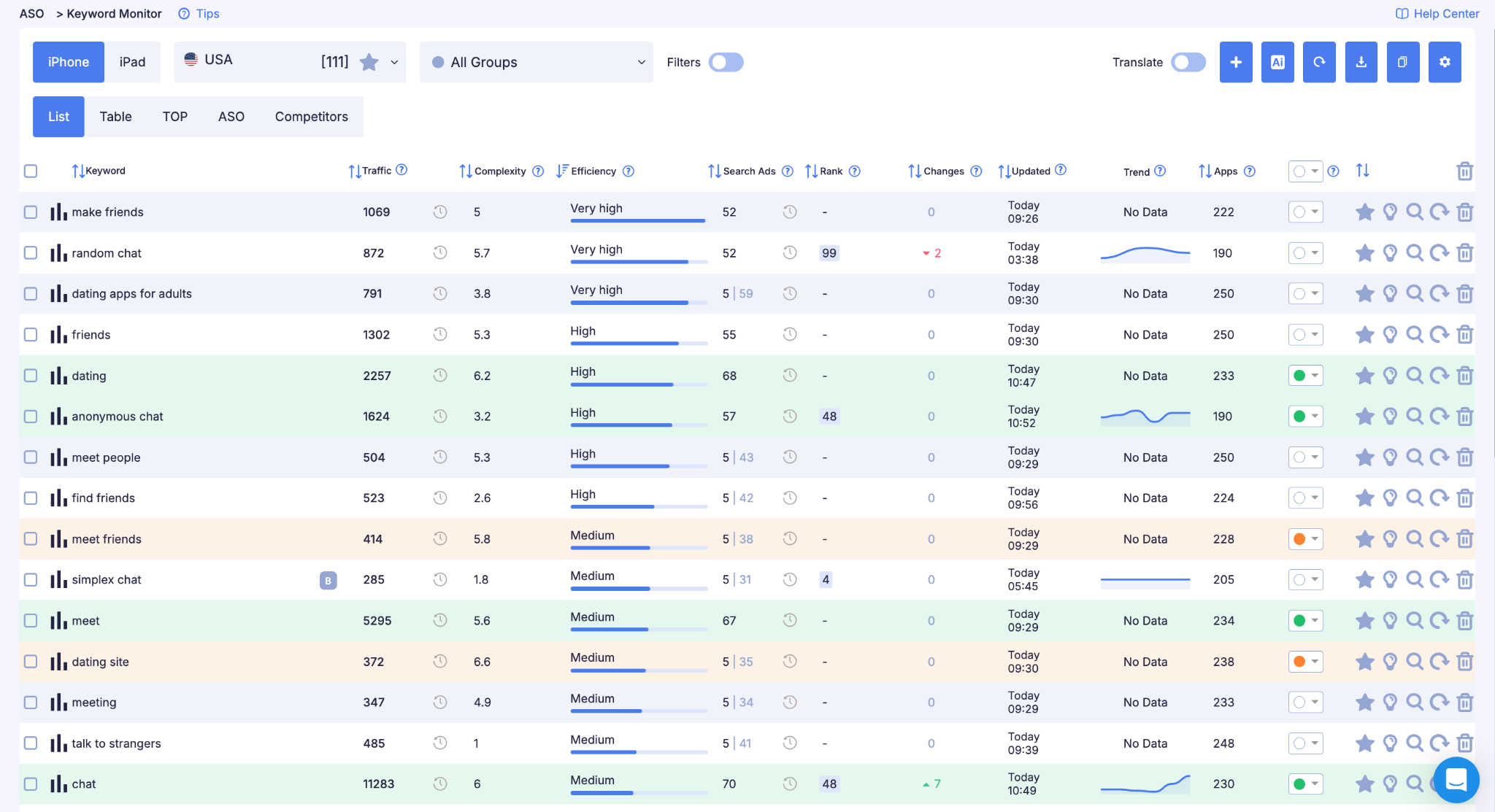
For this app, four clusters were most relevant: community, chat, privacy/safety, and creator/community — directly mapped to the product's functionality. The friends and dating/meet people clusters were partially included via queries with specific context and no direct competition with the dating segment. After filtering and clustering, the final semantic core came to 111 keywords organized into 6 working groups.
Updating Metadata: Title, Subtitle, Keyword Field, Description
With the semantic core ready, we moved to metadata. Using ASO Creator with AI generation: input the app's characteristics, functional differentiators, and target audience — and get a first draft of the title, subtitle, and description with semantic core keywords already embedded.
The first version uses 101 of 111 keywords, covering traffic of 37,848 out of a possible 51,372. Both figures are starting points, not final results.
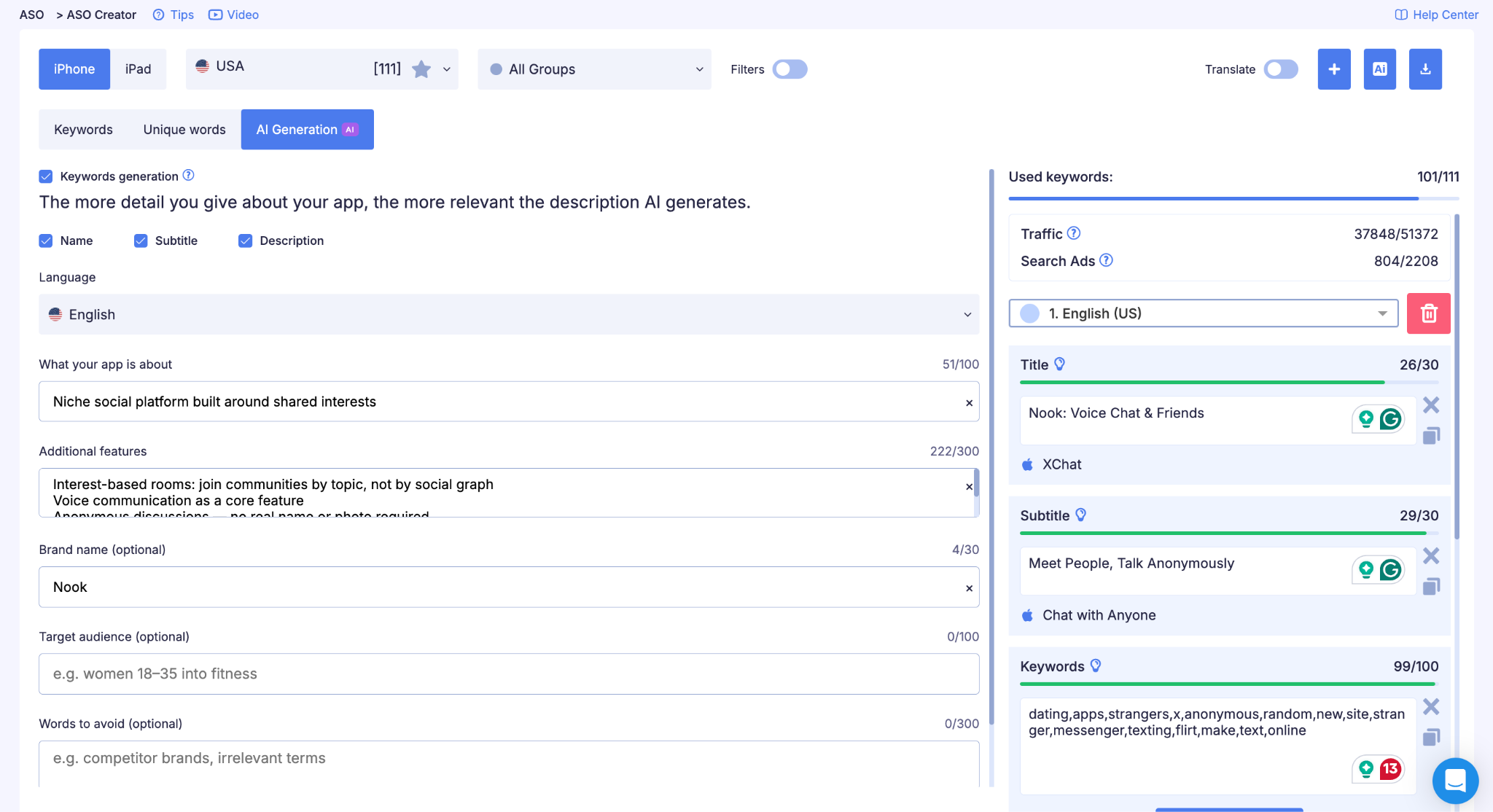
The title covers privacy/safety cluster queries and the core niche keyword. The subtitle takes the community cluster and part of the long tail from creator/community. None of the 29 subtitle characters are filler — each one earns its place through indexation. The description follows the logic of search intent: the opening lines drive conversion (that's what users see on the product page), and the rest handles indexation in Google Play, where the full description is indexed.
Additional locales — Spanish and Portuguese — were used not for full localization, but to extend keyword coverage: the portion of the semantic core that didn't fit the primary metadata was deployed through locale fields. This is the standard way to increase indexed keyword count without building a separate ASO strategy for each market.
Visuals and Conversion
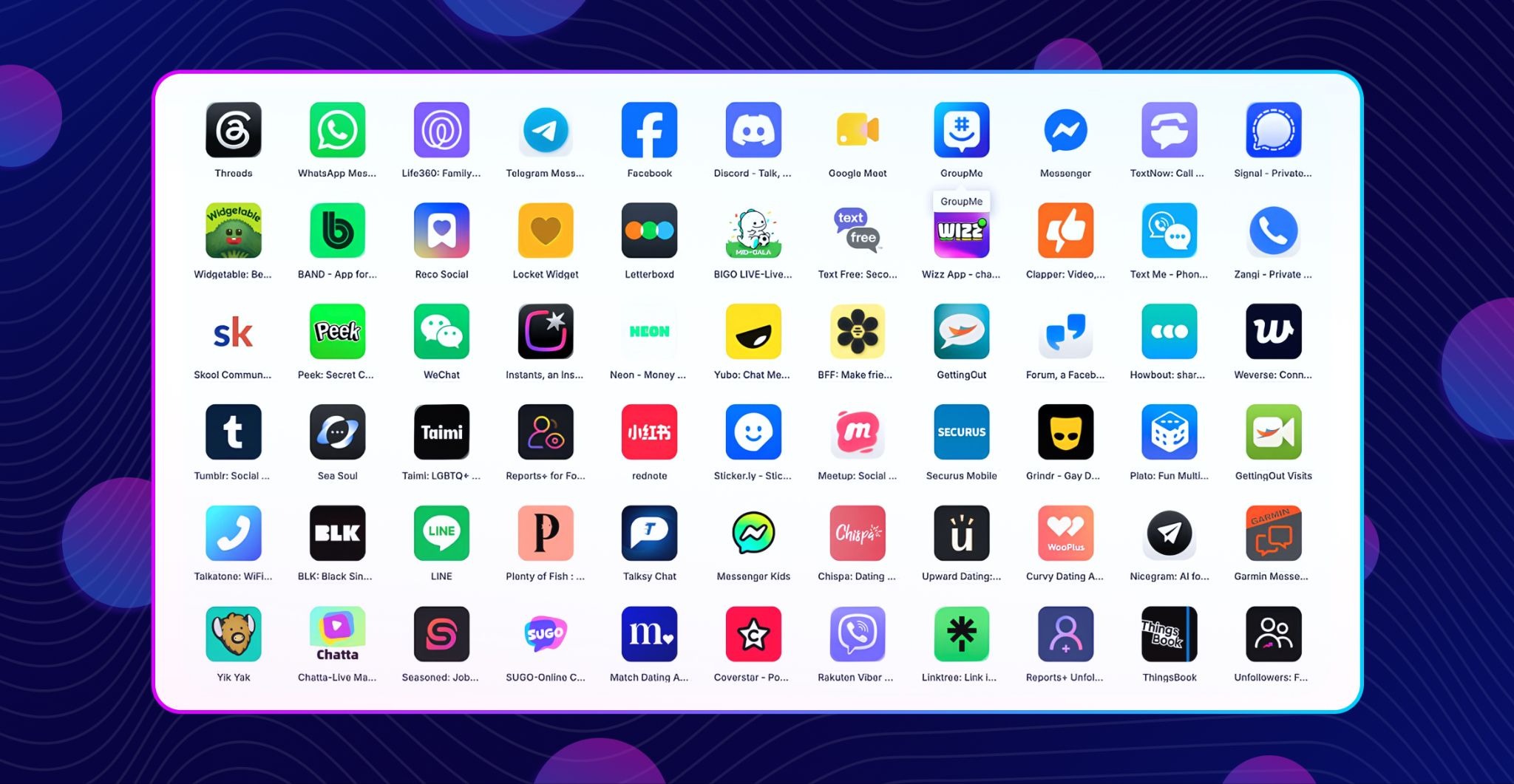
Visual competitor analysis isn't about inspiration — it's about understanding which colors are already claimed in users' perception. In the niche Social segment, the picture was clear: purple belongs to Discord, orange and red to Reddit, yellow to Bumble BFF. Showing up in any of those colors means building their brand recognition, not yours.
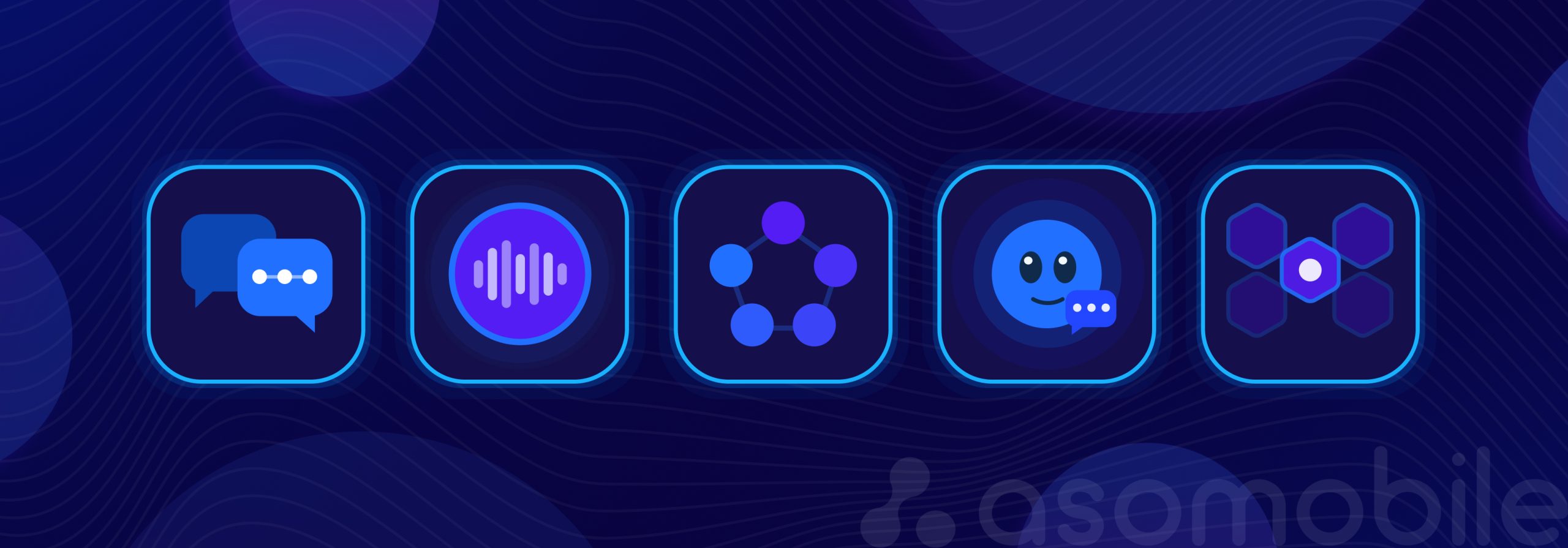
The choice landed on dark navy with teal accents: navy reads as tech and trust, teal signals active human connection. No direct competitor in the niche owns this combination.
Among all icon concepts, the strongest was overlapping speech bubbles with an interest-map detail inside — it reads simultaneously as communication and niche community. The abstract option without a specific association lost its meaning at small sizes.
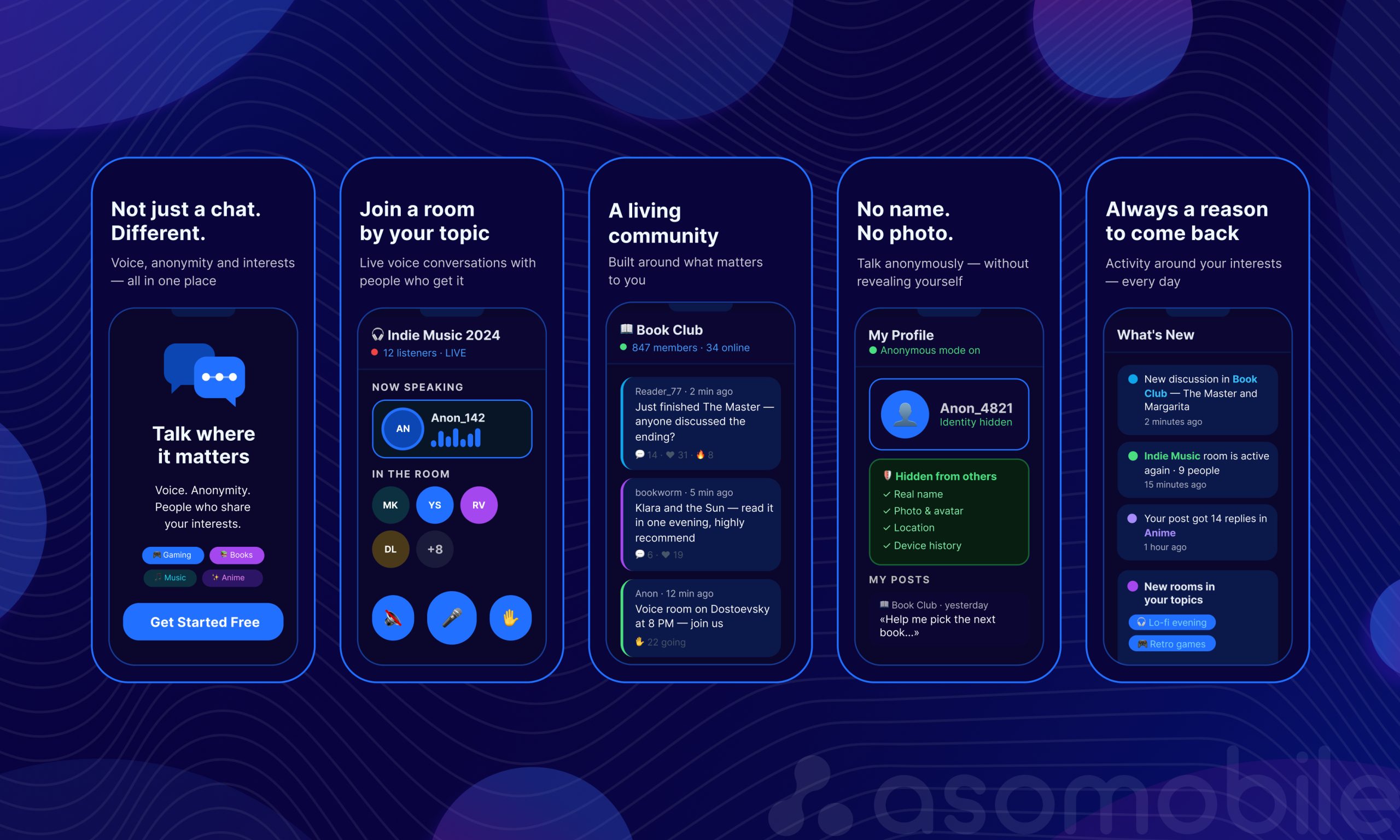
Each screenshot answered one question a skeptical user might have before deciding to install. The first addressed why this app when Reddit and Discord already exist — the answer centered on the combination of anonymity, voice, and interests in one place. The second showed the moment of entering a voice room by topic. The third conveyed the feel of an active community around a specific interest. The fourth addressed the safety question — anonymous mode with no real name or photo required. The fifth answered the retention question: active discussions, new rooms on a favorite topic. None of them showed just an interface — each showed a moment of use.
Ratings, Trust, and Localization
In the Social category, ratings affect conversion more than in most others. Before installing a new social app, users read reviews — they've tried similar products and want to confirm they won't land in a dead community with no activity.
The key challenge with rating prompts is timing. Asking right after install is nearly useless: the user hasn't experienced anything yet. The right moment comes after the first completed content interaction — left a voice room, got replies on a post, found a community around an interest. At that point, the app has already delivered value, and the probability of a positive review is at its peak.
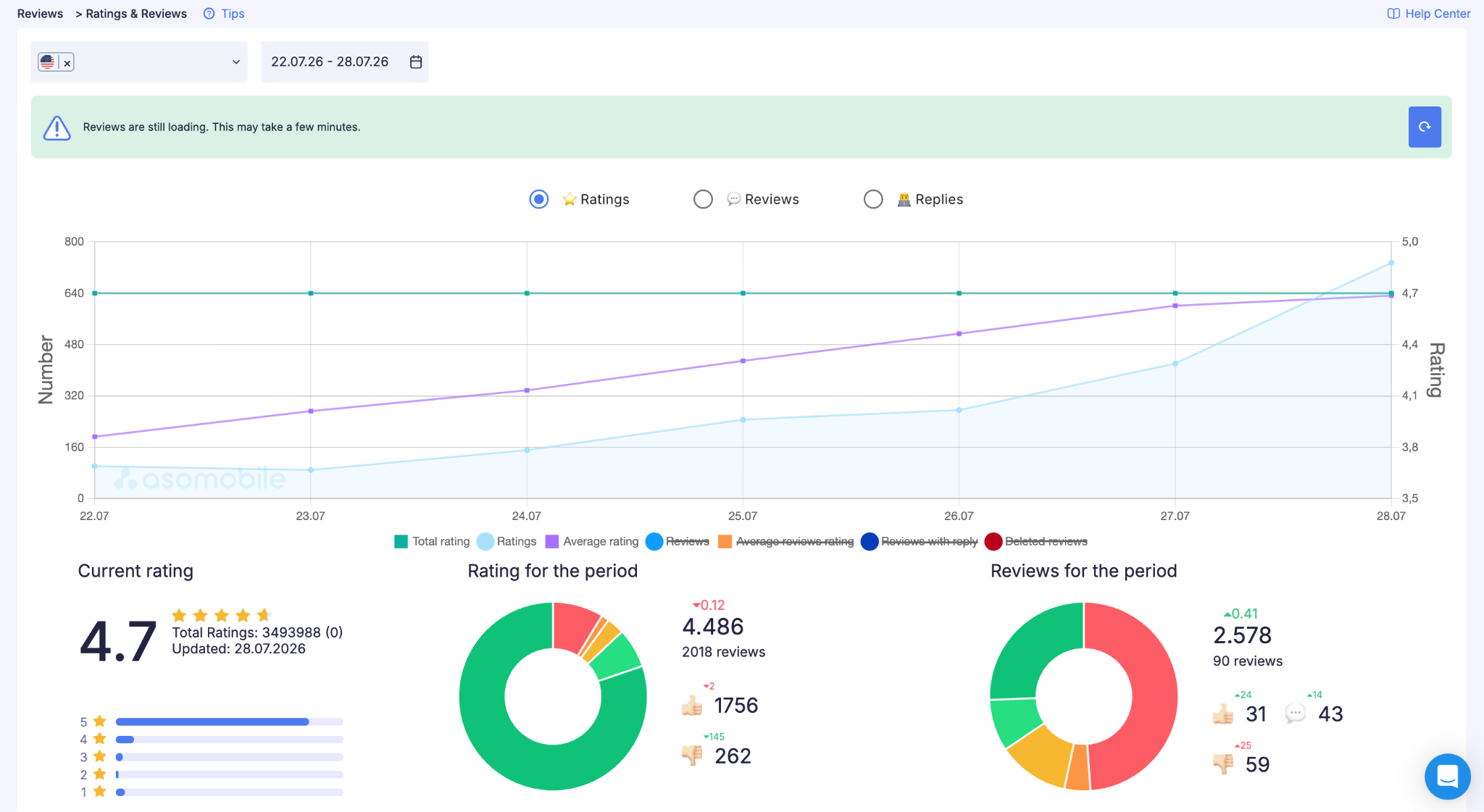
Negative reviews in Social have their own profile: users complain about moderation, bots, bugs, and low activity. Each type demands a specific response, not a generic thank-you. A boilerplate reply signals to future users that no one's paying attention. A specific response that acknowledges the issue and describes what's being done works on two levels: for the person who wrote it, and for everyone who reads it before installing.
Additional locales — Spanish and Portuguese — were used not for full localization, but to extend keyword coverage: the portion of the semantic core that didn't fit the primary metadata was deployed through locale fields. This is the standard way to increase indexed keyword count without building a separate ASO strategy for each market.
Results: From Visibility Growth to Downloads
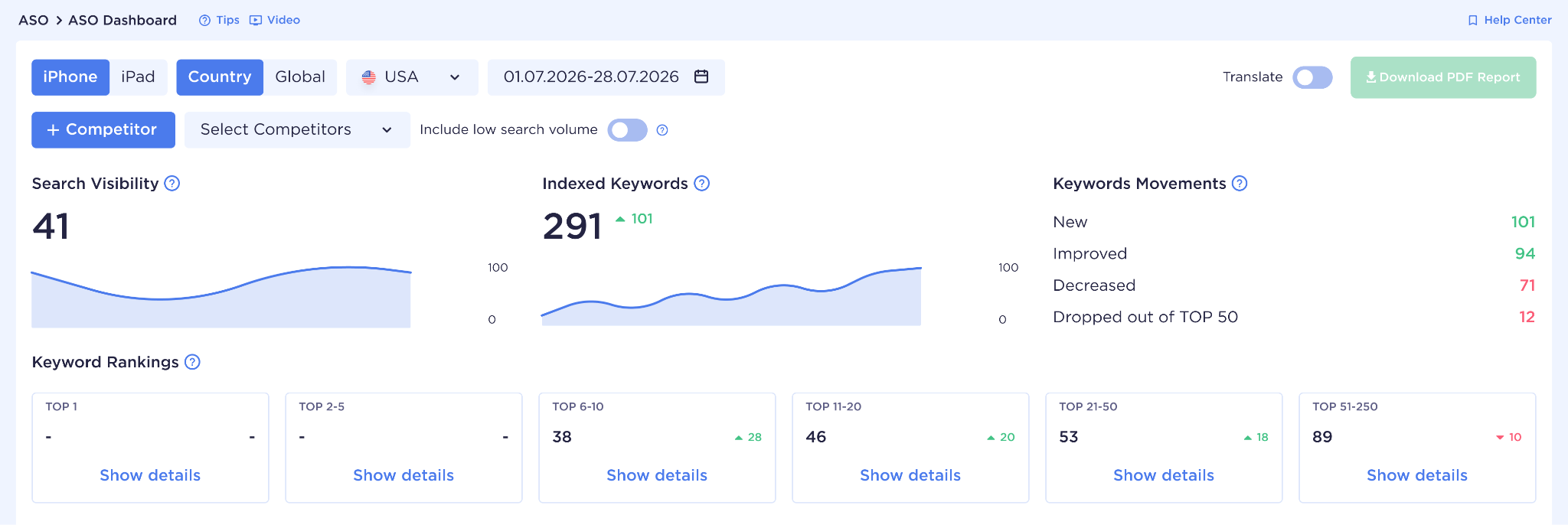
Data one week after the first iteration:
| Metric | Before optimization | After first iteration |
| Indexed keywords | ~190 | 291 |
| New keywords in search results | — | 101 |
| Keywords with improved rankings | — | 94 |
| Keywords in positions 11–20 | 0 | 38 |
| Semantic core coverage | — | 101 of 111 |
Of the 291 indexed keywords, 101 appeared in search results for the first time — the app had no presence for any of them before. The privacy/safety cluster climbed fastest: anonymity-intent queries rose in rankings ahead of community and creator queries. This confirmed the initial hypothesis — anonymity was the primary unclaimed differentiator in the niche.
94 keywords improved rankings, 71 dropped, 12 fell out of the top 50. A normal distribution for a first iteration. Drops on broad Social keywords were expected: metadata was restructured around niche semantics, and the algorithm re-evaluated which queries the app is relevant for. That's not a setback — that's data.
Visibility Score rose from 34 to 41. For a new Social app with no accumulated authority, that's the expected range; the two-week trend matters more.
To keep results readable rather than just captured after the fact, monitoring was built around five measurable parameters. Rankings across key clusters — the primary signal of how the algorithm reads the app after metadata changes. Impressions and Search Visibility in store consoles show how often the app entered a user's field of view — a leading indicator that reacts before downloads move. Page conversion (Page View to Install) measures how effectively visuals and description convince the user who showed up. Rating trend and review volume by version are trust signals that indirectly affect rankings. And competitor movement on priority keywords: if a position dropped, the key question is whether a competitor climbed with new metadata or whether it's a temporary algorithm fluctuation.
One observation shaped the second iteration: the networking cluster delivered the smallest ranking gains despite low competition. The reason was insufficient keyword weight for that cluster in the metadata. The second iteration rebalanced the emphasis.
| Stage | Action | KPI | Expected outcome |
| Audit & semantic core | Keyword collection, clustering 111 queries | Keyword coverage, Visibility Score | Identify low-competition entry points |
| Metadata | Title + subtitle + description, 101/111 coverage | Indexed keyword count | Indexation growth, new keywords in results |
| Visuals | Icon, 5 use-case screenshots | Page CR, A/B test | Higher conversion from view to install |
| Ratings & localization | Rating prompt timing, review management, locale fields | Average rating, review volume | Trust growth, expanded geo coverage |
| Monitoring | Weekly cluster ranking analysis | Ranking dynamics by cluster | Timely adjustments before the next iteration |
How ASOMobile Covers the Full ASO Cycle
ASO work on a Social app isn't a one-time optimization — it's an ongoing process where each stage depends on data from the previous one. ASOMobile handles the entire cycle in one place.
At the keyword collection stage, Keyword Finder and Keyword Suggest provide the base for clustering: search volume, competition, competitor rankings per keyword. ASO Creator assembles metadata from the finished semantic core with coverage tracking — you can see exactly how many keywords are active and how much traffic they cover.
For competitor analysis, Spy Keywords shows which keywords competitors rank for, and Timeline shows the history of their metadata changes. This lets you spot when a competitor found a better keyword or tested new positioning — not a week later, but the moment the change happened.
Keyword Monitor tracks rankings on specific keywords over time: you can see how a metadata change affects rankings the next day, not a week out. Store Benchmarks show average category conversion metrics — Impression to Page View, Page View to Install — and reveal where your numbers diverge from the Social category norm.
For review management, the Reviews section tracks rating trends by version and sentiment by market: a sharp post-update rating drop is visible over time, cutting response time from two weeks to one or two days.
Takeaways for Social App Teams
The Social category doesn't forgive fuzzy positioning. An app trying to compete for broad keywords without accumulated authority loses structurally — not because of optimization mistakes.
A few takeaways that apply beyond this case study.
Competitor analysis needs to happen at the sub-niche level, not at the whole-category level. Comparing yourself to Instagram is pointless — what matters is understanding who's actually splitting your audience on specific keywords.
Niche clusters deliver rankings faster than broad ones. A query with a specific intent — privacy/safety, local social discovery, creator community — is less competitive and reaches exactly the audience that needs the product.
The product page converts or doesn't, regardless of rankings. Visibility growth without compelling screenshots doesn't produce downloads — traffic just leaves. Screenshots that answer a skeptic's questions outperform screenshots that show an interface.
Monitoring needs to be regular, not reactive. In Social, rankings shift fast, and catching a competitor's move within 48 hours is the difference between a targeted adjustment and losing accumulated positions.
The first iteration is not the final answer. It's the first real signal of how the algorithm reads the app. The first iteration's data determines the logic of the second.
ASOMobile covers this entire process — from keyword collection and competitor analysis to ranking monitoring after every update. For teams working iteratively with Social apps, having everything in one place substantially compresses the work cycle.
To understand the structure of the Social category — how users search for apps, which sub-niches are less competitive, and what to look at first — read our article on ASO for Social apps on App Store and Google Play.
Optimize smarter, spend less 💙
FAQ: Frequently Asked Questions
The starting situation with concrete metrics — indexed keyword count, Visibility Score, page conversion rate. A description of each stage with the reasoning behind decisions, not just a list of actions. Before-and-after data from the first iteration. And an honest assessment of what moved, what didn’t, and what the next iteration targets. A case study without numbers and without explaining the logic is just a list of things someone did.
Through two mechanisms. First, visibility growth: more indexed keywords and better rankings mean the app appears in front of more potential users. Second, page conversion: even with strong visibility, downloads only grow if the product page convinces the user who shows up. In Social, the second matters more — users are experienced and skeptical. The page needs to answer their questions within the first two screenshots.
It depends on the sub-niche. The general principle: avoid high-volume broad queries where the top has been locked in for years, and build your semantic core around specific search intents. The most productive clusters are community (interest-based communities), privacy/safety (anonymous communication), creator/community (creator platforms), and local social discovery (local search). These have lower competition, sharper intent, and higher install conversion than broad queries like social network or chat app.
Five key parameters: rankings across target keyword clusters, Impressions and Search Visibility in store consoles, page conversion (Page View to Install), rating trend and review volume by version, and competitor movement on priority keywords. Looking at any one of them in isolation misses the point — they work as a system: visibility growth without conversion doesn’t produce downloads, and strong conversion without traffic doesn’t either.
Competitor analysis reveals two types of information. First, which keywords actually drive traffic in the niche: if a competitor ranks for certain keywords, there’s real demand and traffic there. Second, where established players have weak spots: rankings they hold coincidentally, without deliberate optimization. Those gaps become the entry points for a new app. The analysis needs to happen at the sub-niche level, not across the entire Social category.
Yes. Keyword Monitor tracks rankings on specific keywords over time — you can see how a metadata change affects rankings. Spy Keywords shows which keywords competitors rank for, and Timeline shows the history of their metadata changes. Store Benchmarks let you compare conversion metrics against Social category averages. The Visibility Score and its trend provide an overall signal of how the algorithm assesses the app in search.