Top Mobile Games of 2025: Who Leads Google Play
From hyper-casual projects to AI-driven worlds — let’s explore the top mobile games and the evolution of genres on Google Play in 2025. The era of random hits, like during the COVID boom, is coming to an end. Two years have passed since the peak, the industry is actively recovering, and the rules of the game have noticeably changed.
The market has become more mature, competition has intensified, and players have become more selective. Today, algorithms, product quality, and well-thought-out marketing play a key role. There are many apps, but only those that can retain their audience survive. We will not dwell on macroeconomic reasons in detail — they will be mentioned only briefly. The main focus of this article is an overview of the mobile gaming leaders on Google Play in 2025 and an analysis of why familiar hyper-casual games have transformed into much more complex games.
Today, mobile games are no longer just a way to pass the time. Modern game apps offer both large-scale projects with rich storylines, high-quality visuals, and social mechanics, as well as straightforward formats built around familiar and intuitive actions. A player can spend the evening exploring a fantasy world with friends and, just minutes later, launch a light puzzle game to relax.
According to Statista, this diversity of formats and usage scenarios has become one of the key drivers behind the sustainable growth and mass adoption of mobile gaming.
Key Takeaways
- Mobile games account for over 55% of the global gaming market
- Google Play remains the key platform for scaling
- Hyper-casual has evolved into hybrid-casual
- LiveOps and retention are more important than fast installs
- Player behavior is shifting toward calmer and offline-friendly formats
The State of Mobile Gaming in 2025
Let’s start with the big picture. The good news is that the panic caused by the post-pandemic slowdown is behind us. The market has stabilized and is returning to growth, albeit not as sharply as before.
Unlike traditional gaming formats that require consoles, PCs, and additional equipment, mobile devices have made gaming максимально accessible. Smartphones and tablets have opened the door to gaming for hundreds of millions of users worldwide. Today, players choose from hundreds of thousands of game apps available on Google Play, the App Store, and third-party stores.
According to the latest data, the global number of mobile game downloads has already exceeded 150 billion per year, highlighting the segment's scale and maturity.
According to the Newzoo report, the global gamer audience has reached 3.6 billion people, growing by 4.4% year over year. The mobile segment remains the undisputed leader, generating around $103 billion in revenue, which accounts for 55% of the total global games market.
At the same time, the picture varies significantly by region.
Regional Landscape of Google Play
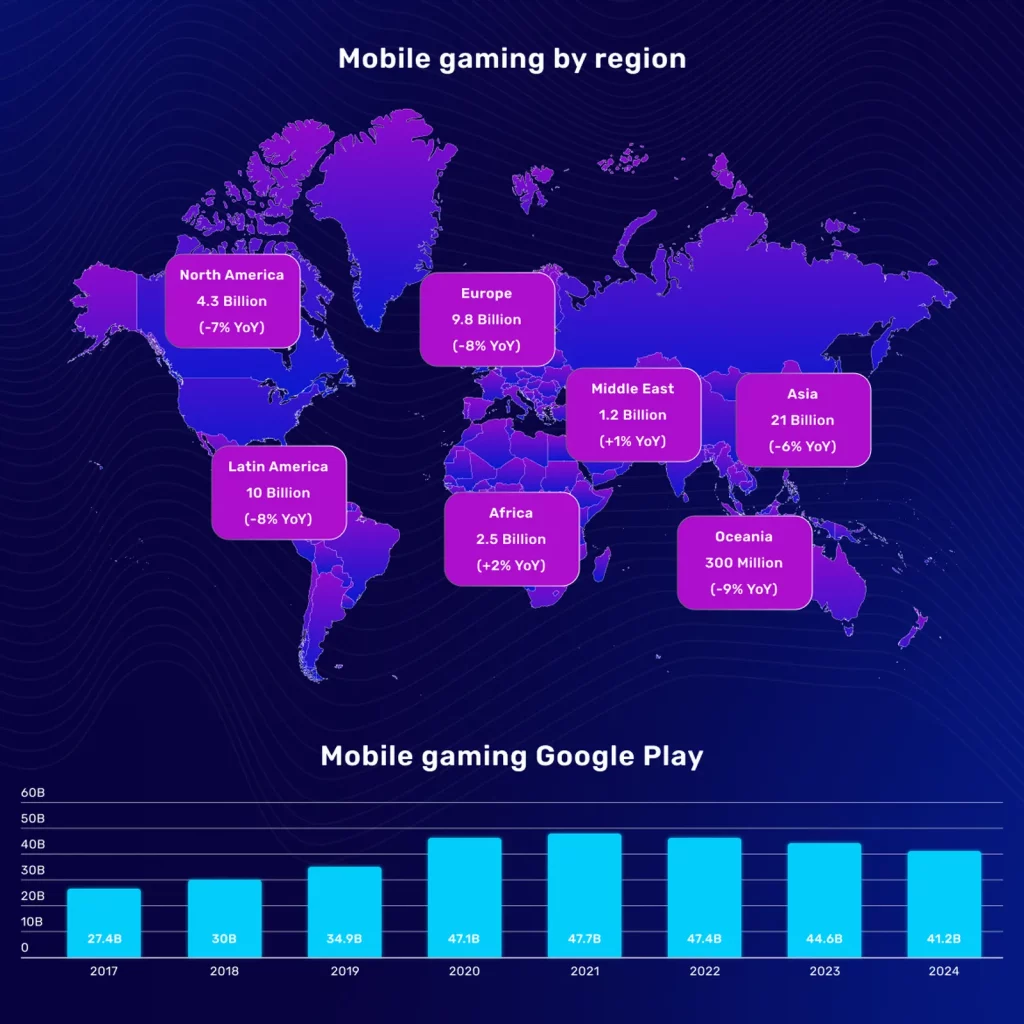
The United States remains the industry’s largest market and the key revenue region. For developers, success on Google Play in the US is still a ticket to the big leagues. This is where the most solvent audience for casual and mid-core hits like Monopoly GO and Royal Match is concentrated. India delivers scale, the US provides revenue.
India is the absolute leader in terms of downloads. While Western markets fight for every dollar of LTV, India generates enormous traffic volumes — around 8.45 billion downloads per year. That’s more than in the US or China.
Japan remains a stronghold of high ARPU. Downloads may stagnate, but the audience's purchasing power remains among the highest in the world. The market remains highly attractive for projects featuring RPG systems, gacha mechanics, and strong IPs.
Latin America and the MENA region show the fastest growth in new audiences. For studios focused on scaling, these regions are becoming key growth points.
From Hyper-Casual to Hybrid-Casual — and Beyond
Just a few years ago, Google Play charts were filled with games created in minimal time. In 2025, this model no longer works. Pure hyper-casual has faced rising traffic costs and retention challenges.
However, the genre has not disappeared — it has evolved. In 2025, we see active growth of hybrid-casual formats. Developers take a simple, intuitive core mechanic and enhance it with meta-game elements such as progression, building, collection, or narrative layers.
The main goal of this approach is to increase retention and boost LTV.
A telling example is the Japanese market. Puzzles account for around 33% of all downloads, but RPGs confidently lead in revenue. Combining these genres allows developers to merge mass appeal with high monetization.
The Role of AI in Mobile Games
Just two years ago, AI was mainly used for generating visuals and icons. In 2025, its role has expanded significantly. Algorithms now help create adaptive levels that adjust to the player’s style and skill level.
This approach makes gameplay potentially endless without becoming exhausting, directly impacting retention and engagement.
Top Google Play Downloads in 2024–2025

Looking at the absolute numbers, one thing becomes clear: the leaders are projects that offer players freedom of action and virtually endless content.
The growth of mobile gaming is primarily driven by major publishers who systematically invest in building their ecosystems. According to Statista, Tencent remains the world’s largest mobile game publisher by revenue and downloads, mainly due to its strong position in the Asia-Pacific region.
On Google Play, the top revenue positions are occupied by publishers of casual and mid-core projects. Companies like Playrix and Scopely consistently rank among the leaders, confirming strong demand for scalable casual formats with deep meta-game systems.
Largest Projects

According to Udonis, the undisputed leader remains Roblox with over 154 million downloads. It’s no longer just a game, but a full-fledged platform where users create their own content.
Next come Subway Surfers with over 133 million downloads and Candy Crush Saga, which surpassed 82 million. Their sustained presence in the charts confirms that brand power and habit remain among the strongest drivers of retention.
Regional Phenomena and Dynamics
Mobile game rankings are generally relatively stable. New projects may shoot up quickly, but not all manage to stay in the top for more than a few months, which makes the exceptions even more valuable.
According to Statista, projects like Honor of Kings and PUBG Mobile have ranked among the most profitable mobile games worldwide for several years. At the same time, the Monopoly GO case shows that even a new product can quickly reach the top if it accurately meets audience expectations and is supported by a strong marketing strategy.

Ludo King, with over 145 million downloads, ranks second worldwide. The project’s success is largely driven by India, where social interaction and cooperative play play a key role.

In the action segment, Free Fire continues to dominate. The standard version and Free Fire MAX together generate around 250 million downloads, remaining an accessible shooter for devices of any performance level.
New Leaders

Block Blast, with over 138 million downloads, confirms sustained demand for simple logic mechanics with low stress levels.
Pizza Ready, with 133 million downloads, has become one of the most notable hybrid-simulator titles, where management is just as important as action.
New Genres and Player Behavior
Analysis of top games reveals clear shifts in user habits.

Offline-friendly and calm formats are rapidly gaining popularity. Projects like Offline Games and Mini Games: Calm & Relax meet the demand for minimal stress and no constant online connection.
Everyday life simulators show steady growth. The success of Pizza Ready and Ojol The Game highlights interest in clear and visual progression.

Virtual pets remain in demand. Projects like My Talking Tom continue to attract a younger audience and retain it over long periods.

Competitive mechanics still work. Games like 8 Ball Pool confirm that the desire to compare results remains a strong motivator.

Monetization and Marketing in 2025
Simple advertising no longer guarantees sustainable revenue. In 2025, operational product work has become the key success factor. LiveOps has turned into the foundation of monetization, with revenue peaks driven by in-game events and time-limited activities.

The hybrid monetization model has become the standard. Ads, rewarded video, subscriptions, and battle passes are used in parallel. Social mechanics directly impact profitability — games focused on cooperative play and communication show higher LTV.
Key Takeaways for Developers
The Google Play market in 2025 requires a systematic approach.
- Regional analysis becomes mandatory
- Retention is more critical than install volume
- The product must be designed for long-term support
Under these conditions, ASO, competitor analysis, and data-driven decision-making are no longer optional tools — they are necessities.
Conclusion
Overall, the mobile games market is at a mature stage of its lifecycle. The continuous growth of mobile device computing power allows developers to create more complex and visually rich projects. According to Statista, this is precisely what drives the development of cross-platform games and increases user engagement, blurring the line between mobile and traditional gaming.
Mobile gaming in 2025 is a market of balance — between innovation and proven mechanics, scale and depth, rapid growth and long-term retention.
To reach the top of Google Play, you don’t always need to create a new genre. Often, it’s enough to take a proven mechanic, deepen it, choose the right regions, and build a strong LiveOps.
ASOMobile helps identify these growth points and turn analytics into measurable results.
Reach the Top — Simply and Cost-Effectively 💙
Pure hyper-casual can no longer compete due to rising user acquisition costs and weak retention. The market has matured: players now expect depth, progression, and long-term engagement rather than a one-off experience.
Hybrid-casual combines a simple core mechanic with meta-game layers (progression, collections, building, events). This approach boosts retention and LTV while still staying accessible to a mass audience — a key requirement on Google Play in 2025.
India leads in downloads and delivers scale, the US remains the top revenue market, and Japan stands out for high ARPU. Latin America and MENA show the fastest growth in new audiences and are becoming promising regions for expansion.
Retention, LiveOps, hybrid monetization, and social mechanics play a decisive role. Fast installs without long-term support no longer guarantee success — the product must evolve systematically and account for regional differences.