The meditation and mental health app market reached $8.64 billion in 2026, with around 2,500 apps competing in the category. When everyone was stuck at home in 2020, the space exploded. Then it pulled back a little. Then it grew again — but for different reasons: not pandemic-driven demand, but a steady need for tools that actually help with anxiety and sleep.
Most apps in the category do roughly the same thing — just with different icons. A few dozen genuinely work and have built real audiences. The hard part is choosing between them: pricing models, approaches, and target users differ.
This review is for anyone who wants to understand what each top app actually does, who it's built for, and what's worth paying for. At the end, an ASO breakdown of how this category works from a store listing perspective. There's a lot to unpack there.
How we selected these apps
Straightforward criteria, no fluff.
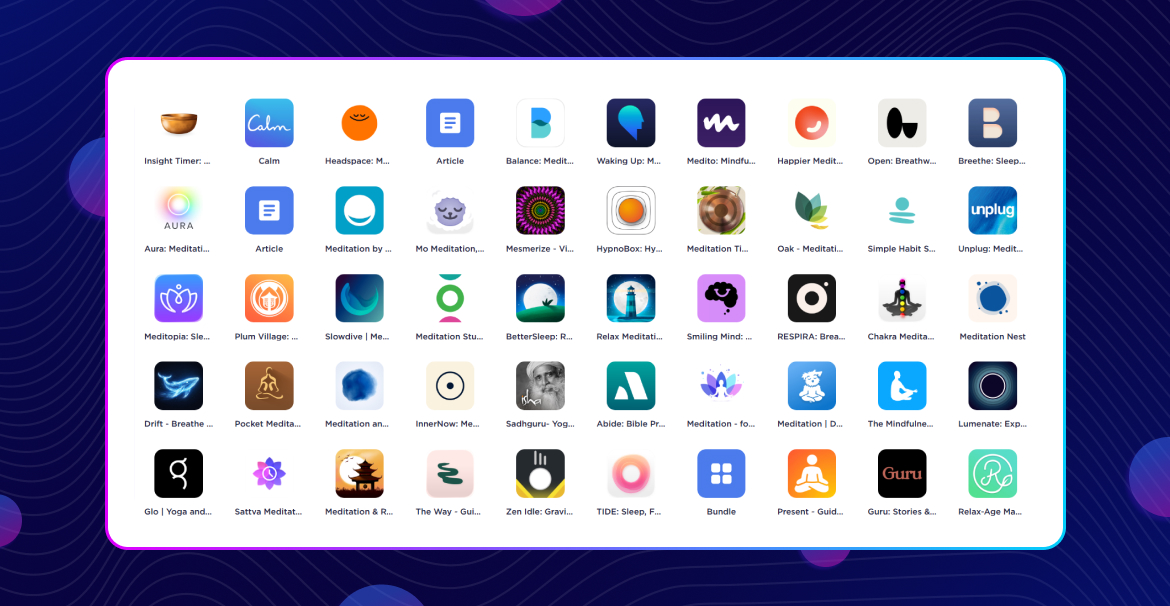
An app made the list if it's actively maintained (with updates in 2025–2026), has a rating above 4.5 in both stores, is available on iOS and Android, and offers at least a basic free tier or a trial period. We covered different segments: major commercial platforms, nonprofit projects, and niche tools built for specific problems — anxiety, sleep, and CBT-based mental health support. Ten apps total — enough to cover almost any use case.
| App | iOS / Android | Best for | Key features | Pricing | Free version |
| Calm | ✅ / ✅ | Sleep and relaxation | Sleep Stories, meditations, breathing, music | from $14.99/mo, $69.99/yr | 7-day trial |
| Headspace | ✅ / ✅ | Beginners | Courses, SOS meditations, AI coach Ebb | $12.99/mo, $69.99/yr | Limited free tier |
| Insight Timer | ✅ / ✅ | Wide selection without a paywall | 80,000+ meditations, timer, live sessions | $9.99/mo or $59.99/yr (Plus) | Yes, full |
| Waking Up | ✅ / ✅ | Curious skeptics | Theory, philosophy, diverse teachers | $14.99/mo, $119.99/yr | Trial + scholarship |
| Ten Percent Happier | ✅ / ✅ | Those who don't believe in meditation | Named teachers, podcast, courses | $14.99/mo, $99.99/yr | 7-day trial |
| Balance | ✅ / ✅ | Personalized programs | Adaptive plans, voice recommendations | $69.99/yr | Extended trial |
| Finch | ✅ / ✅ | Younger users, gamification | Virtual bird, mood check-ins, breathing | Freemium, Plus from $5.99/mo | Yes, full |
| Medito | ✅ / ✅ | Those who don't want to pay | Courses, meditations, sleep — all free | Free | Yes, fully |
| MindShift CBT | ✅ / ✅ | Anxiety management | CBT tools, journal, breathing | Free | Yes, fully |
| Smiling Mind | ✅ / ✅ | Kids, families, schools | Age-based programs, mindfulness | Free | Yes, fully |
App reviews
Calm
Best for: people who struggle with sleep or want to bring their general anxiety level down.
Calm is the most recognizable name in the category. According to ASOMobile, the company reached $596 million in revenue in 2024. Its core bet is sleep: the Sleep Stories library — featuring Matthew McConaughey, Tom Hardy, and Stephen Fry — became the app's signature. Sounds like a marketing gimmick, but it works. Many users report never making it to the end of a story, which is kind of the point.
Beyond sleep, Calm offers daily meditations, breathing exercises, and goal-based programs covering anxiety, focus, and work stress. The interface is clean, with nothing unnecessary. One real downside: almost all content is behind the paywall, and the free tier is very thin.
Key features: Sleep Stories with celebrity voices, daily meditations, breathing exercises, focus music, and goal-based programs.
Pros: the strongest sleep library in the category; clean interface without distractions; works well for people just starting out.
Cons: almost no free content; one of the pricier subscriptions in the category; some content skews toward a US audience.
Platforms: iOS, Android, Web.
Pricing: $14.99/mo or $69.99/yr, 7-day free trial.
Headspace
Best for: beginners who need structure.
Headspace is a meditation textbook in app form. Courses are built from simple to complex, animations explain concepts without filler, and SOS meditations (1–3 minutes) cover acute moments of anxiety or stress. A 4.8 rating on iOS, based on nearly a million reviews, is real confirmation that this works for a broad audience.
In 2024–2025, Headspace added an AI coach, Ebb, and expanded its mental health features — including access to licensed therapists in select regions. The direction is clear: the company is pushing from a meditation app toward a full mental health platform.
Key features: structured courses for all levels, SOS meditations, AI coach Ebb, breathing exercises, and a progress tracker.
Pros: best onboarding in the category; clear structure for people who don't know where to start; works across all major platforms.
Cons: most content requires a subscription; free tier is heavily limited; some mental health features aren't available in all countries.
Platforms: iOS, Android, Web, Apple Watch.
Pricing: $12.99/mo or $69.99/yr.
Insight Timer
Best for: anyone who wants real choice without a mandatory subscription.
80,000+ meditations from thousands of teachers worldwide — not a marketing claim, an actual number. Insight Timer operates as an open platform: any teacher can publish content, and users choose what to listen to. That's both the main advantage and the main problem — navigating that volume takes effort.
The free tier here is genuinely free, not a stripped demo. The Plus subscription ($59.99/yr) adds offline access, courses, and expanded progress analytics. For most users, free is more than enough.
Key features: 80,000+ free meditations, a timer for independent practice, live sessions with teachers, a community, and practice stats.
Pros: the largest free library in the category; works for both beginners and experienced practitioners; active community.
Cons: huge selection with weak navigation — easy to get lost; content quality varies significantly by teacher.
Platforms: iOS, Android, Web.
Pricing: free (basic), $9.99/mo or $59.99/yr (Plus).
Waking Up
Best for: people who want to understand what's actually happening during meditation.
Sam Harris — philosopher, neuroscientist, and podcast host — built an app that explains meditation without the spiritual framing. Attention theory, the nature of consciousness, interviews with scientists and teachers from different traditions. This isn't "close your eyes and breathe" — it's an attempt to explain the mechanics of practice.
The approach is niche. For anyone who just wants to unwind before sleep, Waking Up is overkill. For anyone who wants to understand meditation conceptually, it's one of the only options on the market.
One thing worth mentioning: the scholarship program. If the subscription isn't affordable, you can contact support and get free access — no income verification, no paperwork.
Key features: theory courses on the nature of consciousness, meditations from diverse teachers, interviews and lectures, and daily and introductory courses.
Pros: unique depth compared to anything else in the category; scholarship program removes the price barrier; high audio quality.
Cons: not for people seeking quick results; the interface is minimal, to the point of being sparse.
Platforms: iOS, Android.
Pricing: $14.99/mo or $119.99/yr; free access available on request.
Ten Percent Happier
Best for: skeptics and people who "tried meditation — didn't work."
The name comes from Dan Harris, an ABC journalist who publicly described having a panic attack on live television and came to meditation through skepticism. The app carries that same spirit: no mysticism, just practice and an explanation of why it works.
Teachers here are real practitioners with names and backgrounds, not anonymous voices. There's a built-in podcast. Courses are built around specific goals: anxiety, sleep, productivity, and relationships.
Key features: courses from named teachers, built-in podcast, goal-based meditations, and daily practices.
Pros: the best pick for people with a bias against meditation; strong content from real teachers; the podcast is a genuine bonus.
Cons: pricier than average for the category; less free content than Insight Timer; interface is functional but unremarkable.
Platforms: iOS, Android.
Pricing: $14.99/mo or $99.99/yr, 7-day trial.
Balance
Best for: people who want a personal plan, not a content library.
Balance adapts its program based on user input: goals, experience level, available time, and what's bothering them. Two users with different needs will get different content even on the same plan. The iOS rating of 4.9 from 118,000+ reviews is among the best in the category.
One caveat: Android users have been reporting technical issues recently. Not a problem for iOS, but worth knowing.
Key features: adaptive programs, personalization based on daily feedback, voice recommendations, and a progress tracker.
Pros: the best personalization in the category; extended trial gives you enough time to actually evaluate it.
Cons: technical issues on Android; less variety than Insight Timer.
Platforms: iOS, Android.
Pricing: $69.99/yr, extended free period.
Finch
Best for: younger users and anyone who struggles to build habits through willpower alone.
Finch is a self-care app built around gamification. You do daily exercises — breathing, mood check-ins, small goals — and raise a virtual bird. The mechanic is simple, but it works in the specific place where other apps fail: it gives you a reason to open the app again tomorrow.
It's particularly good for users dealing with anxiety and ADHD — people for whom a standard reminder notification isn't enough. The free tier covers the core functionality; paid adds deeper analytics and extra content.
Key features: a virtual bird as a motivator, daily mood check-ins, breathing exercises, and small goal setting.
Pros: actually works as a habit-building tool; the free tier is full-featured; well-suited for anxiety and ADHD.
Cons: gamification isn't for everyone; less meditation content than competitors; mental health features aren't as deep as Headspace's.
Platforms: iOS, Android.
Pricing: free (basic), Finch Plus from $5.99/mo or $69.99 lifetime.
Medito
Best for: people who want a serious practice without a subscription.
Medito is a nonprofit. Fully free, no ads, no freemium. Courses, meditations, sleep content — all open. A 5.0 rating on Android across nearly 40,000 reviews, 4.9 on iOS — higher than most paid competitors.
The team publishes financial reports publicly. Less than 1% of users donate, and the app keeps running. In a market where everything tries to convert you to a subscription, this is an anomaly.
Key features: meditation courses, breathing exercises, sleep content, timer — all free.
Pros: a genuinely free app with no catch; excellent ratings; transparent nonprofit model.
Cons: smaller library than paid competitors; slower content updates; no community features.
Platforms: iOS, Android.
Pricing: completely free (optional donations).
MindShift CBT
Best for: managing anxiety through concrete tools, not meditation.
MindShift was developed by Anxiety Canada, a Canadian nonprofit, using cognitive behavioral therapy. This isn't a meditation app in the conventional sense — there are no Sleep Stories, no soothing teacher voices. Instead: an anxiety journal, thought-reframing tools, breathing techniques.
Where Calm and Headspace work through relaxation, MindShift works through understanding how anxiety operates. For people with clinical anxiety or panic attacks, this is often a more useful tool than guided meditation.
Key features: anxiety journal, CBT thought-reframing tools, breathing techniques, Chill Zone section, modules for specific anxiety types.
Pros: one of the few apps with a genuine CBT foundation; completely free; developed by clinical specialists.
Cons: not a meditation app — people looking for relaxation will be disappointed; the interface shows its age; content is in English only.
Platforms: iOS, Android.
Pricing: completely free.
Smiling Mind
Best for: families, kids, and organizations.
An Australian nonprofit with programs for children from age 7, teens, adults, and corporate teams. One of the rare cases where an app was genuinely built around developmental psychology, not just repackaged for younger audiences.
Completely free, no ads. Used in thousands of Australian schools as part of mindfulness curriculum.
Key features: age-based programs (7–11, 12–15, 16–18, adults, families), school programs, corporate module.
Pros: the best option for kids and families in the category; completely free; evidence-based approach.
Cons: less content for adults without a family context; audience and content are oriented toward English-speaking markets.
Platforms: iOS, Android, Web.
Pricing: completely free.
Who should use what
People don't pick meditation apps by feature list — they pick by the problem they came to solve.
Want to learn meditation from scratch → Headspace. The structure and onboarding are the best in the category.
Struggling with sleep → Calm. The sleep library has no real competition.
Want to practice but not ready to pay → Insight Timer or Medito. Insight Timer gives maximum choice; Medito offers a more focused experience.
Meditated before, want to go deeper → Waking Up. Nothing else in the category comes close for conceptual depth.
Skeptic who doesn't believe in meditation → Ten Percent Happier. Built exactly for this.
Anxiety, ADHD, can't build habits → Finch plus MindShift CBT: the first helps you show up tomorrow, the second helps you understand specific triggers.
Need something for a child or the whole family → Smiling Mind.
Want an adaptive program built around your needs → Balance, especially on iOS.
ASO insight: how the listing game works in this category
For app developers and ASO specialists, meditation & mental health is a useful lesson in how store differentiation actually works.
The keyword battle comes down to three words. "Meditation," "sleep," and "anxiety" are the main battlegrounds. Calm has historically built its subtitle around sleep ("Sleep, Meditate, Relax"), while Headspace leads with "meditation & mindfulness." Each has locked into the segment where it converts best. If you analyze the metadata of the top 20 apps in the category through ASO tools, "anxiety" stands out: high traffic, but relatively low competition among smaller players — there's still room there.
The icon is the primary differentiator. In search grids, meditation apps look similar: soft colors, nature imagery, minimalist design. Finch is the exception — its bird icon stands out immediately. That's a strategy, not an aesthetic preference. A listing that looks visually distinct from competitors earns more clicks at equal ranking.
Screenshots sell a feeling, not a feature. Look at the first screenshots from Calm and Headspace — there's almost no UI. Instead: nature, sky, quotes. The category figured out long ago that people install these apps for the promise of a state, not a list of capabilities. Screenshots sell that state.
Free apps and positioning. Medito and MindShift CBT solve the listing problem differently: they don't need to convert anyone to a subscription, so their descriptions and screenshots focus on trust and evidence rather than urgency. That drives conversion differently — not through scarcity, but through credibility.
You can dig into the keyword strategy of any of these apps in ASOMobile: see which queries they rank for across different countries, how their metadata has changed over the past months, and where competitors have left gaps.
Conclusion
Picking a meditation app is picking an approach, not a feature set. Calm and Headspace dominate through product polish and marketing scale. Insight Timer and Medito prove a free model can work without compromising quality. Waking Up and Ten Percent Happier carved out their niches by taking the subject seriously instead of making it as simple as possible.
For anyone building in this category or working on store optimization: competition is real, but not brutal. The icon, the first screenshot, and keyword strategy matter more here than in most other categories — because users make install decisions fast and emotionally. This isn't a category where you build the listing at the last minute.
Optimize easily and achieve your goal💙
FAQ: Frequently Asked Questions
They can complement therapy, but they’re not a replacement. Headspace, Calm, and Ten Percent Happier have run their own studies and reported measurable reductions in user stress. MindShift CBT is built on clinically validated CBT methods. For serious anxiety or depression symptoms, an app is a supporting tool — not the primary one.
Most top apps are primarily in English. Calm and Headspace have partial localization, but their main content libraries are English-only. If you’re building for a non-English audience, this is a real consideration — and also an opportunity, since localized competitors in most languages are weak.
Most research points to 8 weeks of regular practice — 10–15 minutes a day — as the minimum threshold for noticeable change. Apps like Headspace build their 30-day introductory courses around exactly this timeline.
Depends on what you need. For basic practice and getting started with meditation, Medito or Insight Timer’s free tier is more than enough. If you need a structured course, sleep tools, or personalization — a paid subscription makes sense. Use a trial period first. Seven to fourteen days is enough to know.