Food & Drinks apps sit on almost every phone today, usually more than one. In 2025 the most downloaded of them, Uber Eats, reached 61.2M downloads, and the category's top 10 is almost entirely delivery services. But delivery solves only part of the problem. Some people want to save on fees, some want to rescue food from the bin, others want to book a table or finally get their recipes in order.
This review covers 10 apps from different corners of the Food & Drinks category: restaurant delivery, groceries, quick commerce, loyalty programs, reservations and recipes. We look at who each one is for, what's worth paying for and where the catch is. At the end, an ASO view of the category: why the brand decides almost everything here and how the fight for search changed in 2026.
How we picked the apps
An app made the list if it was actively updated in 2025–2026, is available on iOS and Android, and either ranks in the category's top by downloads or leads its niche. We deliberately covered different needs and different markets: the US, Europe, India, the Middle East and Latin America. Prices are for the US at the time of publication and vary by country.
Comparison table
| App | Platforms | Best for | Key features | Price |
| Uber Eats | iOS, Android | Delivery in any country | Restaurants, groceries, pharmacies, Uber One | Free, Uber One $9.99/mo |
| DoorDash | iOS, Android | Delivery in the US | Widest restaurant selection in the US, DashPass | Free, DashPass $9.99/mo or $96/yr |
| Instacart | iOS, Android, Web | Grocery shopping | Orders from local supermarkets, ordering via ChatGPT | Free, Instacart+ $9.99/mo or $99/yr |
| Blinkit | iOS, Android | Quick delivery in India | Groceries and essentials in 10–15 minutes | Free, pay per delivery |
| Keeta | iOS, Android | Delivery in the Middle East and Brazil | Aggressive discounts, fast expansion | Free |
| Too Good To Go | iOS, Android | Saving money and fighting food waste | Discounted bags of surplus food | Free, pay per bag |
| McDonald's | iOS, Android | Fast food deals | Coupons, reward points, order ahead | Free |
| Starbucks | iOS, Android | Coffee without the line | Order ahead, tiered loyalty program | Free |
| OpenTable | iOS, Android, Web | Table reservations | 50,000+ restaurants, points for visits | Free |
| Paprika Recipe Manager 3 | iOS, Android, Mac, Windows | Recipes and weekly meal plans | Recipe import, shopping lists, meal planner | $4.99 for iOS, no subscription |
App reviews
Uber Eats
Best for: people who order food in different countries and want one app for everything.
Uber Eats was the most downloaded app in the category in 2025: 61.2M downloads, up 11% year over year. Beyond restaurants, it covers groceries, pharmacies and convenience stores. The Uber One membership at $9.99 a month gives you a $0 delivery fee on orders above the minimum, up to 10% off and credits back on rides.
Pros: works in dozens of countries with one account; one membership for delivery and rides; handy when traveling.
Cons: service fees and menu markups make orders noticeably pricier than eating in; delivery is expensive without the membership.
Platforms: iOS, Android. Price: free, Uber One $9.99/mo.
DoorDash
Best for: US users who want the biggest choice of restaurants.
DoorDash is still the leading delivery service in the US, and in Q4 2025 it stayed near the top of Android downloads, right behind McDonald's. The company is growing outside the US too: it owns Wolt, and in October 2025 it closed the Deliveroo acquisition. The DashPass membership, at $9.99 a month or $96 a year, removes delivery fees and cuts service fees.
Pros: the widest restaurant catalog in the US; delivers groceries and retail as well as food; DashPass pays for itself at a couple of orders a week.
Cons: fees and tips often push the final price above what you expect; support quality varies a lot.
Platforms: iOS, Android. Price: free, DashPass $9.99/mo or $96/yr.
Instacart
Best for: weekly grocery runs without going to the store.
Instacart builds your order at your local supermarkets: a shopper walks the aisles, suggests replacements when an item is out of stock and delivers the same day. In December 2025 Instacart became the first app with checkout right inside ChatGPT: ask for a recipe and the assistant fills your cart. Instacart+ costs $9.99 a month or $99 a year and includes free delivery on orders of $10 or more.
Pros: your usual stores and prices, not a separate warehouse; real-time replacements; family account.
Cons: in-app prices can be higher than on the shelf; available only in the US and Canada.
Platforms: iOS, Android, Web. Price: free, Instacart+ $9.99/mo or $99/yr.
Blinkit
Best for: people in India who want groceries faster than they could walk to the store.
Blinkit was the growth story of 2025: number two worldwide by downloads and up 55.9% year over year. It delivers groceries and household items in 10–15 minutes from a network of small dark stores inside cities. While Europe's quick commerce wave fizzled out, the model works in India.
Pros: real delivery in minutes; a wide range, from milk to electronics; growing faster than competitors.
Cons: works only in Indian cities; at peak hours delivery times stretch and fees go up.
Platforms: iOS, Android. Price: free, delivery and service fees per order.
Keeta
Best for: people in the Middle East, Hong Kong and Brazil looking for a cheaper alternative to the local leaders.
Keeta is the international brand of Chinese giant Meituan. It operates in Hong Kong, Saudi Arabia, Qatar, Kuwait and the UAE, and in fall 2025 it launched in Brazil. The expansion is fast: in Q4 2025 Keeta became number one by Android downloads in Latin America, ahead of iFood. According to Meituan's founder, the service is already profitable in Saudi Arabia and Hong Kong.
Pros: generous discounts and promo codes at launch in every country; fast delivery; simple interface.
Cons: market-grab discounts won't last forever; restaurant choice in new cities is still narrower than with the leaders.
Platforms: iOS, Android. Price: free.
Too Good To Go
Best for: people who want to eat for less and waste less food.
Too Good To Go sells surplus food from bakeries, cafes and supermarkets: you buy a discounted surprise bag and pick it up at the end of the day. The app ranked third worldwide by downloads in 2025, and its registered users passed 120 million.
Pros: real savings on food from good places; a clear environmental benefit; free, with no subscription.
Cons: you don't know what's in the bag; pickup windows are narrow; few offers in small towns.
Platforms: iOS, Android. Price: free, pay per bag.
McDonald's
Best for: regular fast food eaters who don't want to overpay.
The McDonald's app led downloads in Europe and on Android in the US in Q4 2025. People install it for the money, not the ordering: the app has coupons and deals you won't get at the counter, plus loyalty points on every purchase. You can order ahead and pick up without waiting in line or at the drive-thru.
Pros: deals that actually save money; skip the line; points add up automatically.
Cons: the best deals are app-only, which annoys people who don't use it; offers vary a lot by country.
Platforms: iOS, Android. Price: free.
Starbucks
Best for: daily coffee drinkers who value their time.
Starbucks shows what happens when an app becomes part of the product: ordering and paying from your phone has long felt more natural than queuing at the counter. Since March 10, 2026, Starbucks Rewards is tiered again: Green, Gold and Reserve. The higher the tier, the more Stars per dollar, and at Gold your Stars no longer expire.
Pros: order ahead and skip the line; a clear loyalty program; personalized offers.
Cons: Stars expire after six months on the base tier; the benefits only add up if you buy often.
Platforms: iOS, Android. Price: free.
OpenTable
Best for: booking restaurant tables without a phone call.
OpenTable, part of Booking Holdings, works with 50,000+ restaurants in 80+ countries. You see open tables in real time, booking takes a couple of taps, and visits earn points you can redeem for discounts. In South Korea this niche belongs to local apps Catch Table and Tabling, and they top the entire category there (more in the ASO section below).
Pros: free for diners; a huge restaurant base in the US and Europe; handy reminders and waitlists.
Cons: loses to local services in Asia; points build up slowly.
Platforms: iOS, Android, Web. Price: free.
Paprika Recipe Manager 3
Best for: home cooks tired of losing recipes in their bookmarks.
Paprika grabs a recipe from any website in one tap, without the ads and the author's life story. From there you can scale it to any number of servings, send the ingredients to a shopping list sorted by store aisle and drop dishes into a weekly or monthly plan. The app holds a 4.9 rating from 54,000 reviews in the App Store, and it's a rare example in the category with no subscription.
Pros: one purchase instead of a subscription; sync across devices; a handy cooking mode with timers.
Cons: each platform is bought separately; no built-in recipe database, only your own recipes.
Platforms: iOS, Android, Mac, Windows. Price: $4.99 for iOS, one-time purchase.
How to choose a Food & Drinks app for your needs
The choice depends on what you need, not on the chart position.
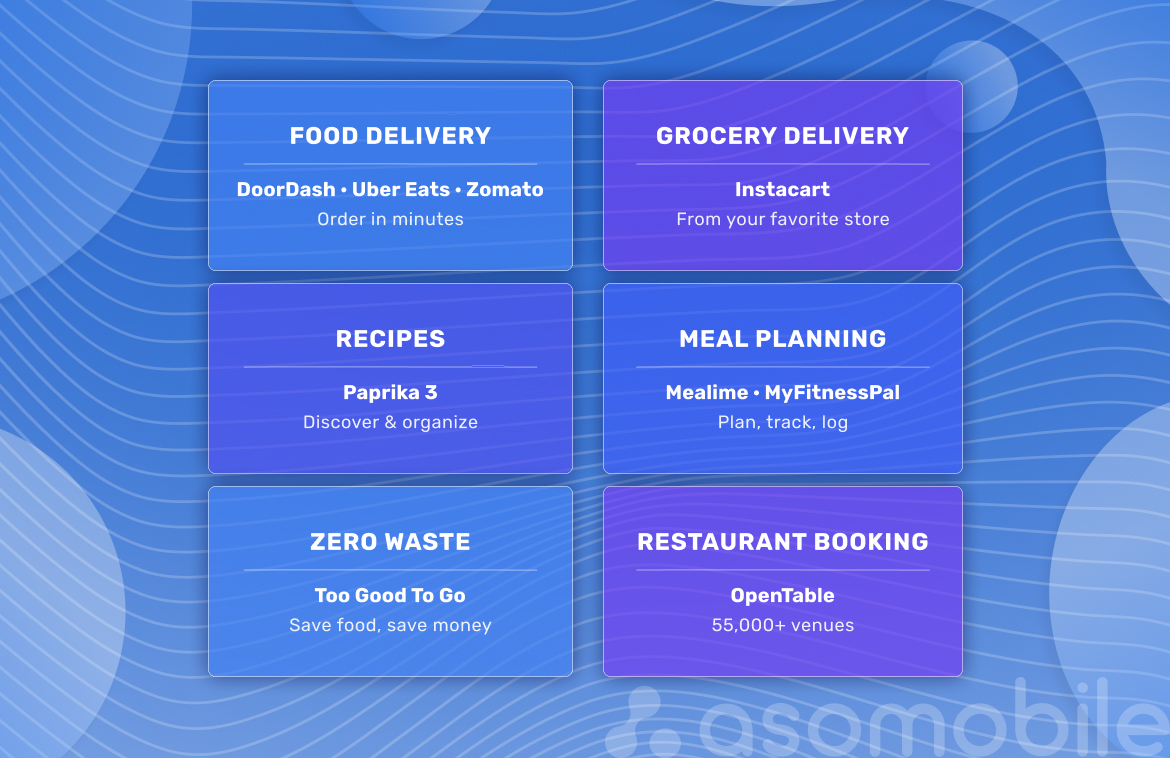
- I order food at home and when traveling → Uber Eats
- I live in the US and want the most restaurants → DoorDash
- I need a weekly grocery order → Instacart
- I need groceries in 10 minutes, and I'm in India → Blinkit
- I want cheaper delivery in the Middle East or Brazil → Keeta
- I want to save money and waste less food → Too Good To Go
- I eat fast food often and want deals → McDonald's
- I drink coffee every day → Starbucks
- I want to book a table without calling → OpenTable
- I cook at home and want my recipes organized → Paprika
ASO insight: how listings work in the Food & Drinks category
In Food & Drinks, the brand decides almost everything. A few observations for anyone building a product in this niche.
The brand sells before the keywords do. Look at the leaders' names: Uber Eats, DoorDash, McDonald's. None of them rely on a single keyword, and they don't need one. Everyone else has to work with words: a subtitle like Restaurant Ordering & Delivery or Food Delivery Services tells the algorithm and the user what the product does.
The page converts; the click is the battle. According to ASOMobile Benchmark data for the US over the last three months of 2026, 62% of Google Play users who open the page install the app. In the App Store, about 9% of people who see the app go to its page, but almost 78% of them install it. A hungry user decides fast, so the main levers are the icon, name, rating, and first screenshots.
Branded traffic got more expensive. Since March 2026, Apple shows several ad slots in App Store search instead of one. In a category where most installs come from brand searches, a competitor can now appear next to you on your own brand query. Monitor search results for your brand keywords and budget for brand defense in Apple Ads.
An icon needs a recognizable shape, not just color. Red is still the signature color of fast food, but in iOS 26 users can switch to clear or tinted icons, and the color disappears. Only the logo's shape stays recognizable.
Local habits beat global brands. ASOMobile data makes this clear in Asia.
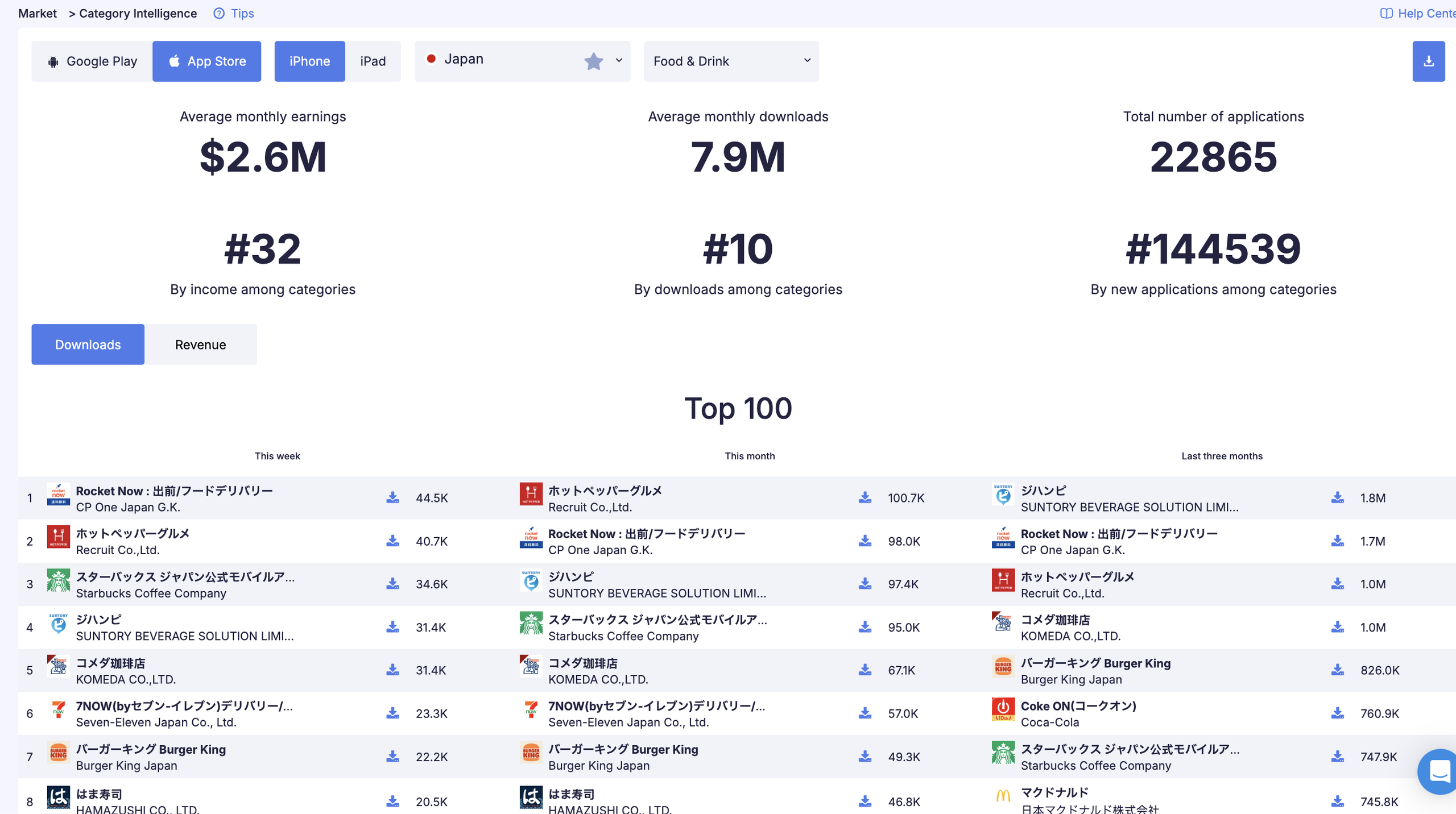
In Japan, Suntory's Jihanpi (1.8 M) is the top iPhone app by downloads over the last three months, an app for drink vending machines. The top 8 also includes the delivery service Rocket Now, the restaurant guide Hot Pepper Gourmet, the Komeda coffee chain and another vending machine app, Coke ON. The category brings in about $2.6M a month in Japan.
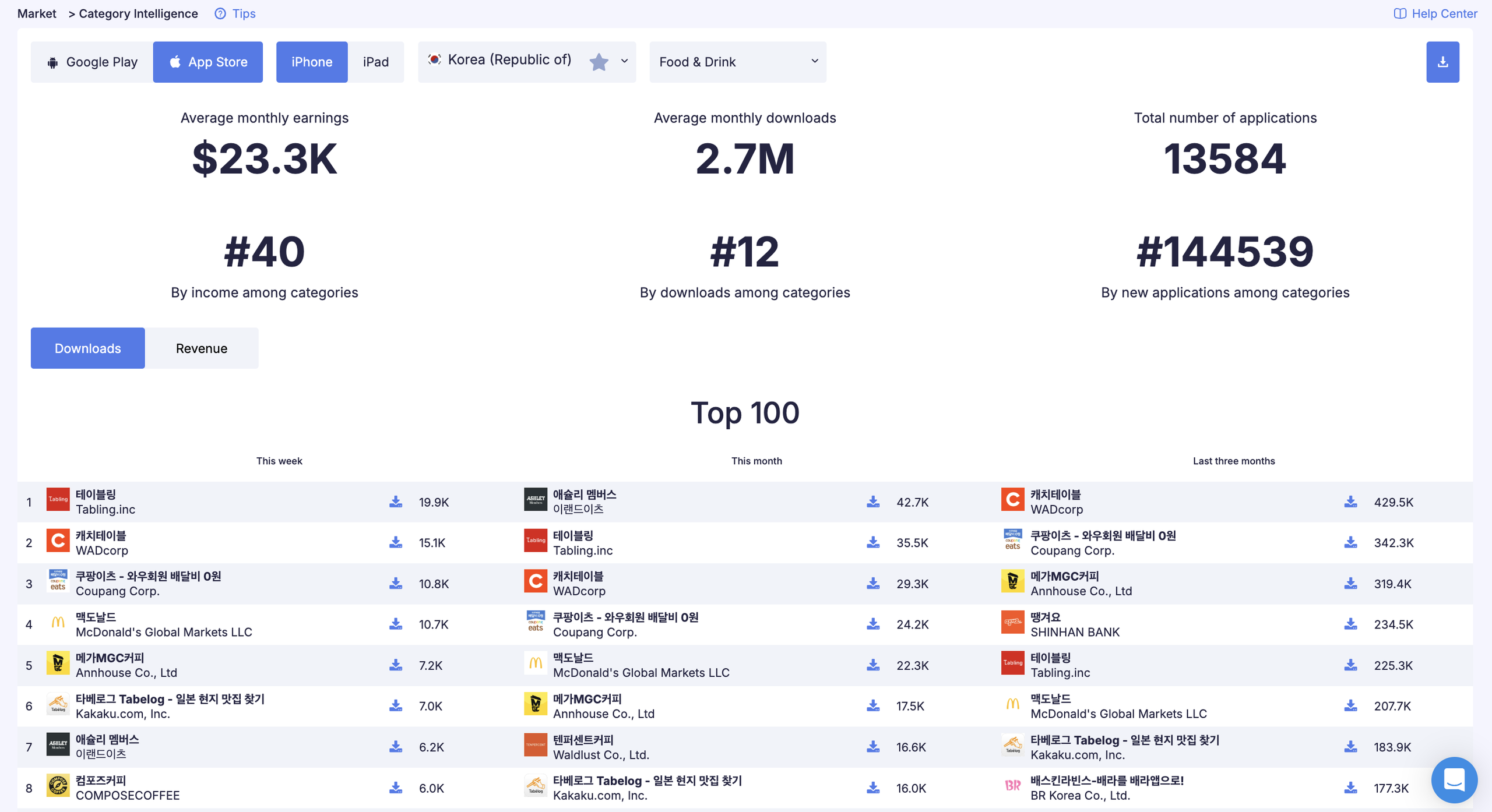
In South Korea, the chart is led by table booking and digital waitlist apps Catch Table (429.5K downloads) and Tabling, with Coupang Eats only in second place. With 2.7M downloads a month, the category earns just $23.3K: Koreans barely pay inside these apps.
For a detailed look at text and visual ASO in this niche, read ASO in the Food & Drinks Category: Trends and Best Practices for 2025.
Conclusion
No single food app is best; only the best one for a specific job. Uber Eats won't replace Too Good To Go, and Paprika won't replace Instacart. That's specialization, not a flaw. Most people keep a set of two or three services: one for delivery, one for deals or loyalty, one for groceries or recipes.
For those building a product in this category: the market has consolidated around a few giants, but niches like food rescue, reservations, and recipes are still open. The winner is whoever matches the user's query and local market habits most precisely.
Appetite comes with analytics
FAQ: Frequently Asked Questions
It depends on the country. Uber Eats works for travel and most markets, DoorDash has the widest restaurant choice in the US, Keeta is worth a look in the Middle East and Brazil, and Blinkit leads in India.
If you order at least once or twice a week, usually yes: a $9.99 monthly membership removes delivery fees and lowers service fees. If you order rarely, paying for delivery per order is simpler.
Use restaurant apps like McDonald’s for coupons you won’t find at the counter, and Too Good To Go, where surplus food from cafes and stores sells at a discount. Loyalty programs like Starbucks Rewards pay off if you buy often.
If you collect recipes from different websites, try Paprika: it imports a recipe in one tap and builds a shopping list and a weekly plan. It’s a one-time purchase with no subscription.
The category depends heavily on local habits. In Japan the top includes vending machine and coffee shop apps, in Korea table booking services, in India quick grocery delivery. That’s why global brands have to adapt their product to each market.