Why focus on ASO in the fitness app category?
Fitness apps didn’t appear as a passing trend — they became a natural extension of how technology entered everyday life. Once it became possible to track activity, count steps, analyze sleep, and build training plans directly on a smartphone, the way people approach fitness started to change. It became measurable and manageable.
Today, fitness is no longer just about workouts. It’s about data and control. With the rise of wearables, users effectively turned their bodies into systems they can monitor and improve — something like a “smart home,” but for health. And like any smart home, this system only works when all devices are connected.
Market economics and monetization model
According to ASOMobile, Health & Fitness apps generated around $6 billion in 2025, with 17% year-over-year growth. About 80% of that revenue comes from subscriptions.
Monetization here is driven by retention, not installs. A user either stays and pays regularly or churns. There’s very little in between — and this directly changes how ASO should be approached. Bringing users to the store is not enough. You need to bring the right users.
Post-pandemic market shift
After the pandemic, there was an expectation that the market would decline: gyms reopened, offline activity returned, and mobile fitness was expected to become secondary again.
That didn’t happen. Users who got used to the flexibility of apps kept using them, and developers quickly adapted to the new behavior.
As a result, a fitness app today is no longer just a set of workouts. It’s a personal coach, an AI assistant, a habit tracker, and a system that connects activity, nutrition, and recovery. This is where competition actually begins.
Market scale and changing user behavior
Fitness has long moved beyond a niche. It’s now a mass market with a global audience and double-digit growth. But this growth is driven less by new users and more by changes in behavior.
Users no longer choose between “going to the gym” or “using an app.” They do both. A smartwatch for tracking, an app for workouts, another service for nutrition. Fitness has become multi-layered, and users have become significantly more demanding.
Market structure and new competition logic
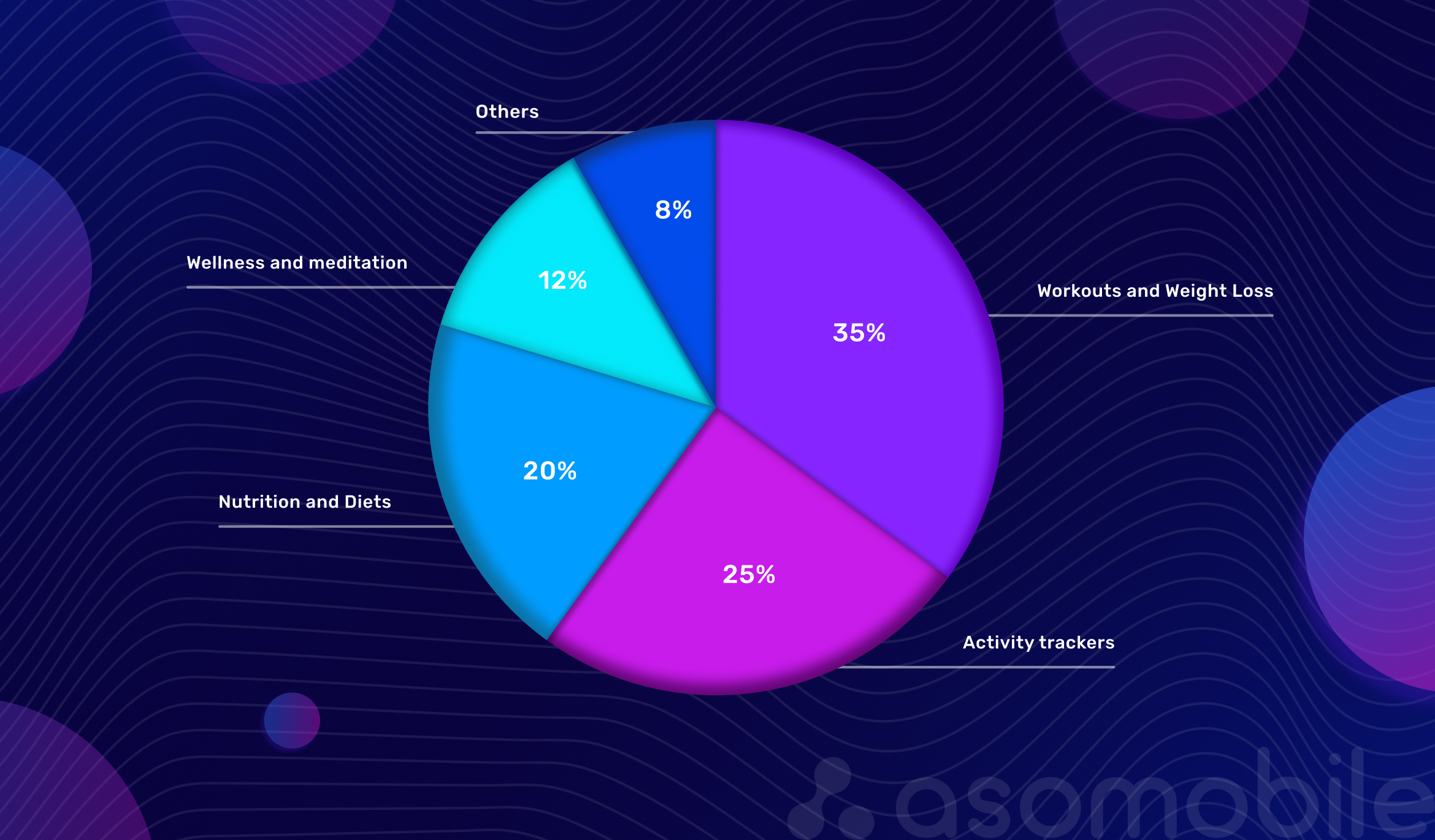
The core use cases remain the same: workouts and weight loss still account for the largest share — around 35%. Activity tracking follows (~25%), nutrition and diet (~20%), and wellness and meditation (~12%).
The fastest growth, however, is in activity trackers — closely tied to the spread of wearables. Users are no longer just working out; they continuously collect data about themselves. The app becomes part of a system: device → data → recommendations.
This shifts the competition. Apps no longer compete only with each other — they compete at the ecosystem level.
Key characteristics of the fitness app category
Platforms: different strategies for iOS and Android
iOS traditionally generates more revenue due to higher-paying users. Android grows faster and provides scale.
These are two different product strategies. One focuses on maximizing conversion and revenue, the other on capturing market share. ASO strategy will differ significantly between them.
Market geography: maturity vs growth
North America remains the largest market in terms of revenue. Growth, however, is shifting toward Asia, driven by user expansion and infrastructure development.
Different regions require different approaches: in some, monetization is key; in others, scale matters more. ASO should reflect that.
What market leaders are doing
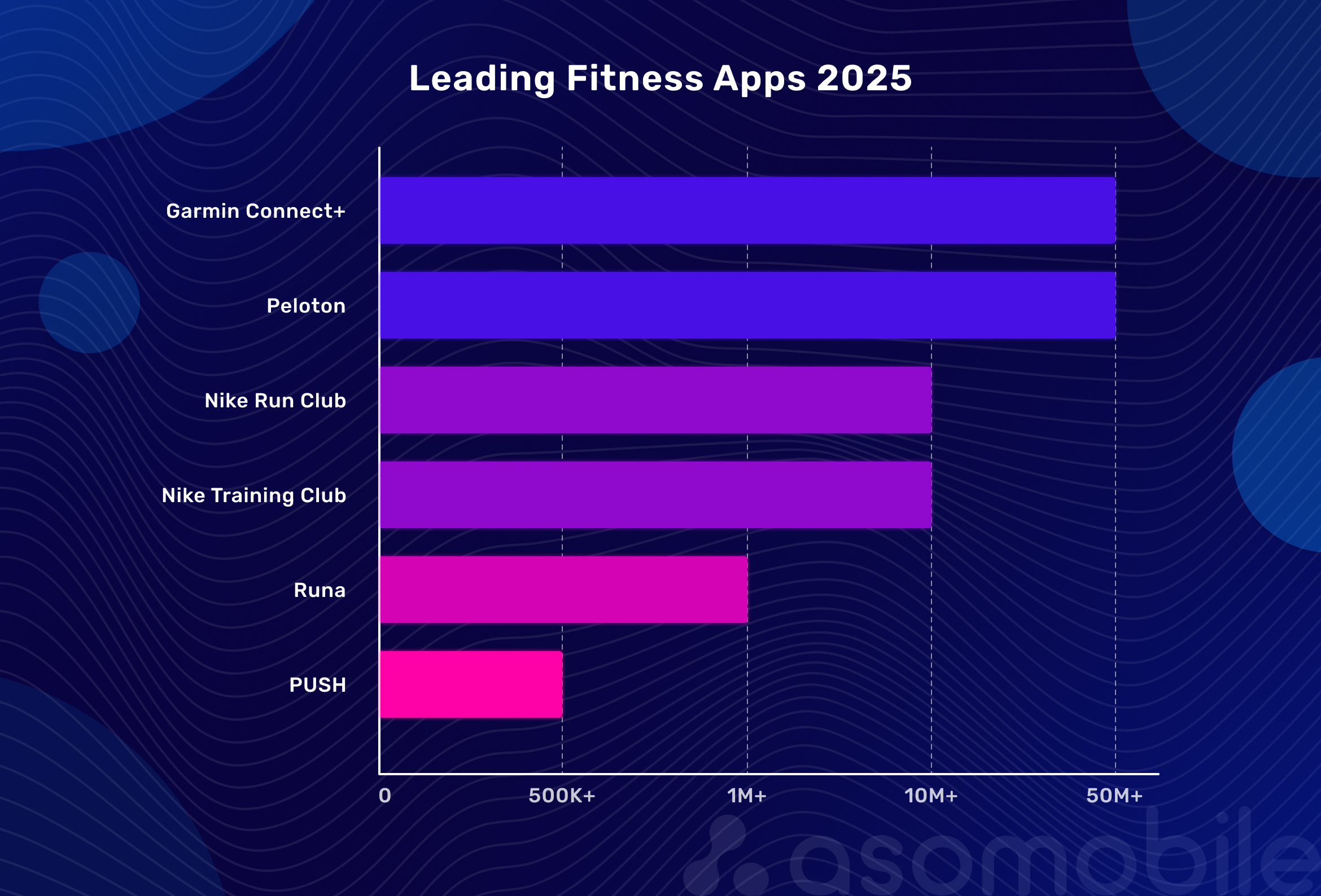
Leading apps like MyFitnessPal, Strava, or Nike Training Club are no longer just workout apps. They build ecosystems, rely on subscriptions, develop communities, and integrate with other services.
Partnerships show the same pattern: fitness increasingly overlaps with mental health, content, and lifestyle products.
What apps actually compete for
Fitness apps no longer compete only within their category. They compete for attention, habits, and a place in the user’s daily routine.
Users are not looking for “another workout app.” They are looking for something that fits their lifestyle. This directly impacts how ASO should be built.
User behavior patterns
There’s a clear pattern: installs peak at the beginning of the week, while activity peaks midweek. Monday is “starting fresh,” by Wednesday users are actually working out.
This is a direct signal: updates and releases work best early in the week, challenges closer to midweek, and creatives can lean on the idea of “start today.”
Why this niche is difficult to market
The challenge is not demand — it’s diversity. The audience ranges from professional athletes to people planning to “start on Monday.” Use cases vary just as much: workouts, nutrition, habits, mental health.
As a result, users often struggle to see the difference between products. This is where ASO becomes critical.
What’s happening in the market right now
Personalized workouts, AI coaches, and feature consolidation — fitness combined with habits and mental health. Simple timer-based apps are losing ground. Products that build systems around users are winning.
This also changes expectations for store pages. Users are not scanning feature lists — they look for confirmation that the app fits their specific situation. “Workouts for busy people” works better than “500 exercises.”
A competitive niche, demanding users, high skepticism — combined with predictable behavior that repeats month after month. A rare combination that can be used strategically.
How this works in practice
Text optimization: when the brand already contains the keyword
In most categories, brand and semantics live separately. In fitness, they don’t.
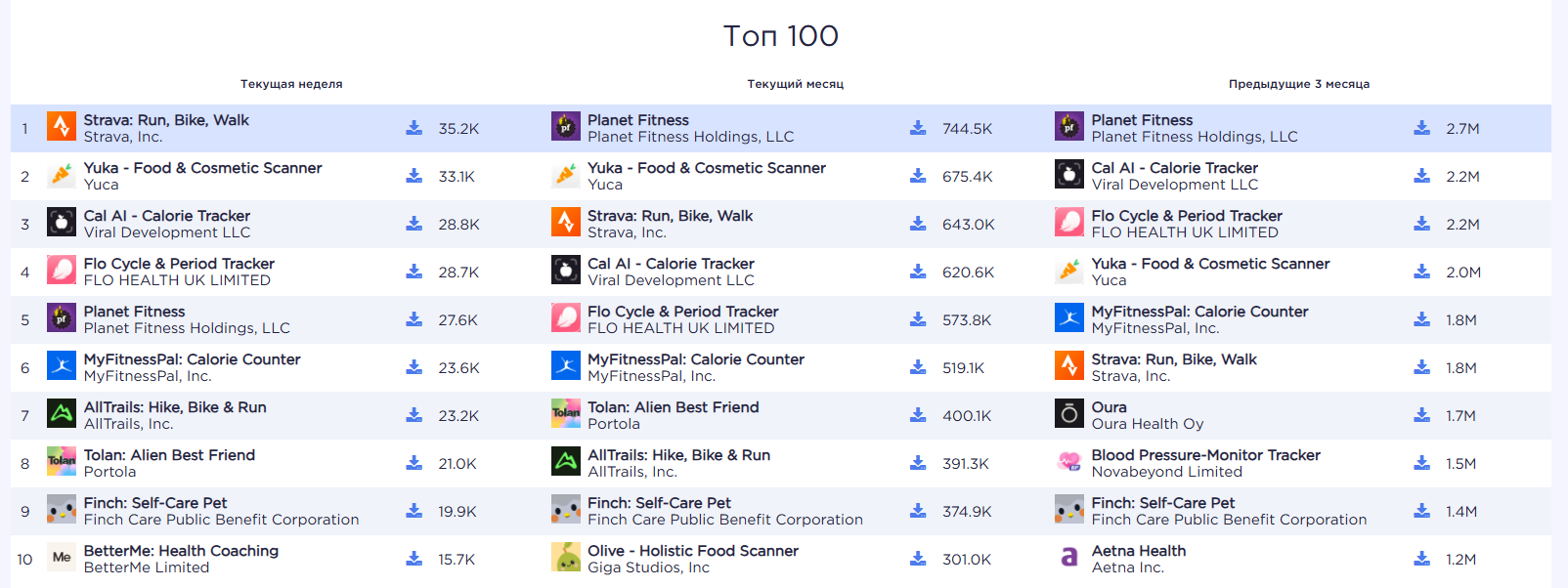
Look at the category leaders: Workout App: Home Fitness, AI Fitness Coach, Running Tracker. The title itself answers the search query — and that is not accidental. A user searching for “workout app” sees a title like that and understands the product immediately. Less cognitive load means a higher CTR even before they open the page.
The working formula is brand + function. Not just “FitLife,” but “FitLife: Home Workout Planner.” The subtitle is not decoration either. It is a second chance to cover semantic space that did not fit into the title. This is exactly where apps often lose positions in mid-competition clusters — simply because the field is left empty or filled with a slogan.
Competing head-on for high-volume keywords like fitness, workout, and health is slow and expensive. Real organic growth usually comes from mid-volume queries with clear intent: “home workout no equipment,” “calorie deficit tracker,” “running plan for beginners.” They reflect real use cases more accurately — and convert better.
Visuals: the first two seconds decide everything
Fitness is a visual category. Most users in the App Store do not read the description. They look at the icon, scan the screenshots, and either leave or stay.
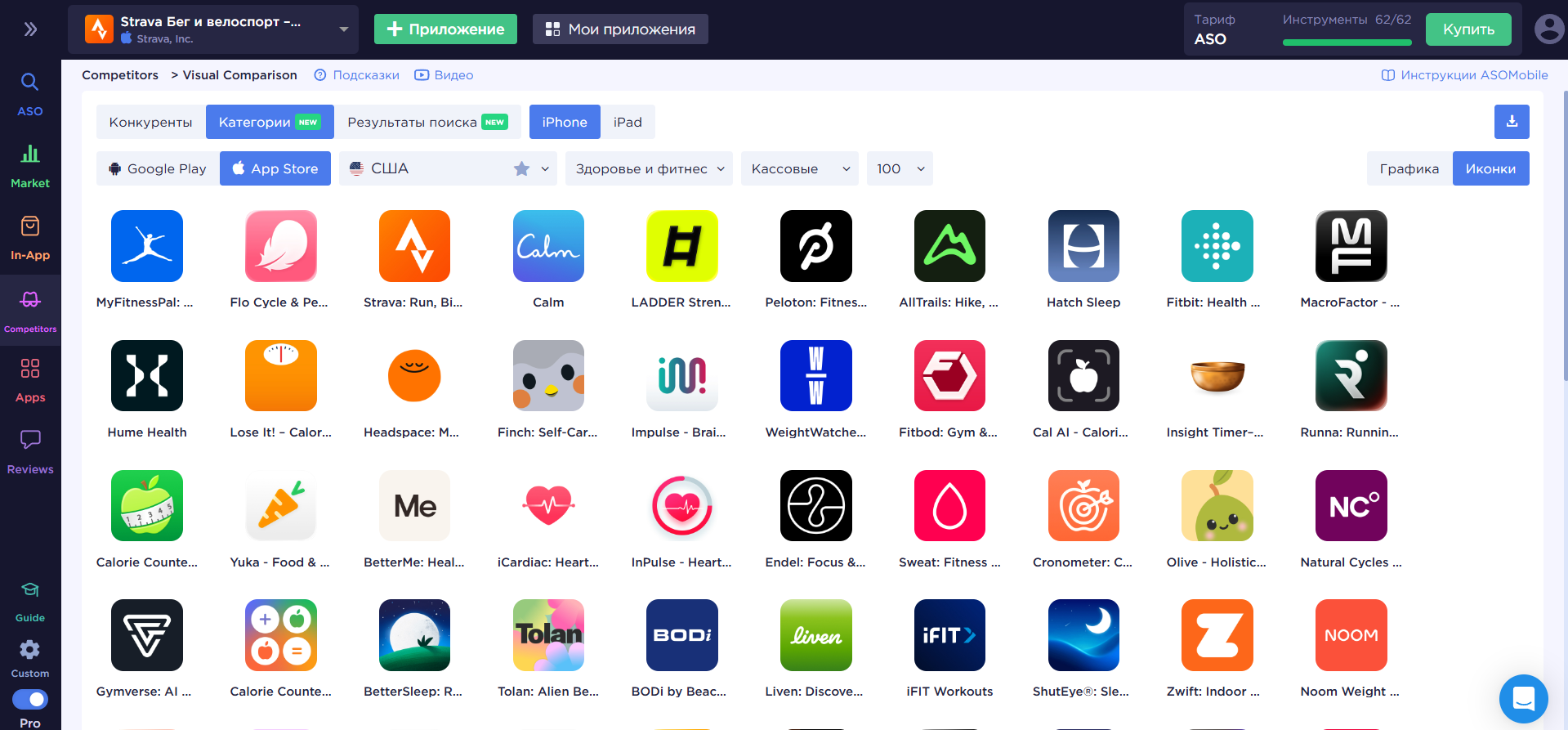
Among category leaders, the first screenshot almost never shows the interface first. It shows the outcome or a person in motion. Not “what the app looks like,” but “what happens if you install it.” Most apps still ignore this.
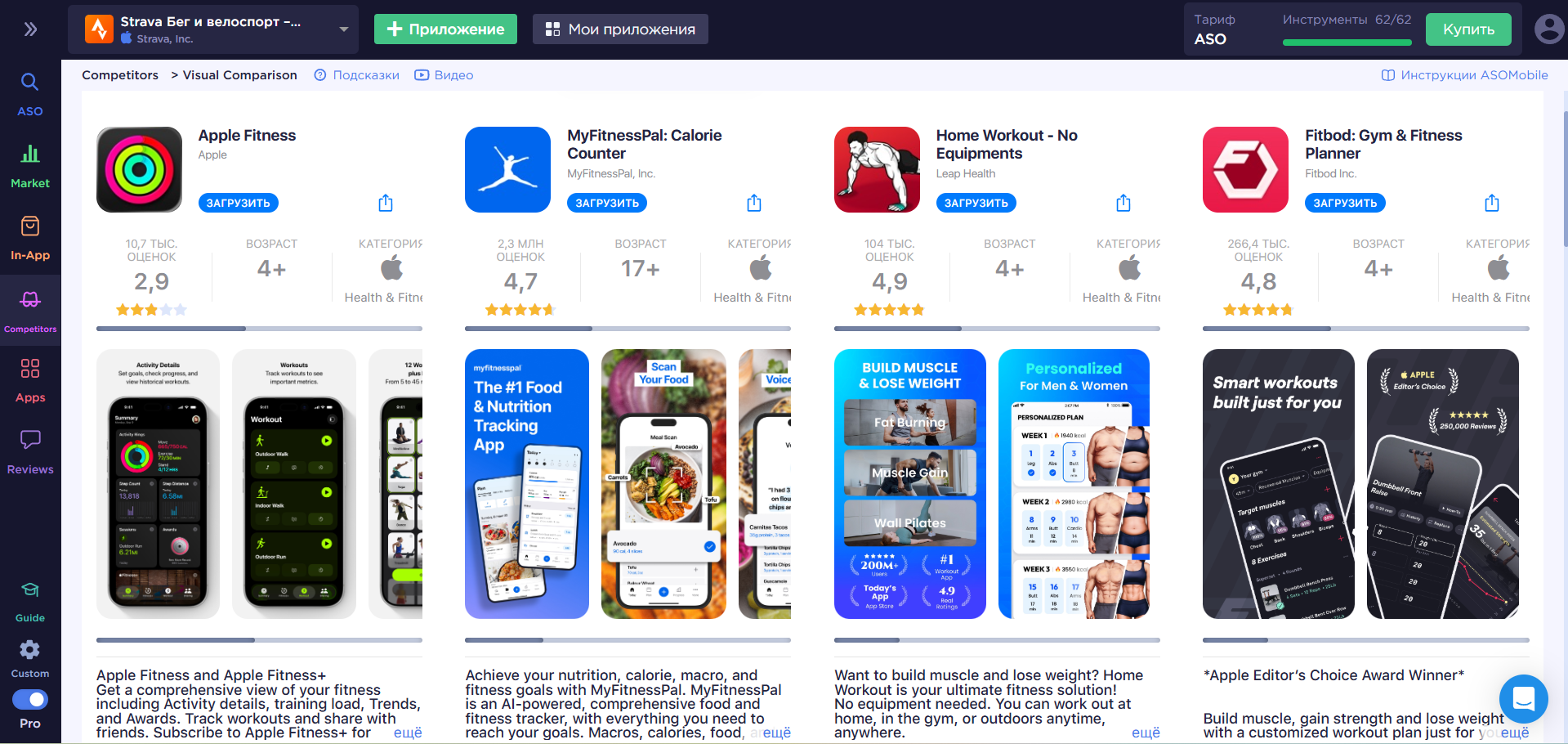
What else works: visible progress indicators (charts, momentum, completed goals), and interfaces without unnecessary elements. What doesn’t: overloaded dashboards, stock photos without context, and abstract “health” illustrations.
On color: blue dominates in fitness apps — it signals technology, trust, and calm. Red also appears quite often, although in a wellness context it can read more as stress than energy. Not a hard rule, but worth testing in A/B experiments before locking the icon.
Screenshots and video: remove doubt instead of selling features
Fitness is a category with high skepticism. The user has already downloaded something similar before. Already quit. And now they look at the page with one question: is this really any different?
The job of screenshots is to remove that doubt. Show a specific use case: a beginner workout with no equipment, a weekly meal plan, what progress looks like after a month. The more concrete the page is, the higher the conversion.
Video previews tend to work better in fitness than in many other categories — movement is more convincing than static visuals. But the first three seconds need to show value, not an animated logo. Most users do not watch to the end, so the decision happens almost immediately.
External traffic: a warmed-up user converts differently
Fitness is one of the most “external” categories. A large share of installs comes not from search, but after users encounter the brand elsewhere: an Instagram influencer, a Reels ad, or a mention in a wellness podcast.
When that kind of user lands on the page, they are no longer exploring the app — they are looking for confirmation of a decision they have almost already made. The common trap is this: the page is optimized for cold search, with a focus on features and keywords, while the incoming user is already warmed up and just needs a reason not to change their mind. These are two different scenarios, and they require different pages. Most apps do not account for that.
The visuals and the message need to match exactly what the user saw in the ad. A mismatch between the promise and the page is one of the most common reasons for conversion drops — and one of the easiest to miss when ASO and paid traffic are analyzed separately.
Seasonality: predictable behavior is a lever
Fitness audiences behave predictably.
January brings the usual spike in installs on the back of the “new life” effect. But there is a second peak that many apps miss — March. The motivation changes there: not “start from scratch,” but “get ready for summer.” It is a different user with a different query, and a page built for January no longer works for them.
After holidays and long weekends, there is another wave of motivation. Mondays are the weekly peak for starting new habits. That is a direct signal for when to update the page, when to launch activities, and what message to use in advertising.
There is also category-specific seasonality. The end of summer tends to bring installs to running apps — users wait until vacation season ends, the weather gets cooler, and then start running. Even within one category, seasonality can show up in different ways.
Mental health apps usually peak around the New Year and then decline as the weather gets warmer and seasonal conditions improve for users.
In practice, the first screen and metadata should be updated to reflect the seasonal context. Not radically — but enough for the page to answer the current user intent right now.
Instead of a conclusion
This is a competitive category, but a profitable one. Visuals are critical for conversion. Brand matters in semantics. User behavior is predictable.
If you work with a fitness app, do not try to appeal to everyone at once. Segment the audience, define the store-page value proposition clearly, prioritize visuals, account for seasonality, and work on retention. Success here is not measured by installs alone.
Users are not looking for a reason to switch apps. They are looking for a reason to stay with what they already have. ASO needs to give them a reason to take that first step.
Optimize and achieve results 💙
FAQ: Frequently Asked Questions
Because competition in this category is high, and monetization is driven primarily by retention and subscriptions, not just installs. Bringing users to the app page is not enough — you need to attract users whose needs, goals, and lifestyle match the product.
Fitness is a highly fragmented category: it includes workouts, activity tracking, nutrition, wellness, habits, and mental health. Users come with different intents but often struggle to see the differences between products. ASO should not just list features — it needs to clearly communicate the app’s value for a specific user segment.
Visuals and a clear message. Users often decide based on the icon, first screenshots, and video, without reading the description. What works better are clear use cases — beginner workouts, visible progress, structured plans — rather than abstract promises or overloaded interfaces.